Largest biochemical circuit built out of small synthetic DNA molecules
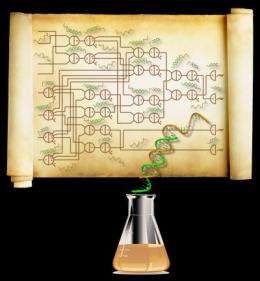
In many ways, life is like a computer. An organism's genome is the software that tells the cellular and molecular machinery—the hardware—what to do. But instead of electronic circuitry, life relies on biochemical circuitry—complex networks of reactions and pathways that enable organisms to function. Now, researchers at the California Institute of Technology (Caltech) have built the most complex biochemical circuit ever created from scratch, made with DNA-based devices in a test tube that are analogous to the electronic transistors on a computer chip.
Engineering these circuits allows researchers to explore the principles of information processing in biological systems, and to design biochemical pathways with decision-making capabilities. Such circuits would give biochemists unprecedented control in designing chemical reactions for applications in biological and chemical engineering and industries. For example, in the future a synthetic biochemical circuit could be introduced into a clinical blood sample, detect the levels of a variety of molecules in the sample, and integrate that information into a diagnosis of the pathology.
"We're trying to borrow the ideas that have had huge success in the electronic world, such as abstract representations of computing operations, programming languages, and compilers, and apply them to the biomolecular world," says Lulu Qian, a senior postdoctoral scholar in bioengineering at Caltech and lead author on a paper published in the June 3 issue of the journal Science.
Along with Erik Winfree, Caltech professor of computer science, computation and neural systems, and bioengineering, Qian used a new kind of DNA-based component to build the largest artificial biochemical circuit ever made. Previous lab-made biochemical circuits were limited because they worked less reliably and predictably when scaled to larger sizes, Qian explains. The likely reason behind this limitation is that such circuits need various molecular structures to implement different functions, making large systems more complicated and difficult to debug. The researchers' new approach, however, involves components that are simple, standardized, reliable, and scalable, meaning that even bigger and more complex circuits can be made and still work reliably.
"You can imagine that in the computer industry, you want to make better and better computers," Qian says. "This is our effort to do the same. We want to make better and better biochemical circuits that can do more sophisticated tasks, driving molecular devices to act on their environment."
To build their circuits, the researchers used pieces of DNA to make so-called logic gates—devices that produce on-off output signals in response to on-off input signals. Logic gates are the building blocks of the digital logic circuits that allow a computer to perform the right actions at the right time. In a conventional computer, logic gates are made with electronic transistors, which are wired together to form circuits on a silicon chip. Biochemical circuits, however, consist of molecules floating in a test tube of salt water. Instead of depending on electrons flowing in and out of transistors, DNA-based logic gates receive and produce molecules as signals. The molecular signals travel from one specific gate to another, connecting the circuit as if they were wires.
Winfree and his colleagues first built such a biochemical circuit in 2006. In this work, DNA signal molecules connected several DNA logic gates to each other, forming what's called a multilayered circuit. But this earlier circuit consisted of only 12 different DNA molecules, and the circuit slowed down by a few orders of magnitude when expanded from a single logic gate to a five-layered circuit. In their new design, Qian and Winfree have engineered logic gates that are simpler and more reliable, allowing them to make circuits at least five times larger.
Their new logic gates are made from pieces of either short, single-stranded DNA or partially double-stranded DNA in which single strands stick out like tails from the DNA's double helix. The single-stranded DNA molecules act as input and output signals that interact with the partially double-stranded ones.
"The molecules are just floating around in solution, bumping into each other from time to time," Winfree explains. "Occasionally, an incoming strand with the right DNA sequence will zip itself up to one strand while simultaneously unzipping another, releasing it into solution and allowing it to react with yet another strand." Because the researchers can encode whatever DNA sequence they want, they have full control over this process. "You have this programmable interaction," he says.
Qian and Winfree made several circuits with their approach, but the largest—containing 74 different DNA molecules—can compute the square root of any number up to 15 (technically speaking, any four-bit binary number) and round down the answer to the nearest integer. The researchers then monitor the concentrations of output molecules during the calculations to determine the answer. The calculation takes about 10 hours, so it won't replace your laptop anytime soon. But the purpose of these circuits isn't to compete with electronics; it's to give scientists logical control over biochemical processes.
Their circuits have several novel features, Qian says. Because reactions are never perfect—the molecules don't always bind properly, for instance—there's inherent noise in the system. This means the molecular signals are never entirely on or off, as would be the case for ideal binary logic. But the new logic gates are able to handle this noise by suppressing and amplifying signals—for example, boosting a signal that's at 80 percent, or inhibiting one that's at 10 percent, resulting in signals that are either close to 100 percent present or nonexistent.
All the logic gates have identical structures with different sequences. As a result, they can be standardized, so that the same types of components can be wired together to make any circuit you want. What's more, Qian says, you don't have to know anything about the molecular machinery behind the circuit to make one. If you want a circuit that, say, automatically diagnoses a disease, you just submit an abstract representation of the logic functions in your design to a compiler that the researchers provide online, which will then translate the design into the DNA components needed to build the circuit. In the future, an outside manufacturer can then make those parts and give you the circuit, ready to go.
The circuit components are also tunable. By adjusting the concentrations of the types of DNA, the researchers can change the functions of the logic gates. The circuits are versatile, featuring plug-and-play components that can be easily reconfigured to rewire the circuit. The simplicity of the logic gates also allows for more efficient techniques that synthesize them in parallel.
"Like Moore's Law for silicon electronics, which says that computers are growing exponentially smaller and more powerful every year, molecular systems developed with DNA nanotechnology have been doubling in size roughly every three years," Winfree says. Qian adds, "The dream is that synthetic biochemical circuits will one day achieve complexities comparable to life itself."
More information: Science paper: "Scaling up digital circuit computation with DNA strand displacement cascades"
Provided by California Institute of Technology


