Japan doubles plant radiation leak estimate
June 7, 2011

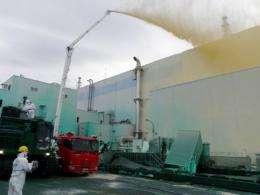
TEPCO has been testing water decontamination equipment to remove radioactive substances at Fukushima nuclear plant

Enlarge

Handout photo issued by TEPCO shows workers spraying a dust inhibitor into buildings at the firm's crippled Fukushima nuclear power plant. Japan has more than doubled its initial estimate of radiation released from the nuclear plant in the week after the March 11 tsunami, ahead of the launch of an official probe Tuesday.

Japan has more than doubled its initial estimate of radiation released from the crippled Fukushima nuclear plant in the week after the March 11 tsunami, ahead of the launch of an official probe Tuesday.

The nation's watchdog, the Nuclear and Industrial Safety Agency (NISA), now says it believes 770,000 terabecquerels escaped into the atmosphere in the first week -- compared to its earlier estimate of 370,000 terabecquerels.

The findings were released on the eve of the first meeting Tuesday of an independent 10-member academic and that will look into the causes of the world's worst since Chernobyl a quarter-century ago.

The group's leader, a Tokyo University researcher on human error, Yotaro Hatamura, said at the meeting that "nuclear power has higher and is dangerous. It was a mistake to consider it safe".

NISA's new figure is closer to that of Japan's independent Commission which had initially estimated a release at 630,000 terabecquerels in the first month.

The revision, almost three months after the quake, is likely to fuel criticism of the initially slow and vague flow of information from the government, and plant operator Tokyo Electric Power Company (TEPCO).
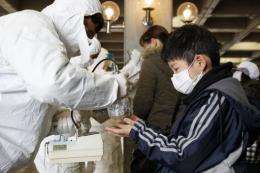
Contaminated water has spilled or been released several times into the Pacific Ocean from Fukushima nuclear plant
Enlarge

An official scans a boy evacuated from the tsunami zone in Japan with a geiger counter to check radiation levels. Months of hosing operations at the stricken Fukuishima plant have left over 100,000 tons of highly radioactive water in buildings, basements and tunnels at the plant, and TEPCO is struggling to remove the runoff so it can resume crucial repair work.

Japanese experts have stressed that most of the released in the first days after the quake, amid a series of hydrogen explosions at the plant, was blown across the Pacific Ocean, not over inhabited areas.

Prime Minister Naoto Kan's special advisor on the , Goshi Hosono, said Monday that the latest findings were unlikely to affect the TEPCO roadmap to bring all reactors to stable "cold shutdown" by October-January.

NISA also said in its review that it believes much of the inside the three reactors melted down faster than previously believed after the tectonic disaster knocked out the plant's cooling systems.

The agency said melted fuel in unit one dropped to the bottom of the pressure vessel and damaged it some five hours after the quake hit the plant at 2:46 pm on March 11, followed by a 14-metre (46 foot) tsunami.
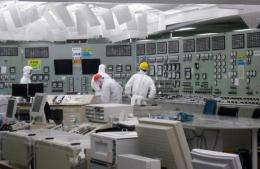
Revised radiation contamination figures are likely to fuel criticism of the information flow from the government
Enlarge

TEPCO-issued photo shows the control room of the second reactor at Fukushima nuclear power plant in northeast Japan. The nation's watchdog, the Nuclear and Industrial Safety Agency, now says it believes 770,000 terabecquerels of radioactive contamination escaped into the atmosphere in the first week -- compared to its earlier estimate of 370,000 terabecquerels.

The agency said the same happened in unit two at about 10:50 p.m. on March 14, and that number three suffered damage at 10:10 p.m. on March 14.

TEPCO has said it believes the molten fuel is now being cooled by water at the bottom of the number one, two and three reactor pressure vessels, citing the relatively low outside temperatures of the containers.

Months of hosing operations have left over 100,000 tons of highly radioactive water in buildings, basements and tunnels at the plant, and TEPCO is struggling to remove the runoff so it can resume crucial repair work.

Contaminated water has spilled or been released several times into the Pacific Ocean, and environmental group Greenpeace has warned that it has found unsafe radiation levels in marine species as far as 50 kilometres offshore.

TEPCO has been testing water decontamination equipment, some provided by US and French companies, to remove radioactive substances, oil and seasalt from the runoff water so it can be reused as a reactor coolant from about mid-June.

With the advent of the summer rainy season in the region, they have also started to ship to the plant 370 truck-sized water tanks with a total capacity of more than 40,000 tons to store excess contaminated .

(c) 2011 AFP

4.5 /5 (2 votes)  

Filter


Move the slider to adjust rank threshold, so that you can hide some of the comments.


Display comments: newest first

hush1
Jun 07, 2011

Rank: not rated yet
Where is ModernMystic? And the promise that the last PRV containment to the environment was 'unbreechable'.

Only your statement stands corrected.
The person, ModernMystic, stands forever.

Incorrigible.
Rank 4.5 /5 (2 votes)
Relevant PhysicsForums posts

More news stories

SpaceX capsule has 'new car' smell, astronauts say (Update)

SpaceX's Dragon cargo vessel smells like a new car, said astronauts at the International Space Station after opening the hatches Saturday following the spacecraft's landmark mission to the orbiting lab.

Space & Earth / Space Exploration

created 23 hours ago | popularity 4.5 / 5 (21) | comments 2

Australia hails surprise super-telescope decision

Australia has hailed a surprise decision giving it a role in a radio telescope project aimed at revolutionising astronomy, vowing to draw on its decades of experience in space science.

Space & Earth / Astronomy

created 23 hours ago | popularity 5 / 5 (4) | comments 2

Astronomers seize last chance in lifetime for Venus Transit

Astronomers are gearing for one the rarest events in the Solar System: an alignment of Earth, Venus and the Sun that will not be seen for another 105 years.

Space & Earth / Astronomy

created 23 hours ago | popularity 5 / 5 (3) | comments 2

Astronauts enter world's 1st private supply ship

(AP) -- Space station astronauts floated into the Dragon on Saturday, a day after its heralded arrival as the world's first commercial supply ship.

Space & Earth / Space Exploration

created 23 hours ago | popularity 5 / 5 (6) | comments 0

Sophisticated simulations predict future warming

The chances of our planet being hit by a global warming of 3 degrees Celsius by 2050 is as likely as it being hit by an increase of 1.4 degrees, new research shows. Presented in the journal Nature Geoscience, the British study ...

Space & Earth / Earth Sciences

created May 22, 2012 | popularity 4.4 / 5 (9) | comments 51


Nvidia trumpets Tegra 3 phone design wins for 2012

(Phys.org) -- Nvidia’s competitive war paint has a name, Tegra 3. On the heels of Nvidia announcements about lowering costs of its Tegra 3 processors and Nvidia-enabled tablets running Android Ice Cream ...

Browser wars flare in mobile space

The browser wars are heating up again, but this time the fight is for dominance of the mobile Internet.

Scientist: Evolution debate will soon be history

(AP) -- Richard Leakey predicts skepticism over evolution will soon be history. Not that the avowed atheist has any doubts himself.

Dell tablet leak: 10.1-inch display, two-battery choice

(Phys.org) -- Headline after headline talks about vendors’ tablets in the wings as likely number-one contenders for the iPad. Such claims have justifiably been taken with a grain of salt, considering ...

SpotterRF debuts Radar Backpack Kit (w/ Video)

(Phys.org) -- SpotterRF has announced a special radar backpack kit designed to enhance situational awareness for soldiers on the ground. The company says its special radar is designed for warfighters as part ...

Thousands of shellfish found dead in Peru

Thousands of crustaceans were found dead off the coast of Lima following the mystery mass death of dolphins and pelicans, the Peruvian Navy said Friday.