Inspired by insect intelligence
Jun 17, 2011
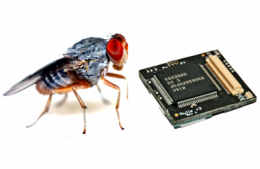
What do you get if you cross a fruit fly with a Mulle wireless sensor?

Monash University researchers, as part of an international collaboration, are using insect intelligence to develop new wireless sensor networks that could transform how we monitor changes to the environment, buildings and infrastructure, and patient health.

It all began with a study on fruit flies, explained Dr. Asad Khan, Senior Lecturer from the Faculty of .

“When it comes to energy efficiency, fruit flies can teach us a lot,” Dr. Khan said.

“A fruit fly’s brain consumes only a few microwatts of power, and yet is still able to integrate sensory information, actions of flight, and control over relatively complex behaviour in order to survive.”

“Conventional computers are no way near as efficient. An average computer sensor node consumes about one milliwatt of power, which is around a thousand times more than that used by a fruit fly.”

Using a process known as ‘bio-inspired computing’, the research team is studying the efficiencies and of biological systems, such as the brain function of the fruit fly, to develop new (WSN).

A typical WSN consists of sensors, numbering from a few to several thousand, which register changes to physical stimulus, such as light, temperature, heat and sound. Information from the sensors is processed at nodes, which then send or receive data from a central computer ‘brain’ that controls the network.

“WSN are hugely important and widely used to monitor patient health, track air pollution and as early detection systems for forest fires,” Dr. Khan said.

“The exciting thing is that bees and receive and process the same kinds of sensory information transmitted by WSN. So what we are doing is taking the lessons from how insects function and applying this knowledge as new design principles to create much more powerful and efficient computer networks.”

“Using this bio-inspired approach it may be possible to create infinitely scalable WSN that could include not just thousands, but millions of sensors.”

Dr. Khan said the development of WSN technology could have far-reaching implications for much larger networks accessible online, with several major computing companies predicting that billions of sensor devices could be connected to the Internet within the next decade.

“It is very exciting that Monash is supporting pioneering research into advanced computing technologies that, while currently untested, have the potential to transform how we monitor and manage just about anything, in ways we can scarcely imagine,” Dr. Khan said.

Explore further: US spy chief: Plot against Wall Street foiled

add to favorites email to friend print save as pdf

Related Stories

Demand for wireless networks growing

Sep 07, 2005

Demand for wireless sensor networking is growing and deployments are accelerating, according to a recently published report by ON World.

Probably wireless

Sep 03, 2008

Wireless Sensor Networks (WSNs) used to detect and report events including hurricanes, earthquakes, and forest fires and for military surveillance and antiterrorist activities are prone to subterfuge. In the International Jo ...

Invasive fruit fly found in North Carolina

Oct 19, 2010

(PhysOrg.com) -- A potentially important invasive insect species – the fruit fly Drosophila suzukii, or spotted wing Drosophila (SWD) – winged its way to North and South Carolina this summer. The insect has the ...

History of flies takes flight

Apr 05, 2011

(PhysOrg.com) -- A Simon Fraser University biologist’s fly research fill out a global tree of life map of all living organisms, even though he retired from SFU three years ago.

Recommended for you

US spy chief: Plot against Wall Street foiled

7 hours ago

The U.S. foiled a plot to bomb the New York Stock Exchange because of the sweeping surveillance programs at the heart of a debate over national security and personal privacy, officials said Tuesday at a rare ...

Tablets thrust Thai classrooms into digital era

18 hours ago

In a rural classroom in the Thai highlands, hill tribe children energetically slide their fingertips over tablet computer screens practicing everything from English to mathematics and music.

Research examines how technology can break down barriers

Jun 17, 2013

A small, pilot study is examining how mobile technology might support deaf and hard-of-hearing college students when an interpreter can't physically be present at the time the services are requested. The University of Cincinnati ...

Hands-free texting still distracting for drivers (Update)

Jun 12, 2013

Using voice commands to send text messages and emails from behind the wheel, which is marketed as a safer alternative for drivers, actually is more distracting and dangerous than simply talking on a cellphone, ...

User comments : 0

More news stories

Mozilla lab wants scientists to step out of analog age

(Phys.org) —Talk about big ideas. Not satisfied to rest on laurels of having brought forth the open source browser Firefox, Mozilla—defined by some as a global project, by others as one of the key open-source ...

Origins of 'The Hoff' crab revealed (w/ Video)

The history of a new type of crab, nicknamed 'The Hoff' because of its hairy chest, which lives around hydrothermal vents deep beneath the Southern Ocean and Indian Ocean, has been revealed for the first ...

3D printing tiny batteries

(Phys.org) —3D printing can now be used to print lithium-ion microbatteries the size of a grain of sand. The printed microbatteries could supply electricity to tiny devices in fields from medicine to communications, ...