Deep history of coconuts decoded
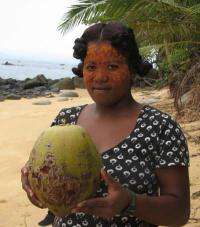
The coconut (the fruit of the palm Cocos nucifera) is the Swiss Army knife of the plant kingdom; in one neat package it provides a high-calorie food, potable water, fiber that can be spun into rope, and a hard shell that can be turned into charcoal. What's more, until it is needed for some other purpose it serves as a handy flotation device.
No wonder people from ancient Austronesians to Captain Bligh pitched a few coconuts aboard before setting sail. (The mutiny of the Bounty is supposed to have been triggered by Bligh's harsh punishment of the theft of coconuts from the ship's store.)
So extensively is the history of the coconut interwoven with the history of people traveling that Kenneth Olsen, a plant evolutionary biologist, didn't expect to find much geographical structure to coconut genetics when he and his colleagues set out to examine the DNA of more than 1300 coconuts from all over the world.
"I thought it would be mostly a mish-mash," he says, thoroughly homogenized by humans schlepping coconuts with them on their travels.
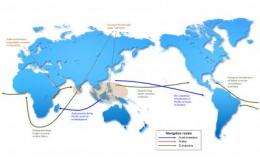
He was in for a surprise. It turned out that there are two clearly differentiated populations of coconuts, a finding that strongly suggests the coconut was brought under cultivation in two separate locations, one in the Pacific basin and the other in the Indian Ocean basin. What's more, coconut genetics also preserve a record of prehistoric trade routes and of the colonization of the Americas.
The discoveries of the team, which included Bee Gunn, now of the Australian National University in Australia, and Luc Baudouin of the Centre International de Recherches en Agronomie pour le Développement (CIRAD) in Montpellier, France, as well as Olsen, associate professor of biology at Washington University in St. Louis, are described in the June 23 online issue of the journal PLoS One.
Morphology a red herring
Before the DNA era, biologists recognized a domesticated plant by its morphology. In the case of grains, for example, one of the most important traits in domestication is the loss of shattering, or the tendency of seeds to break off the central grain stalk once mature.
The trouble was it was hard to translate coconut morphology into a plausible evolutionary history.
There are two distinctively different forms of the coconut fruit, known as niu kafa and niu vai, Samoan names for traditional Polynesian varieties. The niu kafa form is triangular and oblong with a large fibrous husk. The niu vai form is rounded and contains abundant sweet coconut "water" when unripe.
"Quite often the niu vai fruit are brightly colored when they're unripe, either bright green, or bright yellow. Sometimes they're a beautiful gold with reddish tones," says Olsen.
Coconuts have also been traditionally classified into tall and dwarf varieties based on the tree "habit," or shape. Most coconuts are talls, but there are also dwarfs that are only several feet tall when they begin reproducing. The dwarfs account for only 5 percent of coconuts.
Dwarfs tend to be used for "eating fresh," and the tall forms for coconut oil and for fiber.
"Almost all the dwarfs are self fertilizing and those three traits — being dwarf, having the rounded sweet fruit, and being self-pollinating — are thought to be the definitive domestication traits," says Olsen.
"The traditional argument was that the niu kafa form was the wild, ancestral form that didn't reflect human selection, in part because it was better adapted to ocean dispersal," says Olsen. Dwarf trees with niu vai fruits were thought to be the domesticated form.
The trouble is it's messier than that. "You almost always find coconuts near human habitations," says Olsen, and "while the niu vai is an obvious domestication form, the niu kafa form is also heavily exploited for copra (the dried meat ground and pressed to make oil) and coir (fiber woven into rope)."
"The lack of universal domestication traits together with the long history of human interaction with coconuts, made it difficult to trace the coconut's cultivation origins strictly by morphology," Olsen says.
DNA was a different story.
Collecting coconut DNA
The project got started when Gunn, who had long been interested in palm evolution, and who was then at the Missouri Botanical Garden, contacted Olsen, who had the laboratory facilities needed to study palm DNA.
Together they won a National Geographic Society grant that allowed Gunn to collect coconut DNA in regions of the western Indian Ocean for which there were no data. The snippets of leaf tissue from the center of the coconut tree's crown she sent home in zip-lock bags to be analyzed.
"We had reason to suspect that coconuts from these regions —especially Madagascar and the Comoros Islands — might show evidence of ancient 'gene flow' events brought about by ancient Austronesians setting up migration routes and trade routes across the southern Indian Ocean," Olsen says.
Olsen's lab genotyped 10 microsatellite regions in each palm sample. Microsatellites are regions of stuttering DNA where the same few nucleotide units are repeated many times. Mutations pop up and persist pretty easily in these regions because they usually don't affect traits that are important to survival and so aren't selected against, says Olsen. "So we can use these genetic markers to 'fingerprint' the coconut," he says.
The new collections were combined with a vast dataset that had been established by CIRAD, a French agricultural research center, using the same genetic markers. "These data were being used for things like breeding, but no one had gone through and systematically examined the genetic variation in the context of the history of the plant," Olsen says.
Two origins of cultivation
The most striking finding of the new DNA analysis is that the Pacific and Indian Ocean coconuts are quite distinct genetically. "About a third of the total genetic diversity can be partitioned between two groups that correspond to the Indian Ocean and the Pacific Ocean," says Olsen.
"That's a very high level of differentiation within a single species and provides pretty conclusive evidence that there were two origins of cultivation of the coconut," he says.
In the Pacific, coconuts were likely first cultivated in island Southeast Asia, meaning the Philippines, Malaysia, Indonesia, and perhaps the continent as well. In the Indian Ocean the likely center of cultivation was the southern periphery of India, including Sri Lanka, the Maldives, and the Laccadives.
The definitive domestication traits —the dwarf habit, self-pollination and niu vai fruits — arose only in the Pacific, however, and then only in a small subset of Pacific coconuts, which is why Olsen speaks of origins of cultivation rather than of domestication.
"At least we have it easier than scientists who study animal domestication," he says. "So much of being a domesticated animal is being tame, and behavioral traits aren't preserved in the archeological record."
Did it float or was it carried?
One exception to the general Pacific/Indian Ocean split is the western Indian Ocean, specifically Madagascar and the Comoros Islands, where Gunn had collected. The coconuts there are a genetic mixture of the Indian Ocean type and the Pacific type.
Olsen and his colleagues believe the Pacific coconuts were introduced to the Indian Ocean a couple of thousand years ago by ancient Austronesians establishing trade routes connecting Southeast Asia to Madagascar and coastal east Africa.
Olsen points out that no genetic admixture is found in the more northerly Seychelles, which fall outside the trade route. He adds that a recent study of rice varieties found in Madagascar shows there is a similar mixing of the japonica and indica rice varieties from Southeast Asia and India.
To add to the historical shiver, the descendants of the people who brought the coconuts and rice are still living in Madagascar. The present-day inhabitants of the Madagascar highlands are descendants of the ancient Austronesians, Olsen says.
Much later the Indian Ocean coconut was transported to the New World by Europeans. The Portuguese carried coconuts from the Indian Ocean to the West Coast of Africa, Olsen says, and the plantations established there were a source of material that made it into the Caribbean and also to coastal Brazil.
So the coconuts that you find today in Florida are largely the Indian ocean type, Olsen says, which is why they tend to have the niu kafa form.
On the Pacific side of the New World tropics, however, the coconuts are Pacific Ocean coconuts. Some appear to have been transported there in pre-Columbian times by ancient Austronesians moving east rather than west.
During the colonial period, the Spanish brought coconuts to the Pacific coast of Mexico from the Philippines, which was for a time governed on behalf of the King of Spain from Mexico.
This is why, Olsen says, you find Pacific type coconuts on the Pacific coast of Central America and Indian type coconuts on the Atlantic coast.
"The big surprise was that there was so much genetic differentiation clearly correlated with geography, even though humans have been moving coconut around for so long."
Far from being a mish-mash, coconut DNA preserves a record of human cultivation, voyages of exploration, trade and colonization.
Provided by Washington University in St. Louis


