New CryoSat-2 satellite redraws Arctic sea-ice map
June 22, 2011 by Tamera Jones
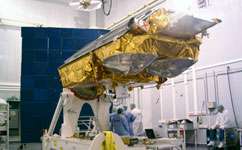
Cryosat in the clean room.
Scientists have produced the most extensive map of Arctic sea-ice thickness yet using just two months' worth of data from the European Space Agency's ice mission, CryoSat-2.
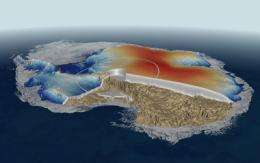
Data from the satellite has also helped them create an updated map of ocean circulation in the Arctic, and a topographical relief map of Antarctica.
All three maps demonstrate that CryoSat-2 is working well and, in some cases, is exceeding expectations.
'This is the first time we've been able to measure sea-ice thickness over almost the entire Arctic ice pack,' says Dr Seymour Laxon, director of the Centre for Polar Observation and Modelling (CPOM) at University College London, a member of the research team.
'
Enlarge
For the first time, data from ESA’s CryoSat mission have been used to map the height of the ice sheet that blankets Antarctica. The preliminary data used here are from February and March 2011. More data still need to be collected to study the ice sheet in detail. Nevertheless, CryoSat's ability to map the edges of the ice sheet is demonstrated by the detail that can be seen of the flow from east Antarctica onto the Ronne-Filchner ice shelf in the west. Orbiting closer to the poles than other Earth observation missions, CryoSat offers additional coverage. The outer white circle represents the limits of earlier missions and the inner circle shows that CryoSat is collecting data up 88° latitude. Credits: CPOM/UCL/ESA/Planetary Visions
The map shows clear agreement with data gathered from aircraft during a recent Arctic campaign, showing that CryoSat-2 can accurately measure changes in ice thickness.''We can't yet say anything about changes for that you need a longer dataset,' he adds.
The sea-ice thickness map is based on data from January and February 2011 and shows thicker, rough, multi-year ice which has survived last summer's melt north of Canada and Greenland, stretching to the North Pole and slightly beyond. Elsewhere in the Arctic the map reveals thinner, first year ice, and corresponds well with maps produced by other researchers.
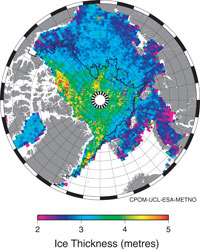
Arctic sea-ice thickness Jan-Feb 2011.
'Other European Space Agency satellites, like Envisat and ERS-1 have let us build a map of sea-ice thickness up to 81.5 degrees north. But CryoSat-2 goes right up to 88 degrees north, which means we've got more coverage up to the North Pole,' says Dr Katharine Giles, also from CPOM.CryoSat-2 is designed to take precise measurements of changes in the thickness of ice in the Arctic and Antarctica, helping scientists understand how melting polar ice could affect ocean circulation patterns, sea-level rise and the global climate.
The satellite measures the thickness of polar ice using an instrument called an altimeter, which fires pulses of microwave energy at the ice and records how long they take to return.
Researchers at CPOM calculate the thickness of the ice by comparing how long it takes for the echoes to return from the top of ice floes and from the water in cracks in the ice, called leads. The aim is to measure the freeboard the part of the ice that sits above the waterline.
The satellite can also tell scientists how winds affect the Arctic Ocean by measuring differences in the height of the sea surface exposed between ice floes.
Echoes returning from leads have a much sharper signature than echoes from the ice. It's this data that has let the CPOM researchers to produce a map of ocean circulation in the Arctic using CryoSat-2 data.
They created a similar map in December 2010. But most of the data for that map came from another ESA satellite called Envisat. The CPOM team used CryoSat-2 data to plug a huge hole over the North Pole left by Envisat.
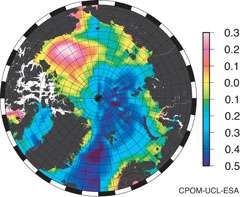
Arctic Ocean dynamic topography and currents.
CryoSat-2 can also measure the height of the ice around the edges of Greenland and Antarctica, which is important for understanding changes in ice thickness.To test how well it does this, the researchers switched the satellite to a different measurement mode as it passed over a prominent chain of mountains under the sea around Hawaii. The mountains in the Hawaiian-Emperor Seamount Chain are so enormous they change how gravity acts on the ocean above them, creating slopes and troughs at the surface.
'We were astonished to find we could measure tiny changes in the ocean surface caused by the seamounts lying deep under water,' says Dr Natalia Galin, also from CPOM.
The satellite is in a polar orbit around 700 kilometres above the Earth. It's expected to be in operation for three years, 'but has enough fuel onboard to keep going for up to seven years,' says Professor Duncan Wingham from CPOM, who conceived the idea for CryoSat-2 more than ten years ago.
Cryosat-2 was launched onboard a Dnepr rocket a converted intercontinental ballistic missile from the Baikonur cosmodrome in Kazakhstan on 8 April 2010.
Wingham presented the team's results at the Paris Air and Space Show today.
Provided by
PlanetEarth Online
-
From lemons to lemonade: Reaction uses carbon dioxide to make carbon-based semiconductor,
32 comments
-
Thioridazine kills cancer stem cells in human while avoiding toxic side-effects of conventional cancer treatments,
3 comments
-
SpaceX private rocket blasts off for space station (Update),
42 comments
-
Climate scientists say they have solved riddle of rising sea,
31 comments
-
SpaceX capsule has 'new car' smell, astronauts say (Update),
2 comments
-
Hypothetical desert earth
12 hours ago
-
More human population = greater mass?
May 25, 2012
-
Conversion from aircraft bearing to normal degrees
May 23, 2012
-
Interpretation/Analysis of the Lab results(HEPA filter)
May 22, 2012
-
Has anyone here attended the The Urbino Summer School in Paleoclimatology?
May 22, 2012
-
Earthquakes: Mag 6 N. Italy and Mag 5.6 W. Bulgaria
May 21, 2012
- More from Physics Forums - Earth
More news stories
Sophisticated simulations predict future warming
The chances of our planet being hit by a global warming of 3 degrees Celsius by 2050 is as likely as it being hit by an increase of 1.4 degrees, new research shows. Presented in the journal Nature Geoscience, the British study ...
Space & Earth / Earth Sciences
May 22, 2012 |
4.4 / 5 (9) |
51
Kyoto Protocol architect 'frustrated' by climate dialogue
UN climate talks are going nowhere, as politicians dither or bicker while the pace of warming dangerously speeds up, one of the architects of the Kyoto Protocol told AFP.
May 23, 2012 |
3.7 / 5 (7) |
39
Aliens don't want to eat us, says former SETI director
Alien life probably isnt interested in having us for dinner, enslaving us or laying eggs in our bellies, according to a recent statement by former SETI director Jill Tarter.
Space & Earth / Space Exploration
May 25, 2012 |
4.4 / 5 (13) |
37
Dragon arrives at space station in historic 1st (Update 2)
The privately bankrolled Dragon capsule made a historic arrival at the International Space Station on Friday, triumphantly captured by astronauts wielding a giant robot arm.
Space & Earth / Space Exploration
May 25, 2012 |
5 / 5 (10) |
19
What's the big deal about private space launches?
(AP) -- The first private spaceship is headed to the International Space Station. Some questions and answers about the cargo mission by Space Exploration Technologies, known as SpaceX:
Space & Earth / Space Exploration
May 22, 2012 |
5 / 5 (6) |
32
Nvidia trumpets Tegra 3 phone design wins for 2012
(Phys.org) -- Nvidias competitive war paint has a name, Tegra 3. On the heels of Nvidia announcements about lowering costs of its Tegra 3 processors and Nvidia-enabled tablets running Android Ice Cream ...
Browser wars flare in mobile space
The browser wars are heating up again, but this time the fight is for dominance of the mobile Internet.
Scientist: Evolution debate will soon be history
(AP) -- Richard Leakey predicts skepticism over evolution will soon be history. Not that the avowed atheist has any doubts himself.
Dell tablet leak: 10.1-inch display, two-battery choice
(Phys.org) -- Headline after headline talks about vendors tablets in the wings as likely number-one contenders for the iPad. Such claims have justifiably been taken with a grain of salt, considering ...
Keep food safety in mind this memorial day weekend
(HealthDay) -- Picnics, parades and cookouts are as much a part of Memorial Day weekend as tributes to the United States' war veterans.
Social welfare cuts ultimately come with heavy price, researchers say
(Phys.org) -- Slashing government funding for Medicaid, food stamps and other programs that serve the poor while politically popular with some lawmakers and many conservatives may do more harm ...