Conflicting policies on flying under ash confuse
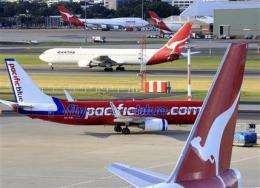
(AP) -- If you had hoped to fly Qantas between Australia and New Zealand, you were out of luck. The national carrier grounded planes after a plume of ash from a Chilean volcano moved over the southern Pacific.
But the suspension this past week didn't leave the island nation entirely cut off: If you booked on Virgin Australia or Air New Zealand, your flight ran as scheduled for much of the week.
Stranded Qantas passengers could only watch in frustration as competitors' customers boarded planes, but it also left them wondering what was going on. Was Qantas overly cautious or were its pilots less capable? Do Virgin and Air New Zealand have a greater appetite for risk?
"It's quite concerning that other airlines are still flying, and Qantas can't do the same thing," said Briton Tina Gunn, who got stuck in Sydney on her way to New Zealand to see her daughter who was due to give birth to her first child any day.
All the airlines operating flights affected by the ash insisted that safety was their No. 1 priority. On Thursday, when the cloud between the two countries drifted to lower altitudes, Virgin followed its competitors and canceled some flights. Air New Zealand periodically suspended some domestic flights, but never stopped flying across the Tasman Sea. On Friday, service between the two countries was returning to normal.
The difference in approach made passengers wonder: Was safety more of a priority for some?
Analysts say all three airlines are among the world's safest, and the different approaches - and the flak Qantas caught for not flying - simply lays bare the dilemma airlines face when they make decisions without perfect information. Little is known about how thick ash has to be to affect jet engines, and there are few good ways to measure the density of the clouds.
"The airlines you're talking about are airlines that all have outstanding safety records," said Arnold Barnett, a statistician at the Massachusetts Institute of Technology. "We're talking about disagreements among the greats."
The last time a volcano caused widespread flight cancelations, there were no such comparisons to be made: In the days after last year's eruption in Iceland, European civil authorities closed airspace from Scotland to Hungary. Airlines complained bitterly that they were best placed to make decisions about safety and sent test flights into the air to prove that it was safe to fly.
More than 100,000 flights were canceled and 10 million passengers affected before the agencies relented.
In a less severe situation, Australia left the decision-making to individual airlines. Virgin and Air New Zealand have repeatedly said their safety procedures are robust, but Qantas had the best retort by keeping its planes on the ground.
Qantas has built its reputation on safety, and all week it never lost a chance to remind the public that it would never put "safety before schedule." It attached the hashtag "safety first" to all of its tweets updating passengers on cancelations. On Thursday night, it posted a video on YouTube, explaining the dangers of ash and how it makes decisions about when to fly.
But the carrier's reputation has been dented recently by a series of accidents. Most serious was the explosion of a Rolls Royce engine in mid-air last year. A handful of forced landings have followed and an oxygen tank once exploded, ripping a hole in a plane.
The airline still has never had a fatality, but the Qantas name may not be what it was when Dustin Hoffman's "Rain Man" famously insisted he would only fly the Australian carrier because it had never had a crash.
Did the ash cloud provide the airline with a chance to make a comeback?
"Qantas' prudence in this matter only reminds us that its safety record is among the world's most brilliant," Barnett said. "They might particularly feel that they don't want to take chances" right now.
Spokesman Tom Woodward said the airline was merely implementing a policy it has long had in place: to not fly when it doesn't know the density of the ash cloud, as it did not over this past week.
"Where we don't know the density of the ash, we won't fly through it, we won't fly below it, we won't fly around it," he said.
But Barnett noted that the Virgin group has never had a fatality either, and Air New Zealand is admired throughout the industry.
"Virgin isn't taking chances," he said.
The airlines may have made different decisions, but the Civil Aviation Safety Authority said one thing united them.
"The outcome was the same: that no airplane would fly through the ash," said Peter Gibson, a spokesman for the authority.
Ash can stick to and clog engine parts, leading to overheating and eventual engine failure.
The ash from the Eyjafjallajokull (pronounced ay-yah-FYAH-lah-yer-kuhl) volcano was even more dangerous to planes because its plume contained tiny glass crystals, according to Kenneth Button of George Mason University. When those crystals melt, they can coat engine parts and restrict air flow.
The Australian authority said it does not allow planes to fly through ash, but it's up to the airlines to develop plans for how to deal with a plume. The authority approves those plans long before any ash is in the air, so airlines aren't tempted to make snap decisions based on business concerns.
Barnett said it was important to note that there's nothing inherently dangerous about flying at a lower altitude - which some airlines did to avoid the cloud - though it burns more fuel. Short commuter flights - such as the well-traveled leg between Boston and New York - never get above 20,000 feet (6,000 meters), he noted, "and no one's suggesting those flights are unsafe."
But some companies might choose not to take to the air when they can't fly at upper altitudes because higher flight paths give them more time to deal with problems before a crash if anything were to go wrong, Barnett said.
Part of the difference in airline responses - and the debate in Europe over whether civil authorities were overly cautious - stems from the difficulty of measuring an ash cloud's density. European airlines have provided their civil aviation authorities with equipment that can do that, but other parts of the world, like Australia, don't have that capability.
There also is uncertainty over what density is dangerous. The International Civil Aviation Organization is currently tackling that question and hoping to provide global guidelines.
In the meantime, Barnett said you can't go wrong with an Australian airline.
"No one in Australia is taking serious risks," he said.
©2011 The Associated Press. All rights reserved. This material may not be published, broadcast, rewritten or redistributed.


