Cloud composition cliffhanger at point reyes national seashore
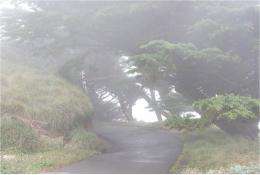
Turns out, polluted air from San Francisco is not the culprit. It's a thermal trough pushing north from Arizona. In a surprise result, scientists found that this weather pattern significantly affects the chemistry of fog and clouds over Point Reyes National Seashore. Scientists from Pacific Northwest National Laboratory, Washington State University, the University of Colorado, and the National Oceanic and Atmospheric Administration found very high amounts of ammonia and organic material in aerosol particles and cloud droplets during a large-scale weather pattern originating in Arizona. Their results also show the interactions between these small airborne particles and the cloud water chemistry during clear and foggy conditions.
The results were achieved through a team collaboration. The U.S. Department of Energy's Atmospheric Chemistry Program (now the Atmospheric System Research Program) used specialized air quality measurements, and combined these with local climate data collected by the U.S. Department of Energy's (DOE's) Atmospheric Radiation Measurement (ARM) Mobile Facility (AMF).
This research provided scientists with a rare opportunity to study how cloud water droplets form around tiny particles in the air in a remote area. Understanding aerosols, small particles suspended in the atmosphere, is a primary focus in understanding how clouds form. This is important because clouds are known to play a central role in the Earth's climate system. Studying cloud and aerosol interactions in remote areas also contributes valuable baseline information so policy makers can develop air quality standards and scientists can improve climate models. Getting and using accurate data in climate models will lead to better climate change predictions. For the Point Reyes studies, investigators were able to examine the cloud and aerosol properties during two distinct weather patterns that were found to have a significant impact on the area's air quality.
Point Reyes National Seashore in California is one of the cloudiest locations in the United States. During July 2005, scientists from DOE's Atmospheric Chemistry Program (now the Atmospheric Systems Research Program) joined investigators from DOE's ARM to collect information about the particle size and composition of cloud droplets for the Marine Stratus Experiment.
Scientists used a special set of instruments to separate atmospheric particles into two categories: those that attract moisture and lead to the formation of clouds; and those that could not. They analyzed the chemical make-up of both sets of particles using an aerosol mass spectrometer. Combined with meteorology observations, a suite of instruments allowed scientists to contrast the size and chemical composition of particles during four categories of weather patterns: a) maritime flow; b) over-land flow; c) clear conditions; and d) foggy conditions. Air moving from the ocean comprised the marine flow; the over-land flow was found to be strongly influenced by a large weather feature called a thermal trough, originating in Arizona (see sidebar).
The team began their analysis by comparing their high-time resolution data with more coarse weekly observations made at a permanent IMPROVE (Interagency Monitoring of Protected Visual Environments) station at Point Reyes, set up to track long-term visual air quality trends. Finding good agreement between their measurements and the IMPROVE data they then compared the chemistry of particles and cloud droplets during both periods of foggy and clear weather. A pronounced change in the chemical composition of particles between the start and the end of the study period was analyzed during these two intervals. The team was able to identify the role of the thermal trough on cloud particles, including very high levels of ammonia gas, a byproduct of fertilizer use and production. The chemical composition of cloud droplets affects the light-reflecting and absorbing properties of the particles, which has a large effect on regional climate.
The team expected to find long periods of clean air broken by a few days of pollution coming from San Francisco, Calif. Instead, the chemical make-up of the particles was strongly influenced the large thermal trough. In addition, the particles from marine air were acidic or near-neutral while particles associated with the thermal trough appeared to be the opposite. High concentrations of ammonia gas and organic matter, linked to the circulation pattern from the warm air pushing up from Arizona, have an impact on otherwise clean air coming in from the Pacific Ocean. This new information is of special interest to the National Park Service monitoring air quality in the park.
Researchers are now investigating the relationship between aerosol particles, the way cloud droplets form, and the effect the pre-existing particles have on the ability of marine-formed clouds to reflect light and produce rain. This study also sets the stage for a major DOE campaign, the Two Column Aerosol Project on Cape Cod, Mass. in the summer of 2012.
More information: Berkowitz CM, et al. "The Influence of Fog and Airmass History on Aerosol Optical, Physical and Chemical Properties at Pt. Reyes National Seashore." Atmospheric Environment 45(15):2559-2568. DOI: 10.1016/j.atmosenv.2011.02.016.
Provided by Pacific Northwest National Laboratory


