How climate change is impacting marshes
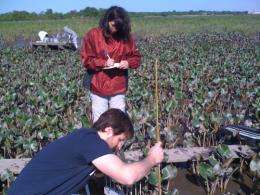
It is a very muddy trek from the small boat to the field site along Raccoon Creek near Bridgeport, N.J. Villanova University marine scientist Nathaniel Weston and his team are all carrying ladders and equipment as they slosh through ankle deep mud toward their experiments.
"The whole reason I got into this line of research is because I like being outside, I like coastal estuaries and marsh systems, I like getting muddy, so I have fun with it," says Weston enthusiastically.
With support from the National Science Foundation (NSF), Weston, also a biogeochemist, is investigating how climate change and sea level rise may impact fresh and saltwater ecosystems, such as this marsh.
"What we wanted to do was have sites that are a gradient from fresh water to salt water so that we could investigate these processes of how salt water intrusion impacts freshwater marshes, and how sea level rise impacts both tidal freshwater and salt marshes," says Weston.
While a lot of people might just see mud, marshes like these are crucial for plants, animals and humans.
"A lot of people refer to marshes as the kidneys of Earth's ecosystems. They do a good job of filtering," explains Weston. "They also produce a lot of organic matter that acts as food for a whole set of organisms in these coastal environments. So the marsh ecosystems are basically nurseries for fish and shellfish. They provide refuge for a lot of different fish when they are in the juvenile stage."
Marshes are fairly resilient to change; they deal with a changing environment day to day because of tides, and additional changes with each season. "But the concern is that we are pushing the envelope on what they can deal with," says Weston.
In a freshwater system, adding even a little bit of salt can be a big change for the organisms living there, from plants to animals, to even bacteria.
Weston says sea levels have risen about two millimeters (0.08 inches) per year over the past century and it's averaged about three millimeters a year during the past decade. Global climate change may increase those amounts drastically.
As the Earth's climate gets hotter, ocean water warms up and expands, causing higher sea levels. Runoff from melting ice sheets and glaciers will dump even more water into the oceans. The Intergovernmental Panel on Climate Change (IPCC), chartered by the United Nations, estimates sea levels may rise up to 23 inches (58.42 centimeters) by the year 2100. Some climate scientists predict an even higher rise.
"There's pretty good evidence that sea level rise is accelerating, and it is certainly faster now than it has been in any point in the last 4,000 years," says Weston. "And so these coastal marshes that have only been able to develop in the last 4,000 years, how are they going to respond to these faster rates of sea level rise going forward? That's really what we are trying to understand," he adds.
The experiments at Raccoon Creek and several other field sites are designed to help provide insight into how a marsh is growing vertically to keep up with sea level rise. "One of the tricks with working in the marsh is you care a lot about elevation. Everything is relative to sea level," says Weston.
He uses a surface elevation table to very accurately measure the level of the marsh surface. Those measurements are taken every three months to monitor changes.
The equipment at these sites can detect changes smaller than any other means of monitoring. "Even the most accurate GPS units we have, you can see changes maybe about a centimeter, but that's just not good enough for what we are trying to do here," explains Weston.
"The funding I've received through the American Recovery and Reinvestment Act (ARRA) has allowed me to hire the personnel and purchase the equipment that this type of intensive monitoring and experimentation requires," he adds.
Some experiments at the site involve examining the composition of the soil. "So part of what we're interested in here is understanding deposition of watershed derived sediment. We take soil cores from these marsh sites, bring them back to the lab and date the recent and less recent deposition of sediment with our gamma counter," continues Weston.
The gamma counter detects both man-made and naturally occurring radioactive elements, to determine sedimentation rates, to learn more about how the marsh landscape is changing.
Whether it is the summer houses of the wealthy on the East Coast of the United States, or the vast majority of people in a developing country like Bangladesh, Weston says rising sea levels could mean that millions of people living in coastal areas are going to be much more vulnerable to extreme events such as hurricanes.
"Fifty years in the future you can expect to see much greater numbers of storm-related deaths and property damage in coastal areas," he says.
Healthy marshes act as buffers during a storm surge, nurseries for young fish and shellfish, and a water filtering system. Protecting marshes over time will be the key to keeping humans healthy, too.
Weston says monitoring these marshes is both important and enjoyable.
"When you've got a very productive marsh, very green, and you've got great blue herons or egrets flying around, fish jumping: It's a beautiful ecosystem and I really enjoy it," he says.
Provided by National Science Foundation


