Cassini captures ice queen Helene
Jun 21, 2011
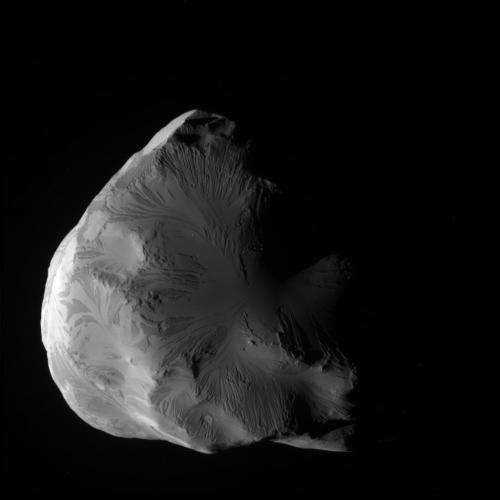
NASA's Cassini spacecraft obtained this unprocessed image of Saturn's moon Helene on June 18, 2011. Image credit: NASA/JPL-Caltech/Space Science Institute

(PhysOrg.com) -- NASA's Cassini spacecraft has successfully completed its second-closest encounter with Saturn's icy moon Helene, beaming down raw images of the small moon. At closest approach, on June 18, Cassini flew within 4,330 miles (6,968 kilometers) of Helene's surface. It was the second closest approach to Helene of the entire mission.

Cassini passed from Helene's night side to the moon's sunlit side. It also captured images of the Saturn-facing side of the moon in sunlight, a region that was only illuminated by sunlight reflected off the last time Cassini was close, in March 2010. This will enable scientists to finish creating a global map of Helene, so they can better understand the history of impacts to the moon and gully-like features seen on previous flybys.
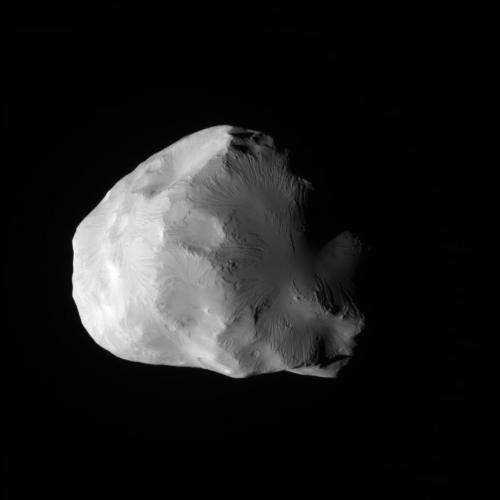
NASA's Cassini spacecraft obtained this unprocessed image of Saturn's moon Helene on June 18, 2011. Image credit: NASA/JPL-Caltech/Space Science Institute

The closest Helene encounter of the mission took place on March 10, 2010, when Cassini flew within 1,131 miles (1,820 kilometers) of the moon.

Explore further: Building a better team—on Mars

More information: The latest raw images are online at: saturn.jpl.nasa.gov/photos/raw/

Related Stories

Cassini captures Rhea coming down

Jan 13, 2011

Raw images obtained by NASA's Cassini spacecraft from the closest flyby of Saturn's moon Rhea have begun streaming to Cassini's raw image page.

Cassini Set to Do Retinal Scan of Saturnian Eyeball

Feb 12, 2010

(PhysOrg.com) -- On Feb. 13, 2010, NASA's Cassini spacecraft will make its closest examination yet of Mimas, an eyeball-shaped moon of Saturn that has also been likened to the Death Star of "Star Wars." The ...

Cassini flies by Saturn's tortured moon Mimas

Aug 05, 2005

On its recent close flyby of Mimas (MY-muss), the Cassini spacecraft found the Saturnian moon looking battered and bruised, with a surface that may be the most heavily cratered in the Saturn system.

Cassini Attempts 12th Titan Flyby

Feb 28, 2006

NASA's Cassini spacecraft returns to Titan on Monday for its twelfth flyby since beginning to survey Saturn and its moons on July 4, 2004.

Cassini gazes at veiled Titan

Sep 23, 2010

(PhysOrg.com) -- NASA's Cassini spacecraft will swing high over Saturn's moon Titan on Friday, Sept. 24, taking a long, sustained look at the hazy moon. At closest approach, Cassini will fly within 8,175 kilometers ...

Recommended for you

Forecast for Titan: Wild weather could be ahead

8 hours ago

(Phys.org) —Saturn's moon Titan might be in for some wild weather as it heads into its spring and summer, if two new models are correct. Scientists think that as the seasons change in Titan's northern hemisphere, ...

SDO observes mid-level solar flare

8 hours ago

UPDATE 16:30 p.m. EDT: The M7-class flare was also associated with a coronal mass ejection or CME, another solar phenomenon that can send billions of tons of particles into space. While this CME was not Ea ...

NASA's IRIS mission readies for a new challenge

17 hours ago

(Phys.org) —The time draws near. NASA is getting ready to launch a new mission, a mission to observe a largely unexplored region of the solar atmosphere that powers its dynamic million-degree outer atmosphere and drives ...

User comments : 1

Adjust slider to filter visible comments by rank

Display comments: newest first

LKD
4 / 5 (1) Jun 21, 2011
"Cassini captures ice queen Helene". Helene is reported to have told Cassini that she would never no matter the situation. Sorry, please forgive the joke, I couldn't resist.

More news stories

Forecast for Titan: Wild weather could be ahead

(Phys.org) —Saturn's moon Titan might be in for some wild weather as it heads into its spring and summer, if two new models are correct. Scientists think that as the seasons change in Titan's northern hemisphere, ...

Theorists weigh in on where to hunt dark matter

(Phys.org) —Now that it looks like the hunt for the Higgs boson is over, particles of dark matter are at the top of the physics "Most Wanted" list. Dozens of experiments have been searching for them, but ...