Squeezed light from single atoms
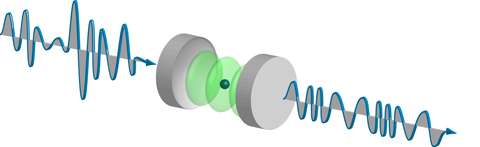
(PhysOrg.com) -- Max Planck Institute of Quantum Optics scientists generate amplitude-squeezed light fields using single atoms trapped inside optical cavities.
In classical optics light is usually described as a wave, but at the most fundamental quantum level this wave consists of discrete particles called photons. Over the time, physicists developed many tools to manipulate both the wave-like and the particle-like quantum properties of the light. For instance, they created single photon sources with single atoms, using their ability to absorb and emit photons one by one. A team around Professor Gerhard Rempe, Director at the Max Planck Institute of Quantum Optics (Garching near Munich) and head of the Quantum Dynamics Division, has now observed that the light emitted by a single atom may exhibit much richer dynamics (Nature 474, 623, June 30, 2011). Strongly interacting with light inside a cavity, the atom modifies the wave-like properties of the light field, reducing its amplitude or phase fluctuations below the level allowed for classical electromagnetic radiation. This is the very first observation of “squeezed” light produced by a single atom.
The “graininess” of the photons in a light wave causes small fluctuations of the wave’s amplitude and phase. For classical beams, the minimal amount of amplitude and phase fluctuations is equal. However, by creating interactions between the photons, one can “squeeze” the fluctuations of the amplitude below this so-called “shot noise” level at the expense of increasing the fluctuations of the phase, and vice-versa. Unfortunately, the photonic interactions inside standard optical media are very weak, and require bright light beams to be observed. Single atoms are promising candidates to enable such interactions at a few-photon level. Their ability to generate squeezed light has been predicted 30 years ago, but the amount of light they emit is very tiny and so far all attempts to set this idea into realization have failed. In the Quantum Dynamics Division at MPQ sophisticated methods for cooling, isolating and manipulating single atoms have been developed over many years, and made this observation possible.
A single rubidium atom is trapped inside a cavity made of two very reflective mirrors in a distance of about a tenth of a millimetre from each other. When weak laser light is injected into this cavity, the atom can interact with one photon many times, and forms a kind of artificial molecule with the photons of the light field. As a consequence, two photons can enter the system at the same time and become correlated. “According to the model of Bohr, a single atom emits exactly one single energy quantum, i.e., one photon. That means that the number of photons is exactly known, but the phase of the light is not defined”, Professor Gerhard Rempe explains. “But the two photons that are emitted by this strongly coupled atom are indistinguishable and oscillate together. Therefore this time the wave-like properties of the propagating light field are modified.”
When the physicists use a laser beam which is resonant with the excitation frequency of the atom, the measurements show a suppression of the phase fluctuations. If the laser light is resonant with the cavity, they observe a squeezing of the amplitude instead.
The latter situation is illustrated in the figure: The atom in the cavity turns a laser beam into light which has less amplitude and more phase fluctuations than the shot-noise limit. “Our experiment shows that the light emitted by single atoms is much more complex than in the simple view of Albert Einstein concerning photo-emission”, Dr. Karim Murr emphasizes. “The squeezing that we observe is due to the coherent interaction between the two photons emitted from the system. Our measurement is in excellent agreement with the predictions of quantum electrodynamics in the strong-coupling regime.” And Dr. Alexei Ourjoumtsev, who has been working on the experiment as a post doc, adds: “Usually single quantum objects are used to manipulate the particle-like properties of light. It is interesting to see that they can also modify its wave-like properties, and create observable squeezing with excitations beams containing only two photons on average”.
So far squeezed light has only been generated with systems containing many atoms, such as crystals, using very high intensity beams, i.e. many photons. For the first time now physicists have succeeded in generating this kind of non-classical radiation with single atoms and extremely weak light fields. The ability of a single atom to induce strong coherent interactions between propagating photons opens up new perspectives for photonic quantum logic with single emitters.
More information: A. Ourjoumtsev, A. Kubanek, M. Koch, C. Sames, P. W. H. Pinkse, G. Rempe, & K. Murr
Observation of squeezed light from one atom excited with two photons , Nature 474, 623, 30 June 2011.
Provided by Max-Planck-Gesellschaft


