Astrophysicists use X-ray fingerprints to study eating habits of giant black holes
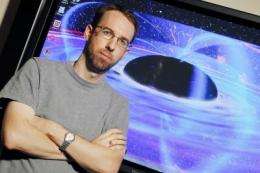
Georgia Tech astrophysicists have provided an important test of a long-standing theory that describes the extreme physics occurring when matter spirals into massive objects known as black holes. Here, David Ballantyne poses with a NASA illustration of a black hole. Credit: Georgia Tech Photo: Gary Meek
By studying the X-rays emitted when superheated gases plunge into distant and massive black holes, astrophysicists at the Georgia Institute of Technology have provided an important test of a long-standing theory that describes the extreme physics occurring when matter spirals into these massive objects.
Matter falling into black holes emits tremendous amounts of energy which can escape as visible light, ultraviolet light and X-rays. This energy can also drive outflows of gas and dust far from the black hole, affecting the growth and evolution of galaxies containing the black holes. Understanding the complex processes that occur in these active galactic nuclei is vital to theories describing the formation of galaxies such as the Milky Way, and is therefore the subject of intense research.
Though light cannot escape from black holes themselves, black holes with accretion disks which are swirling clouds of matter about to enter the black hole are among the most luminous objects in galaxies. By studying how the radiation and accretion disk interact, astrophysicists can learn much about the extreme gravitational fields, magnetic forces and radiation processes close to these black holes.
"We reviewed data collected from space telescopes over the past few years and found that the more rapidly a black hole was gobbling up material, the more highly ionized the accretion disk was," said David Ballantyne, an assistant professor in Georgia Tech's School of Physics. "The simple theory of accretion disks predicts this, but the relationship we saw between the ionization and rate of accretion was different from what the theory predicted."
The large difference between the observed and theoretical relationships a linear dependence on the rate of accretion as opposed to a cubic dependence is not surprising for a phenomenon that can't exactly be tested under controlled laboratory conditions. In a paper published online June 3 in The Astrophysical Journal, Ballantyne describes the research and speculates about possible reasons for the difference between observations and theory. The research, which will appear in the Journal's June 20 issue, was supported in part by the National Science Foundation (NSF).
"As in many areas of science, especially astronomy, we end up needing more data many more high-quality observations to better define this relationship," he added.
Astrophysicists don't have a detailed understanding of how the accretion process works, why black holes grow at different rates or what makes them stop growing. These questions are important because the growth of active galactic nuclei the black holes and their surrounding accretion disks has broader effects on the galaxies of which they are part.
"The rapid accretion phase releases a lot of energy, not only in radiation, but also in outflows that drive gas out of a galaxy, which can shut off star formation and hold back the growth of the galaxy," said Ballantyne, a scientist in Georgia Tech's Center for Relativistic Astrophysics. "We could potentially learn something fundamental about the flow of energy through the accretion disk very close to the black hole. We could learn about the viscosity of this matter and how efficiently radiation transport takes place. These are very important questions in astrophysics."
X-rays are believed to originate from innermost portion of active galactic nuclei. As they pass through matter on its way into the black hole, the X-rays are altered by the materials in ways that astrophysicists can measure. In their study, Ballantyne and his collaborators were interested in studying the ionization state of the matter which is related to the illumination and were able to do so by analyzing the "fingerprint" the ionization left on the X-rays.
"From laboratory work, we understand the physics of how gas interacts with X-ray radiation because that's basically an atomic physics problem," he explained. "We can model what these fingerprints might look like on the X-rays, and compare that to the actual data to help us understand what's going on."
Because of their high energy and short wavelength, X-rays pass through many materials, such as human bodies, with little attenuation. This makes them ideal for examining processes in active galactic nuclei. Longer wavelengths, such as ultraviolet and visible light, are absorbed by intergalactic dust, or are difficult to distinguish from light originating in stars. However, X-rays do get absorbed by dense objects, such as bones and crucially for this study accretion disks.
Ballantyne and his collaborators Jon McDuffie and John Rusin studied ten X-ray observations reported by other scientists from eight different active galactic nuclei. The observations were made using such space telescopes as Chandra and XMM.
To be useful, they used only measurements of X-ray emissions from the innermost and hottest portion of the accretion disk, and only where the mass of the black holes which range from a million to a billion times the size of our sun had high quality estimates.
In pursuing the study, Ballantyne hopes to maintain the involvement of Rusin, a student from South Cobb High School in Marietta, near Atlanta. Rusin became involved when he contacted Georgia Tech to inquire about astrophysics projects.
"He helped us with data acquisition and was a really big help," said Ballantyne. "I treated him just like an undergraduate student. I'm pleased to know that he has decided to attend Georgia Tech."
The next step in the research will be to gather additional information from other studies of active galactic nuclei to see if the linear relationship Ballantyne's group measured holds up. The work may also lead to other techniques for learning about black holes and the accretion process.
"Black holes themselves are very simple, but what goes on around them can be very complex," Ballantyne said. "There is still a lot to be learned about how black holes get fueled, and how some accrete slowly while others grow rapidly. The astrophysics of black holes is actually very important in determining what our universe looks like."
Provided by
Georgia Institute of Technology
-
From lemons to lemonade: Reaction uses carbon dioxide to make carbon-based semiconductor,
32 comments
-
Thioridazine kills cancer stem cells in human while avoiding toxic side-effects of conventional cancer treatments,
3 comments
-
SpaceX private rocket blasts off for space station (Update),
42 comments
-
Climate scientists say they have solved riddle of rising sea,
31 comments
-
SpaceX capsule has 'new car' smell, astronauts say (Update),
2 comments
-
revamping general concept and cosmological principle
May 25, 2012
-
Transiting Exoplanet Light Curve
May 25, 2012
-
Math behind Theoretical Physics
May 24, 2012
-
Do we know whats at the center of galaxies yet?
May 23, 2012
-
Structure of the Milky Way?
May 20, 2012
-
What would it take to terraform Pluto and Charon?
May 19, 2012
- More from Physics Forums - General Astronomy
More news stories
Sophisticated simulations predict future warming
The chances of our planet being hit by a global warming of 3 degrees Celsius by 2050 is as likely as it being hit by an increase of 1.4 degrees, new research shows. Presented in the journal Nature Geoscience, the British study ...
Space & Earth / Earth Sciences
May 22, 2012 |
4.4 / 5 (9) |
51
Kyoto Protocol architect 'frustrated' by climate dialogue
UN climate talks are going nowhere, as politicians dither or bicker while the pace of warming dangerously speeds up, one of the architects of the Kyoto Protocol told AFP.
May 23, 2012 |
3.7 / 5 (7) |
39
Aliens don't want to eat us, says former SETI director
Alien life probably isnt interested in having us for dinner, enslaving us or laying eggs in our bellies, according to a recent statement by former SETI director Jill Tarter.
Space & Earth / Space Exploration
May 25, 2012 |
4.4 / 5 (13) |
37
Dragon arrives at space station in historic 1st (Update 2)
The privately bankrolled Dragon capsule made a historic arrival at the International Space Station on Friday, triumphantly captured by astronauts wielding a giant robot arm.
Space & Earth / Space Exploration
May 25, 2012 |
5 / 5 (10) |
19
What's the big deal about private space launches?
(AP) -- The first private spaceship is headed to the International Space Station. Some questions and answers about the cargo mission by Space Exploration Technologies, known as SpaceX:
Space & Earth / Space Exploration
May 22, 2012 |
5 / 5 (6) |
32
Nvidia trumpets Tegra 3 phone design wins for 2012
(Phys.org) -- Nvidias competitive war paint has a name, Tegra 3. On the heels of Nvidia announcements about lowering costs of its Tegra 3 processors and Nvidia-enabled tablets running Android Ice Cream ...
Browser wars flare in mobile space
The browser wars are heating up again, but this time the fight is for dominance of the mobile Internet.
Scientist: Evolution debate will soon be history
(AP) -- Richard Leakey predicts skepticism over evolution will soon be history. Not that the avowed atheist has any doubts himself.
Dell tablet leak: 10.1-inch display, two-battery choice
(Phys.org) -- Headline after headline talks about vendors tablets in the wings as likely number-one contenders for the iPad. Such claims have justifiably been taken with a grain of salt, considering ...
Keep food safety in mind this memorial day weekend
(HealthDay) -- Picnics, parades and cookouts are as much a part of Memorial Day weekend as tributes to the United States' war veterans.
Social welfare cuts ultimately come with heavy price, researchers say
(Phys.org) -- Slashing government funding for Medicaid, food stamps and other programs that serve the poor while politically popular with some lawmakers and many conservatives may do more harm ...
Jun 06, 2011
Rank: not rated yet
Jun 06, 2011
Rank: not rated yet
Second, why isn't the gamma/x-ray red-shifted from leaving the singularity's gravity well.
And, third, if in-falling matter is accelerated to something approaching C, how can we observe emitted gamma/x-rays from matter whose fall into the EH has surely all but halted from the time dilation, matter, moving at that velocity, must experience?
Jun 06, 2011
Rank: 3 / 5 (6)
In my opinion, neutron repulsion in Oliver's brain prevents the formation of rational thought.
Jun 07, 2011
Rank: 4 / 5 (4)
And the direct observational evidence to back up these two sweeping statements is...?
Jun 07, 2011
Rank: not rated yet
Yes, the accretion disk is pretty big in AGNs, the gas is heated long before it reaches the black hole itself.
The x-rays are created far from the edge of the black hole, too far away to suffer significant red shifting.
Again, the x-rays are generated some distance away from the black hole. Also, the accretion disk isn't moving at the speed of light.
Jun 07, 2011
Rank: 1.6 / 5 (7)
And In my opinion Sir Manuel is the best professor.
Jun 07, 2011
Rank: 1 / 5 (5)
We are all trying to figure out the universe.
My conclusions are based on:
a.) Nuclear rest mass data, e.g.,
www.omatumr.com/D...Data.htm
b.) Isotope and element abundance data, e.g.,
www.omatumr.com/D...Data.htm
c.) Astronomical observations, e.g.,
www.nasa.gov/miss...ure.html
I try to respect and follow wise teachings, e.g.
"To know that you do not know is the best.
To pretend to know when you do not know is a disease."
Lao-tzu, The Way of Lao-tzu
Chinese philosopher (604 BC - 531 BC)
www.quotationspag...008.html
Oliver K. Manuel
Jun 07, 2011
Rank: 1 / 5 (5)
given above
Jun 07, 2011
Rank: not rated yet
I seem to remember in "a brief history of time" that matter falling towards an event horizon will, from an outside observer's standpoint, never actually make it to the EH, due to time dilation. Something about the lifetime of the Universe not being long enough.
Additional strangeness was found when it was discovered that this selfsame matter will find itself looking at its own backside, as it orbits within a closed time-like loop. Extreme frame dragging, yes?
Time stops at the EH (math reaches infinity, who will renormalize?), from the perspective of an outside observer.
I could be wrong about which book, but not about the description of what happens to the in-falling matter.
Jul 23, 2011
Rank: not rated yet