Information sharing interferes with 'wisdom of crowds': study
May 17, 2011 by Deborah Braconnier report

Information sharing interferes with 'wisdom of crowds': study

Enlarge

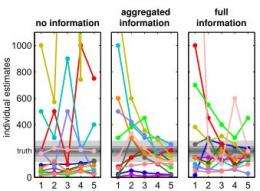
Social influence effect: Social influence diminishes group diversity without diminishing the collective error. Typical examples of experimental sessions for three information conditions, displaying five individual responses. Image (c) PNAS, doi: 10.1073/pnas.1008636108

(PhysOrg.com) -- A statistical phenomenon, called the Wisdom of Crowds, happens when a group of individuals make guesses and the average of the guesses reveal accurate average answers. However, researchers have discovered that when the individuals are made aware of other participant’s guesses, there is a clear disruption to the accuracy of the guesses.

The study, led by mathematician Jan Lorenz and sociologist Heiko Rahut from Switzerland's ETH Zurich published their recent findings in Proceedings of the National Academy of Sciences, showing that even a small amount of social influence on a group can interfere with the Wisdom of Crowd effect.

For the study, researchers brought in 144 students and placed them in isolated locations and asked them to guess things like how many crimes were committed in 2006 and what the population density of Switzerland was. Based on the accuracy of their answers, participants were given a small monetary award and then the process was repeated for a total of four rounds. The students were broken up into two groups, with one group receiving information on what other had guessed and the other remaining isolated.

As each round continued, the group with no influence by other peers showed their results becoming more accurate. The individuals that received information on what their peers were guessing however showed less accuracy in their answers.

Researchers found that those receiving social input from their peers either led individuals to second guess themselves or, seeing others may have answered the same, become more confident in their incorrect responses. According to the results of the study, the of Groups appears to only be accurate when the in the group are not aware or influenced by others in the .

More information: How social influence can undermine the wisdom of crowd effect, PNAS, Published online before print May 16, 2011, doi: 10.1073/pnas.1008636108

Abstract
Social groups can be remarkably smart and knowledgeable when their averaged judgements are compared with the judgements of individuals. Already Galton [Galton F (1907) Nature 75:7] found evidence that the median estimate of a group can be more accurate than estimates of experts. This wisdom of crowd effect was recently supported by examples from stock markets, political elections, and quiz shows [Surowiecki J (2004) The Wisdom of Crowds]. In contrast, we demonstrate by experimental evidence (N = 144) that even mild social influence can undermine the wisdom of crowd effect in simple estimation tasks. In the experiment, subjects could reconsider their response to factual questions after having received average or full information of the responses of other subjects. We compare subjects’ convergence of estimates and improvements in accuracy over five consecutive estimation periods with a control condition, in which no information about others’ responses was provided. Although groups are initially “wise,” knowledge about estimates of others narrows the diversity of opinions to such an extent that it undermines the wisdom of crowd effect in three different ways. The “social influence effect” diminishes the diversity of the crowd without improvements of its collective error. The “range reduction effect” moves the position of the truth to peripheral regions of the range of estimates so that the crowd becomes less reliable in providing expertise for external observers. The “confidence effect” boosts individuals’ confidence after convergence of their estimates despite lack of improved accuracy. Examples of the revealed mechanism range from misled elites to the recent global financial crisis.

© 2010 PhysOrg.com

4.8 /5 (10 votes)  

Filter


Move the slider to adjust rank threshold, so that you can hide some of the comments.


Display comments: newest first

bbbeard
May 17, 2011

Rank: 5 / 5 (7)
I think this is an argument for forbidding news organizations from revealing election polling data -- even official state-by-state results -- until the polls close everywhere. It has long been common understanding that balloting results on the West Coast are affected by earlier results on the East Coast.
dogbert
May 17, 2011

Rank: 5 / 5 (1)
There are many valid arguments for restricting information about national elections until all the polls close. This is a compelling argument too.

Unfortunately, freedom of the press makes it very difficult to restrict information.
Jotaf
May 17, 2011

Rank: 5 / 5 (3)
This seems like a heavy blow to the idea of markets as good predictors :) In my opinion, most of the "good predictions" you see in markets today are nothing more than self-fulfilling prophecies: *of course* that company failed after every shareholder thought it would fail and started to sell.
kaasinees
May 17, 2011

Rank: 5 / 5 (2)
Unfortunately, freedom of the press makes it very difficult to restrict information.


Don't give it to the press until the counting is done, simple.
dogbert
May 17, 2011

Rank: 5 / 5 (1)
Don't give it to the press until the counting is done, simple.


Not simple. How do you prevent New Jersey (or any other state in the eastern time zone) from publishing their election results as soon as they have been counted?

How do you prevent the news media from doing exit polls and predicting the results before the ballots are counted?

kaasinees
May 17, 2011

Rank: 5 / 5 (1)
Not simple. How do you prevent New Jersey (or any other state in the eastern time zone) from publishing their election results as soon as they have been counted?

By not giving the numbers until every one is done counting...
Or rather yet, don't allow counting until the voting time is over, like they do here.
How do you prevent the news media from doing exit polls and predicting the results before the ballots are counted?

They will have to state that it is an unofficial estimate, otherwise it would be fraud.
RobertKarlStonjek
May 17, 2011

Rank: not rated yet
It's said that the easiest person in the world to fool is yourself...but in reality, the others aren't far behind...(especially true of students)
dogbert
May 18, 2011

Rank: not rated yet
Not simple. How do you prevent New Jersey (or any other state in the eastern time zone) from publishing their election results as soon as they have been counted?


By not giving the numbers until every one is done counting...
Or rather yet, don't allow counting until the voting time is over, like they do here.


I don't know where "here" is, but in the U.S., there are legal impediments to the imposition of such arbitrary controls.
How do you prevent the news media from doing exit polls and predicting the results before the ballots are counted?


They will have to state that it is an unofficial estimate, otherwise it would be fraud.


They do state that it is an estimation and yet the media projections have a significant effect on voting in the areas where the polls are still open.
Rank 4.8 /5 (10 votes)
Relevant PhysicsForums posts
  • Consumption rivalry
    createdMay 25, 2012
  • Bilateral trade between all countries
    createdMay 24, 2012
  • Is the economic foundation of social media in jeopardy?
    createdMay 20, 2012
  • Psychology: Rosenthal and Hawthorne Effect
    createdMay 15, 2012
  • Is GDP and National Income the Same Thing?
    createdMay 13, 2012
  • Difference between hourly wage and real GDP per hour worked?
    createdMay 12, 2012
  • More from Physics Forums - Social Sciences

More news stories

Social welfare cuts ultimately come with heavy price, researchers say

(Phys.org) -- Slashing government funding for Medicaid, food stamps and other programs that serve the poor – while politically popular with some lawmakers and many conservatives – may do more harm ...

Other Sciences / Social Sciences

created May 24, 2012 | popularity 4.3 / 5 (16) | comments 133

Ancient Bethlehem seal unearthed in Jerusalem

Israeli archaeologists have discovered a 2,700-year-old seal that bears the inscription "Bethlehem," the Israel Antiquities Authority announced Wednesday, in what experts believe to be the oldest artifact ...

Other Sciences / Archaeology & Fossils

created May 23, 2012 | popularity 3.5 / 5 (14) | comments 23

Oldest Jewish archaeological evidence on the Iberian Peninsula

German archaeologists of the Friedrich Schiller University Jena found one of the oldest archaeological evidence so far of Jewish Culture on the Iberian Peninsula at an excavation site in the south of Portugal, ...

Other Sciences / Archaeology & Fossils

created May 25, 2012 | popularity 4.3 / 5 (4) | comments 12

Dollars and sense: Why are some people morally against tax?

As the U.S. presidential election campaigns heat up, the economic debate is dominated by bailouts, austerity and, inevitably, taxation. Now a new study published in Symbolic Interaction asks why tax is such an important issue ...

Other Sciences / Social Sciences

created May 23, 2012 | popularity 3 / 5 (2) | comments 12

Oldest art even older

New dates from Geißenklösterle Cave in Southwest Germany document the early arrival of modern humans and early appearance of art and music.

Other Sciences / Archaeology & Fossils

created May 24, 2012 | popularity 4.3 / 5 (3) | comments 6


Nvidia trumpets Tegra 3 phone design wins for 2012

(Phys.org) -- Nvidia’s competitive war paint has a name, Tegra 3. On the heels of Nvidia announcements about lowering costs of its Tegra 3 processors and Nvidia-enabled tablets running Android Ice Cream ...

Browser wars flare in mobile space

The browser wars are heating up again, but this time the fight is for dominance of the mobile Internet.

Scientist: Evolution debate will soon be history

(AP) -- Richard Leakey predicts skepticism over evolution will soon be history. Not that the avowed atheist has any doubts himself.

Dell tablet leak: 10.1-inch display, two-battery choice

(Phys.org) -- Headline after headline talks about vendors’ tablets in the wings as likely number-one contenders for the iPad. Such claims have justifiably been taken with a grain of salt, considering ...

Keep food safety in mind this memorial day weekend

(HealthDay) -- Picnics, parades and cookouts are as much a part of Memorial Day weekend as tributes to the United States' war veterans.

Is a classical electrodynamics law incompatible with special relativity?

(Phys.org) -- The laws of classical electromagnetism that were developed in the 19th century are the same laws that scientists use today. They include Maxwell’s four equations along with the Lorentz la ...