West coast radar network is world's largest
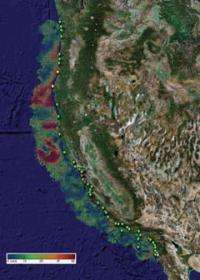
A network of high-frequency radar systems designed for mapping ocean surface currents now provides detail of coastal ocean dynamics along the U.S. West Coast never before available.
The network has grown over the last decade from a few radars to what is now considered the largest network of its kind in the world consisting of 78 sites in operation as of May 1.
In a recent paper in the American Geophysical Union publication Journal of Geophysical Research - Oceans highlighted in today's issue of the AGU publication Eos, an integrated analysis led by Sung Yong Kim, a postdoctoral researcher at Scripps Institution of Oceanography, UC San Diego, reports several scientific aspects of coastal surface circulation derived from the West Coast high-frequency radar network, operated by a team of oceanographers.
The researchers performed a multi-year synthesis of surface current observations, provided through a centralized data center designed and operated by Scripps in support of the U.S. Integrated Ocean Observing System, led by NOAA. Scientists have known for years that ocean currents at the ocean's surface are governed by a complex combination of factors including coastal tides, winds, Earth's rotation, synoptic ocean signals, and interactions of these forces, but the relative contributions of these drivers are very location specific and difficult to predict. With an ability to retrieve data on kilometer-scale currents out to approximately 150 kilometers (90 miles) offshore and 2,500 kilometers (1,500 miles) of shoreline, the researchers report on how the network allows the determination of geographic differences of these dynamics and illustrate how the system is able to characterize phenomena such as the seasonal transition of alongshore surface circulation, eddies less than 70 kilometers (43 miles) in diameter and coastal trapped waves.
"This radar network provides the detailed coastal surface circulation and ocean dynamics at a resolution - kilometers in space and hourly in time - never before resolved," said Kim.
More remarkable, said report authors, is that the "network of networks" expanded through the oceanographic community through disparate funding from multiple agencies. The state of California and NOAA lead funding for the network, but National Science Foundation, Bureau of Ocean Energy Management, Regulation and Enforcement and Office of Naval Research have all contributed to the researchers efforts in the past decade.
"We applaud the leadership of the West Coast oceanographic community in establishing this network which serves national interests in monitoring U.S. coastal waters," said Dave Kennedy, assistant administrator for NOAA's National Ocean Service. "The scientists have demonstrated that first-class science will result from maintaining long term observations, while the real-time data capability will contribute to keeping our coastlines safe. It is a great example of a state/ federal partnership for establishing the
country's capacity in monitoring our ocean."
Scientists contributing to the report include Burt Jones from USC; Libe Washburn from UC Santa Barbara; Mark Moline from Cal Poly, San Luis Obispo; Jeffrey Paduan from the Naval Postgraduate School in Monterey, Calif.; Newell Garfield from San Francisco State University; John Largier from UC Davis-Bodega Marine Laboratory; Greg Crawford from Humboldt State University (now at Vancouver Island University in Canada); Michael Kosro from Oregon State University, and Scripps oceanographers Eric Terrill and Bruce Cornuelle.
"This work illustrates the collaborative nature of the West Coast oceanographic community in establishing a scientific facility that is now beginning to pay dividends in increasing our knowledge about how our coastline interacts with the ocean," said Terrill, director of the Coastal Observing Research and Development Center at Scripps, who led the installation of radars in Southern California and whose group manages the data from all the radars. "In addition to the science gleaned from the network, the real-time data is increasingly being relied upon for marine operations including oil spill response, search and rescue, and maritime transportation. As the network persists, it is bound to become a key component in long-term monitoring of our coastal waters to understand how climate changes influence biological systems."
The researchers envision the network will continue to provide valuable real-time monitoring of the West Coast as well as provide long-term, high-quality records of ocean climate signals.
Provided by University of California - San Diego


