Standing up to fight: Does it explain why we walk upright, why women like tall men?
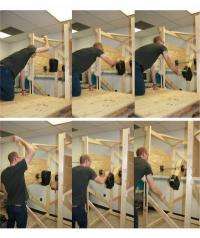
These two photo sequences depict a key part of a University of Utah experiment that showed why there is a fighting advantage to walking on two legs and being tall -- something that may help explain why ape-like human ancestors started walking upright and why women today tend to prefer tall men. In the top three photos, a participant in the study kneels with four limbs on the ground and then raises one arm to strike downward on a padded block equipped with sensors to measure the force of the blow. The bottom three photos show the same experiment, but with the blow delivered from an upright position. The study found that blows delivered downward from a two-legged posture are more powerful than downward blows from an all-fours posture, or than any blows delivered upward, from the front or sideways. Photo credit: David Carrier, University of Utah
(PhysOrg.com) -- A University of Utah study shows that men hit harder when they stand on two legs than when they are on all fours, and when hitting downward rather than upward, giving tall, upright males a fighting advantage.
This may help explain why our ape-like human ancestors began walking upright and why women tend to prefer tall men.
"The results of this study are consistent with the hypothesis that our ancestors adopted bipedal posture so that males would be better at beating and killing each other when competing for females," says David Carrier, a biology professor who conducted the study. "Standing up on their hind legs allowed our ancestors to fight with the strength of their forelimbs, making punching much more dangerous."
"It also provides a functional explanation for why women find tall men attractive," Carrier adds. "Early in human evolution, an enhanced capacity to strike downward on an opponent may have given tall males a greater capacity to compete for mates and to defend their resources and offspring. If this were true, females who chose to mate with tall males would have had greater fitness for survival."
Carrier's new study is being published Wednesday, May 18 in the online Public Library of Science journal PLoS ONE.
The idea is not new that fighting and violence played a role in making human ancestors shift from walking on all fours to walking on two legs. But Carrier's new study physically demonstrates the advantage of fighting from an upright, two-legged posture.
Carrier measured the force of punches by male boxers and martial arts practitioners as they hit in four different directions: forward, sideways, down and up.
A punching bag fitted with a sensor measured the force of forward and sideways punches. For strikes downward and upward, the men struck a heavy padded block on the end of a lever that swung up and down because it was suspended from an axle.
In either case, the men struck the target as hard as they could both from a standing posture and on their hands and knees.
The findings: for all punching angles, men hit with far more force when they were standing, and from both postures they could hit over twice as hard downward as upward.
Humans: Two-Legged Punching Apes?
The transition from four-legged to two-legged posture is a defining point in human evolution, yet the reason for the shift is still under debate. Darwin thought that our ancestors stood up so they could handle tools and weapons. Later scientists have suggested that bipedalism evolved for a host of other reasons, including carrying food, dissipating heat, efficient running and reaching distant branches while foraging in trees.
"Others pointed out that great apes often fight and threaten to fight from bipedal posture," says Carrier. "My study provides a mechanistic explanation for why many species of mammals stand bipedally to fight."
Carrier says many scientists are reluctant to consider an idea that paints our ancestors as violent.
"Among academics there often is resistance to the reality that humans are a violent species. It's an intrinsic desire to have us be more peaceful than we are," he says.
Nevertheless, human males and their great ape cousins chimpanzees, gorillas and orangutans frequently fight each other for territory and access to females.
The most popular theories about why we became bipedal are based on locomotor advantages increases in the efficiency of walking and running. However, research shows upright posture is worse for locomotion, contrary to what Carrier initially believed.
"If you're a chimpanzee- or gorilla-type ancestor that is moving on the ground, walking bipedally has a cost," he says. "It's energetically more expensive, it's harder to speed up and slow down, and there are costs in terms of agility. In every way, going from four legs to two is a disadvantage for locomotion. So the selective advantage for becoming bipedal, whatever it was, must have been important."
Nearly all mammals, including chimps and gorillas, move on all fours when they run or cover long distances on the ground. On the other hand, all sorts of four-legged animals stand up and use their front legs to fight. They include anteaters, lions, wolves, bears, wolverines, horses, rabbits and many rodents and primates.
Carrier believes that the usefulness of quadruped forelegs as weapons is a side effect of how forelegs are used for walking and running. When an animal is running with its body positioned horizontally, the forelegs strike down at the ground. By lifting the body to a vertical posture, animals can direct that same force toward an opponent.
In addition, quadrupeds are stronger pulling back with their forelimbs than pushing forward. That translates to a powerful downward blow when they rear up on their hind legs. These advantages, which grow directly out of four-legged movement, can be used most effectively by an animal that can stand easily on two legs.
Carrier predicted that animals would hit harder with their forelegs when their bodies were held upright than when they were horizontal, and that they would hit harder downward than upward. Although it would be ideal to test these hypotheses with four-legged animals, humans should still possess the advantages that led our ancestors to stand upright, and they are more practical test subjects.
The results were exactly what Carrier expected. Men's side strikes were 64 percent harder, their forward strikes were 48 percent harder, their downward strikes were 44 percent harder, and their upward strikes were 48 percent harder when they were standing than when they were on their hands and knees. From both postures, subjects delivered 3.3 times as much force when they hit downward rather than upward.
Do Women Want Men Who Can Fight?
While Carrier's study primarily deals with the evolution of upright posture, it also may have implications for how women choose mates. Multiple studies have shown that women find tall men more attractive. Greater height is also associated with health, social dominance, symmetrical faces and intelligence in men and women. These correlations have led some scientists to suggest that women prefer tall men because height indicates "good genes" that can be passed on to offspring. Carrier believes there is more to it.
"If that were the whole story, I would expect the same to be true for men that men would be attracted to tall women. But it turns out they're not. Men are attracted to women of average height or even shorter," he says.
The alternative explanation is that tall males among our ancestors were better able to defend their resources, partners and offspring. If males can hit down harder than they can hit up, a tall male has the advantage in a fight because he can punch down to hit his opponent's most vulnerable targets.
Carrier certainly isn't saying women like physically abusive men or those who get into fights with each other. He is saying that women like tall men because tallness is a product if the evolutionary advantage held by our ancestors who began standing upright to fight.
"From the perspective of sexual selection theory, women are attracted to powerful males, not because powerful males can beat them up, but because powerful males can protect them and their children from other males," Carrier says.
"In a world of automatic weapons and guided missiles, male physical strength has little relevance to most conflicts between males," he adds. "But guns have been common weapons for less than 15 human generations. So maybe we shouldn't be surprised that modern females are still attracted to physical traits that predict how their mates would fare in a fight."
Provided by
University of Utah
-
From lemons to lemonade: Reaction uses carbon dioxide to make carbon-based semiconductor,
32 comments
-
Thioridazine kills cancer stem cells in human while avoiding toxic side-effects of conventional cancer treatments,
3 comments
-
SpaceX private rocket blasts off for space station (Update),
42 comments
-
Climate scientists say they have solved riddle of rising sea,
31 comments
-
Research team claims to have found evidence Lake Cheko is impact crater for Tunguska Event,
18 comments
-
What would stain as translucent on light-coloured fabric?
13 hours ago
-
How do I identify different bacteria on culture plates?
23 hours ago
-
Why Do Dogs do Strange things...
May 25, 2012
-
What does exophillic and endophillic mean in terms of mosquito and their control?
May 24, 2012
-
Semen stains glows under black lights (uv light)?
May 23, 2012
-
Question on Human Chromosome 2
May 23, 2012
- More from Physics Forums - Biology
More news stories
Scientist: Evolution debate will soon be history
(AP) -- Richard Leakey predicts skepticism over evolution will soon be history. Not that the avowed atheist has any doubts himself.
12 hours ago |
3.5 / 5 (11) |
30
Thousands of shellfish found dead in Peru
Thousands of crustaceans were found dead off the coast of Lima following the mystery mass death of dolphins and pelicans, the Peruvian Navy said Friday.
22 hours ago |
4.8 / 5 (4) |
7
More plant species responding to global warming than previously thought
(Phys.org) -- Far more wild plant species may be responding to global warming than previous large-scale estimates have suggested.
May 22, 2012 |
4.6 / 5 (14) |
18
|
For monogamous sparrows, it doesn't pay to stray (but they do it anyway)
It's quite common for a female song sparrow to stray from her breeding partner and mate with the male next door, but a new study shows that sleeping around can be costly.
May 22, 2012 |
5 / 5 (1) |
7
|
Study uncovers secret to speedy burrowing by razor clams
(Phys.org) -- If you look at a razor burrowing clam sitting in a bucket, youd never guess that it could burrow itself down into the soil, much less do it with any speed. Razor clams look like fat straws, ...
Browser wars flare in mobile space
The browser wars are heating up again, but this time the fight is for dominance of the mobile Internet.
Nvidia trumpets Tegra 3 phone design wins for 2012
(Phys.org) -- Nvidias competitive war paint has a name, Tegra 3. On the heels of Nvidia announcements about lowering costs of its Tegra 3 processors and Nvidia-enabled tablets running Android Ice Cream ...
Dell tablet leak: 10.1-inch display, two-battery choice
(Phys.org) -- Headline after headline talks about vendors tablets in the wings as likely number-one contenders for the iPad. Such claims have justifiably been taken with a grain of salt, considering ...
SpotterRF debuts Radar Backpack Kit (w/ Video)
(Phys.org) -- SpotterRF has announced a special radar backpack kit designed to enhance situational awareness for soldiers on the ground. The company says its special radar is designed for warfighters as part ...
SpaceX capsule has 'new car' smell, astronauts say (Update)
SpaceX's Dragon cargo vessel smells like a new car, said astronauts at the International Space Station after opening the hatches Saturday following the spacecraft's landmark mission to the orbiting lab.
Australia hails surprise super-telescope decision
Australia has hailed a surprise decision giving it a role in a radio telescope project aimed at revolutionising astronomy, vowing to draw on its decades of experience in space science.
May 18, 2011
Rank: 3.8 / 5 (5)
You people are absolutely ignorant.
Any person who has even so much as heard of boxing, wrestling, or mixed martial arts would already know this.
Certainly any person who has ever actually been in a fight or a sparring match could have told you this as well.
Depending on the exact height of an individual, the ideal stance for maximum power in a punch is feet shoulder width apart in both dimensions, give or take a few inches.
This is not an "accident" nor an "evolution". The human body was designed for the upright position.
By comparison, a horse can kick the living hell out of you from a horizontal position.
Moreover, if a human is doing punches or hammerfist strikes downward they add their weight to the force of their muscles, which increases the power of the blow.
This is introductory martial arts. You don't get past white belt without knowing this "baby stuff".
Educated morons.
May 18, 2011
Rank: 2.7 / 5 (3)
100 pct correct!
May 18, 2011
Rank: 2 / 5 (3)
May 18, 2011
Rank: 4 / 5 (5)
Wrong. Human beings are cursorial hunters well adapted to running upright. Few animals are our equal in this. Human beings can run a horse to the ground.
May 18, 2011
Rank: 5 / 5 (3)
1.) Which came first, walking upright or boxing/martial arts?
2.)The horse kick: yes a horse can kick the piss out of something horizontally, but it can also rear up and trample something with its front hooves. Which impact carries more force? Good possibility that the outcome would defend this article.
3.) I bow to your better understanding but it would seem reasonable that for fights between laymen overwhelming force trumps any kind of amateurish form.
Also, using only humans in this experiment skews the results as humans have gone through life upright, it is the only stance most of them can understand or conceive. To suddenly force them to go to all fours and count their strikes as equal to upright ones doesn't seem experimentally sound. It's like giving an archer a gun and a sniper a bow and expecting them to be as competent as the other person was with their weapon of choice.
That's all I got right now.
May 18, 2011
Rank: 1 / 5 (1)
If I strike you with an upwards elbow under the jaw, it is going to do more damage than a downwards elbow on the skull. A side-on hook attack would do even more damage than either, because it would lever the jaw, and the worst direction for the brain to receive G's is sideways on, or torsion, where the two halves of the brain will be separated and then squished. This is why hitting to the jaw with a hook is known as hitting "the button" in fighting.
I also have to wonder why you hardly ever see downwards blows when you see two average guys fight. It's usually instinctive swinging hooks from side-on from what I've seen.
May 18, 2011
Rank: not rated yet
It really depends. Different unskilled fighters have different unskilled forms.
To tell the truth, almost every "unskilled" street fight or school yard fight I ever witnessed consisted of both parties throwning unskilled hammerfist strikes and maybe some hooks.
Sometimes focused intent is more important than marginal skill advantages, especially when neither fighter is particularly skilled anyway.
In Boxing, hammerfist strikes are banned because they are unnecessarily damaging.
Actually, the overhand "haymaker" hammerfist is statistically one of the more common unskilled attacks which martial artists train their students against. However, it is easily thwarted by a moderately skilled outside overhead circle block, which gives the skilled defender a natural advantage, and sets up an arm bar into a rear naked choke. With an inside overhead circle block it sets up your choice of a chop to an unprotected throat, or an instant kill reverse neck breaker.
May 18, 2011
Rank: 5 / 5 (1)
But take a short victim and have a taller man approach from behind. There are too many choices to enumerate here of attacks which give the attacker an overwhelming advantage. Switch roles, and without a sharp implement, the short attacker has no easy approach. (Yeah, a martial arts expert would try a leg sweep. If you have a sharp implement and if the taller man is bending forward at the neck there is a killing blow, if you know what you are doing.)
Second, on standing upright. Ever gone hiking in the mountains? Even a novice will pick out a walking stick and use it. It allows you to use your upper body strength when climbing. Of course, such a stick has other advantages to. But it is very hard to carry on all fours. ;-)
May 18, 2011
Rank: not rated yet
It's banned in boxing. However, in boxing the counter to the hammerfist, being the circle block, is also banned, as circle blocks are considered "grappling" or "trap boxing". In boxing you are not supposed to "re-direct" an attack, you can only "block".
In Mixed Martial Arts it's a low percentage strike but with high potential damage, and therefore only normally used when you already havea natural advantage, such as mounting someone on the floor, or the other person is already off balance from a previous combo, etc.
Most real street fights go to the ground within 10 to 15 seconds anyway, that is if someone isn't already knocked out by the first few strikes, because what happens is someone loses their balance, and in desperation does the best possible thing in that situation, which is to pull the other person down with them, evening the odds again.
May 18, 2011
Rank: 5 / 5 (1)
May 18, 2011
Rank: 1 / 5 (2)
This is where I certainly differ from anything in this article.
"Evolution" has nothing to do with it.
The human form and human intelligence is already having a high degree of freedom in terms of functionality and problem solving both physically and mentally.
There is little to no reason or benefit for the human form to change, since humans can make tools and change their environment.
Due to farming, we must neither run from predators nor chase prey. Even hunter/gatherers, such as some native American tribes, did not "chase" prey. They hunted by tracking, pattern recognition, strategy, and etc.
Due to shelter, all but the most extreme weather and disasters are but minimal influences on our lives.
These two facts have been mostly constant throughout human existence.
May 19, 2011
Rank: not rated yet
May 19, 2011
Rank: 5 / 5 (2)
Most horses are quite a bit faster than most humans. Most quadrupeds bigger than a cat are faster than humans.
The amazing long distance running ability of humans comes from our ability to sweat, not bipedality. Animals with fur overheat and have to stop to cool down. Humans are very efficient at cooling themselves. Try to run a marathon in a fur coat!
May 19, 2011
Rank: not rated yet
It is certainly more than the ability to sweat. Horses sweat and dogs are our equal in long distance running. Dogs have a lot of fur and do not sweat well.
May 19, 2011
Rank: 1 / 5 (1)
There is none, yet we do it every day...
May 20, 2011
Rank: not rated yet
Patently false, walking bipedally uses about half the energy as quadruped walking.
May 20, 2011
Rank: not rated yet
It's true other animals than humans sweat also. Horses and many other are not very efficient at sweating because of the fur. It slows down the evaporation of water from the skin. Dogs are good at evaporating water through their tongue and breathing. Human sized animals have more skin/volume than horse sized animals, which is also an advantage for us.
May 22, 2011
Rank: not rated yet
Do you have any proof of that? I'd be interested in reading a study about it.
May 22, 2011
Rank: 1 / 5 (2)
I ask because this seems contradictory to the fact that humans are the least sexually size dimorphic species of the great apes.
http://web.missou...s/sd.htm
Note: The above reference includes gibbons which are considered "lesser apes" and are the least sexually size dimorphic of all the apes.
http://en.wikiped...i/Gibbon
May 22, 2011
Rank: 1 / 5 (1)
Once you are bipedal, you can get good at it, but there's an entry cost so you can't explain going bipedal simply by its efficiency. It doesn't save you anything immediately.
Hence there's all these "water ape" theories that try to find other use for walking on two legs before it starts to consume less energy - like wading in shallow water.
May 22, 2011
Rank: 5 / 5 (1)
http://en.wikiped..._note-31
http://www.anthro...ism1.pdf
Five minutes on google...
May 23, 2011
Rank: not rated yet
May 23, 2011
Rank: not rated yet
Only if the processes which result in diversity are expected to be goal oriented.
Note also that a lot of animals are bipedal. Birds, kangaroos, gerbils for example.
May 23, 2011
Rank: not rated yet
Hmm.. The wiki article doesn't seem to adress the topic particularly(from an admittedly quick skim).
The second article gives your statement only slim support, in that it does seem to show human bipedalism as more efficient at walking speeds than chimpanzee locomotion, while apparently conceding that non-homonoid quadrapedalism is generally at least equally efficient...
Probably, the truth will be a mixture of small advantages accruing. The freeing of the hands, an increase in energy utilisation, elevation of the eyes allowing a better view of the surroundings, all conferring some statistical boost to survival...
May 23, 2011
Rank: 5 / 5 (1)
It wasn't supposed to, I pointed to you at the sources at the end of the article 32, and 33 if I remember correctly.
No the conclusion of the article is that bipedal walking bestowed and energy advantage to hominids. Re-read it. I got excellent marks in kinesiology and bio-mechanics in college. This is elementary stuff and has been known for a long time. If I can find a medical journal article I'll provide it if you promise to buy it and read it.
May 23, 2011
Rank: not rated yet
It's an interestign article. Their approach of comparing efficiency within the hominid branch makes good sense; much more useful in terms of figuring out evolutionary advantage than comparing human gait to, say, that of an ungulate.
And apologies but I shan't promise to buy the journal; while I find the topic to be an interesting one, I don't find it quite that engrossing! :)
May 24, 2011
Rank: not rated yet
Jun 14, 2011
Rank: not rated yet
To bring your fist high and strike down is to expose you chest and lower body. Not recommended against any thing with horn.
For early hunters, the firm spear thrust will be slightly up with planted feet. A down thrust is only effective on small games. On large animal the weight of the human body counts for nothing, remember that our ancesters were smaller than us. Against bear, boar, elephant(mesodon) and larger animals, we need the charge of the animal to bring home the killing thrust with the spear butt planted.
A throwing spear would benefit from the body height. But with introduction of the bow, this advantage is minimal.
The research should consult expert hunters from Africa and New Guinea.