Turtle embryos move to bask in the sun

May 25, 2011 by Deborah Braconnier report

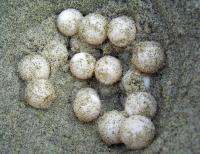
turtle eggs

Turtle eggs. Image credit: naturescrusaders

(PhysOrg.com) -- Turtles, like the majority of reptiles, are unable to regulate their own body heat and use their environment to control their temperature. In order to stay warm, reptiles will bask in this sun. Researchers believed that this was a learned behavior, however, in a journal published in the Proceedings of the National Academy of Sciences, Wei-Guo Du from the Chinese Academy of Sciences have found that this basking behavior starts while the turtle is still in the egg.

Du collected 260 Chinese soft shelled turtle (Pelodiscus sinensis) eggs from local turtle farms and placed them in jars and warmed them with a heat lamp. The side of the egg where the heat lamp was placed created a temperature increase of one degree Celsius. With a combination of candling (the use of light through a shell to see the embryo) and a partial removal of , Du discovered that the seemed to sense this and moved to the side of the egg closest to the heat. When the light was moved, the embryos would follow to the warmer side.

In another, more natural experiment, Du used 540 eggs and buried them in natural nest settings like a sloping river bank or a flat field. When the eggs were placed into the nests, he arranged them so that the embryos were in the uppermost part of the egg. After about 20 days, the embryos which had been buried on the slop had moved to toward the bank while those in the flat field, which had the sun shining from directly overhead, had stayed in the same position.

This ability to move and control their temperature can be a big difference for the young turtle. A change in temperature for the turtle embryo by only one degree Celsius can mean it will hatch 4.5 days sooner and reduce their risk of becoming a meal for egg predators. This ability to determine their path also raises an interesting question which Du plans to research. For many reptiles, the sex is determined by the they were incubated in. Those in the 22.5 - 27 degree range are usually male while those at 30 degrees are usually female. The question is, are these turtle embryos then able to determine if they are going to be a boy or a girl?

More information: Behavioral thermoregulation by turtle embryos, PNAS, Published online before print May 23, 2011, doi: 10.1073/pnas.1102965108

Abstract
Mobile ectothermic animals can control their body temperatures by selecting specific thermal conditions in the environment, but embryos—trapped within an immobile egg and lacking locomotor structures—have been assumed to lack that ability. Falsifying that assumption, our experimental studies show that even early stage turtle embryos move within the egg to exploit small-scale spatial thermal heterogeneity. Behavioral thermoregulation is not restricted to posthatching life and instead may be an important tactic in every life-history stage.

© 2010 PhysOrg.com

Filter


Move the slider to adjust rank threshold, so that you can hide some of the comments.


Display comments: newest first

stealthc
May 25, 2011

Rank: not rated yet
I would say that question is moot, the answer is yes, if the eggs move on their own as described here then it's definitely probable that an embryo will ideally move into a 30 C incubation zone. Anyways, that question is dumb, maybe captain obvious can answer it.
Rank not rated yet
Relevant PhysicsForums posts

More news stories

Scientist: Evolution debate will soon be history

(AP) -- Richard Leakey predicts skepticism over evolution will soon be history. Not that the avowed atheist has any doubts himself.

Biology / Evolution

created 12 hours ago | popularity 3.5 / 5 (11) | comments 30

Thousands of shellfish found dead in Peru

Thousands of crustaceans were found dead off the coast of Lima following the mystery mass death of dolphins and pelicans, the Peruvian Navy said Friday.

Biology / Ecology

created 22 hours ago | popularity 4.8 / 5 (4) | comments 7

More plant species responding to global warming than previously thought

(Phys.org) -- Far more wild plant species may be responding to global warming than previous large-scale estimates have suggested.

Biology / Ecology

created May 22, 2012 | popularity 4.6 / 5 (14) | comments 18 | with audio podcast

For monogamous sparrows, it doesn't pay to stray (but they do it anyway)

It's quite common for a female song sparrow to stray from her breeding partner and mate with the male next door, but a new study shows that sleeping around can be costly.

Biology / Plants & Animals

created May 22, 2012 | popularity 5 / 5 (1) | comments 7 | with audio podcast

Study uncovers secret to speedy burrowing by razor clams

(Phys.org) -- If you look at a razor burrowing clam sitting in a bucket, you’d never guess that it could burrow itself down into the soil, much less do it with any speed. Razor clams look like fat straws, ...

Biology / Plants & Animals

created May 25, 2012 | popularity 1 / 5 (1) | comments 3 | with audio podcast report


Browser wars flare in mobile space

The browser wars are heating up again, but this time the fight is for dominance of the mobile Internet.

Nvidia trumpets Tegra 3 phone design wins for 2012

(Phys.org) -- Nvidia’s competitive war paint has a name, Tegra 3. On the heels of Nvidia announcements about lowering costs of its Tegra 3 processors and Nvidia-enabled tablets running Android Ice Cream ...

Dell tablet leak: 10.1-inch display, two-battery choice

(Phys.org) -- Headline after headline talks about vendors’ tablets in the wings as likely number-one contenders for the iPad. Such claims have justifiably been taken with a grain of salt, considering ...

SpotterRF debuts Radar Backpack Kit (w/ Video)

(Phys.org) -- SpotterRF has announced a special radar backpack kit designed to enhance situational awareness for soldiers on the ground. The company says its special radar is designed for warfighters as part ...

SpaceX capsule has 'new car' smell, astronauts say (Update)

SpaceX's Dragon cargo vessel smells like a new car, said astronauts at the International Space Station after opening the hatches Saturday following the spacecraft's landmark mission to the orbiting lab.

Australia hails surprise super-telescope decision

Australia has hailed a surprise decision giving it a role in a radio telescope project aimed at revolutionising astronomy, vowing to draw on its decades of experience in space science.