Toxic toll of rat poison on birds revealed
Rats might not be everyone's cup of tea, but you might want to think twice about reaching for the rat poison next time you come across one. While rat poison is brilliant at killing rats, it also spells danger for a whole host of other creatures – especially birds of prey.
Now in the latest study, researchers have found that different birds vary hugely in their susceptibility to rat poison: a dose that kills one species might have little effect on another.
They also found that rat poison can be harmful in much smaller doses than previously thought.
Until now, scientists have struggled to say exactly how much rat poison could kill different birds of prey.
"We've known for a long time that wildlife is exposed to rat poisons, but the big question is, so what?" Explains Professor Richard Shore from the Center for Ecology & Hydrology, a member of the team involved in the study.
"The only figure we had up until this research was a 'potentially lethal range' that indicated if the amount of rat poison accumulated by a barn owl was sufficient to kill it. But the figure was always just an indicator and we didn't know if it applied to other species," he adds.
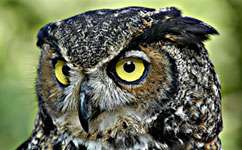
To get a better idea of how toxic rat poisons are for different birds of prey, a team of scientists led by Philippe Thomas from Environment Canada decided to analyze published data on rat poisoning in birds. They also analyzed 196 livers from great horned owls and red-tailed hawks found dead throughout Canada.
The researchers then built probability curves to figure out what percentage of the population of a given bird species might die.
"This approach gives us for the first time the potential to estimate the likelihood of mortality for individual animals and their populations," says Shore.
Using their probability curves, the scientists found that at least 11 per cent of the sampled great horned owl population in Canada is at risk of being 'directly killed by second-generation anticoagulant rodenticides (SGARs).'
They found more poison in great horned owls' livers than in red-tailed hawks' livers: almost all the owls they investigated had poisons like brodifacoum and bromadiolone in their livers, while around half the hawks' livers contained the same poisons. The difference between the two species may be down to the way the birds feed. Great horned owls get by on a much narrower diet than red-tailed hawks.
Scientists developed SGARs in the 1970s when rats started to become resistant to older so-called first generation poisons, such as warfarin. SGARs are more toxic and stay in creatures' livers for longer than earlier poisons. Rats that have eaten bait survive for several days before they die. This means they can get disorientated, stay out in the open, and become a prime target for birds of prey.
In Canada, rat poisons are only meant to be used 'indoors', but this includes just outside farms and places where food is prepared. Clearly, this is likely to increase the chance that other wildlife will be exposed.
"The original thinking was that these poisons are dangerous just to wildlife that feed on rats and house mice. But we now know that lots of predators are exposed, largely because they feed on other creatures that also eat the bait," says Shore.
"Our approach using probability curves should allow us to find out which species are most sensitive to rat poisons. We can then put mitigation measures in place that tailor the use of poisons to reduce exposure."
"We still need to control rats - they're pests and carry diseases that are dangerous to people, but we need to be careful about how we use rat poisons. It's not just how much poison people use that's important; the way it's used is crucial," he adds.
This story is republished courtesy of Planet Earth online, a free, companion website to the award-winning magazine Planet Earth published and funded by the Natural Environment Research Council (NERC).
More information: Philippe J. Thomas, et al. Second generation anticoagulant rodenticides in predatory birds: Probabilistic characterisation of toxic liver concentrations and implications for predatory bird populations in Canada, Environment International, Available online 9 April 2011, doi:10.1016/j.envint.2011.03.010
Provided by PlanetEarth Online


