Sodium channels evolved before animals' nervous systems, research shows
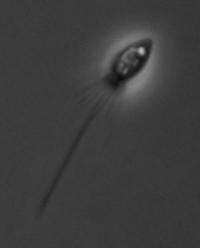
University of Texas at Austin researchers discovered the genes for sodium channels that occur in animal neurons in the single-celled choanoflagellate, Monosiga brevicollis, showing that the sodium channels evolved before neurons. Credit: Mark J. Dayel, University of California, Berkeley.
An essential component of animal nervous systemssodium channelsevolved prior to the evolution of those systems, researchers from The University of Texas at Austin have discovered.
"The first nervous systems appeared in jellyfish-like animals six hundred million years ago or so," says Harold Zakon, professor of neurobiology, "and it was thought that sodium channels evolved around that time. We have now discovered that sodium channels were around well before nervous systems evolved."
Zakon and his coauthors, Professor David Hillis and graduate student Benjamin Liebeskind, published their findings this week in PNAS.
Nervous systems and their component neuron cells were a key innovation in the evolution of animals, allowing for communication across vast distances between cells in the body and leading to sensory perception, behavior and the evolution of complex animal brains.
Sodium channels are an integral part of a neuron's complex machinery. The channels are like floodgates lodged throughout a neuron's levee-like cellular membrane. When the channels open, sodium floods through the membrane into the neuron, and this generates nerve impulses.
Zakon, Hillis and Liebeskind discovered the genes for such sodium channels hiding within an organism that isn't even made of multiple cells, much less any neurons. The single-celled organism is a choanoflagellate, and it is distantly related to multi-cellular animals such as jellyfish and humans.
The researchers then constructed evolutionary trees, or phylogenies, showing the relationship of those genes in the single-celled choanoflagellate to multi-cellular animals, including jellyfish, sponges, flies and humans.
Because the sodium channel genes were found in choanoflagellates, the scientists propose that the genes originated not only before the advent of the nervous system, but even before the evolution of multicellularity itself.
"These genes were then co-opted by the nervous systems evolving in multi-cellular animals," says Hillis, the Alfred W. Roark Centennial Professor in Natural Sciences. "This study shows how complex traits, such as the nervous system, can evolve gradually, often from parts that evolved for other purposes."
"Evolutionarily novel organs do not spring up from nowhere," adds Zakon, "but from pre-existing genes that were likely doing something else previously."
Liebeskind, a graduate student in the university's ecology, evolution and behavior program, is directing his next research efforts toward understanding what the sodium channels do in choanoflagellates.
Provided by
University of Texas at Austin
-
From lemons to lemonade: Reaction uses carbon dioxide to make carbon-based semiconductor,
32 comments
-
Thioridazine kills cancer stem cells in human while avoiding toxic side-effects of conventional cancer treatments,
3 comments
-
SpaceX private rocket blasts off for space station (Update),
42 comments
-
Climate scientists say they have solved riddle of rising sea,
31 comments
-
Research team claims to have found evidence Lake Cheko is impact crater for Tunguska Event,
18 comments
-
What would stain as translucent on light-coloured fabric?
13 hours ago
-
How do I identify different bacteria on culture plates?
22 hours ago
-
Why Do Dogs do Strange things...
May 25, 2012
-
What does exophillic and endophillic mean in terms of mosquito and their control?
May 24, 2012
-
Semen stains glows under black lights (uv light)?
May 23, 2012
-
Question on Human Chromosome 2
May 23, 2012
- More from Physics Forums - Biology
More news stories
Scientist: Evolution debate will soon be history
(AP) -- Richard Leakey predicts skepticism over evolution will soon be history. Not that the avowed atheist has any doubts himself.
12 hours ago |
3.5 / 5 (11) |
30
Thousands of shellfish found dead in Peru
Thousands of crustaceans were found dead off the coast of Lima following the mystery mass death of dolphins and pelicans, the Peruvian Navy said Friday.
22 hours ago |
4.8 / 5 (4) |
7
More plant species responding to global warming than previously thought
(Phys.org) -- Far more wild plant species may be responding to global warming than previous large-scale estimates have suggested.
May 22, 2012 |
4.6 / 5 (14) |
18
|
For monogamous sparrows, it doesn't pay to stray (but they do it anyway)
It's quite common for a female song sparrow to stray from her breeding partner and mate with the male next door, but a new study shows that sleeping around can be costly.
May 22, 2012 |
5 / 5 (1) |
7
|
Study uncovers secret to speedy burrowing by razor clams
(Phys.org) -- If you look at a razor burrowing clam sitting in a bucket, youd never guess that it could burrow itself down into the soil, much less do it with any speed. Razor clams look like fat straws, ...
Browser wars flare in mobile space
The browser wars are heating up again, but this time the fight is for dominance of the mobile Internet.
Nvidia trumpets Tegra 3 phone design wins for 2012
(Phys.org) -- Nvidias competitive war paint has a name, Tegra 3. On the heels of Nvidia announcements about lowering costs of its Tegra 3 processors and Nvidia-enabled tablets running Android Ice Cream ...
Dell tablet leak: 10.1-inch display, two-battery choice
(Phys.org) -- Headline after headline talks about vendors tablets in the wings as likely number-one contenders for the iPad. Such claims have justifiably been taken with a grain of salt, considering ...
SpotterRF debuts Radar Backpack Kit (w/ Video)
(Phys.org) -- SpotterRF has announced a special radar backpack kit designed to enhance situational awareness for soldiers on the ground. The company says its special radar is designed for warfighters as part ...
SpaceX capsule has 'new car' smell, astronauts say (Update)
SpaceX's Dragon cargo vessel smells like a new car, said astronauts at the International Space Station after opening the hatches Saturday following the spacecraft's landmark mission to the orbiting lab.
Australia hails surprise super-telescope decision
Australia has hailed a surprise decision giving it a role in a radio telescope project aimed at revolutionising astronomy, vowing to draw on its decades of experience in space science.
May 18, 2011
Rank: not rated yet
May 19, 2011
Rank: not rated yet