Small bangs and white holes
May 23, 2011 By Steve Nerlich

Astronomy without a telescope - small bangs

Enlarge

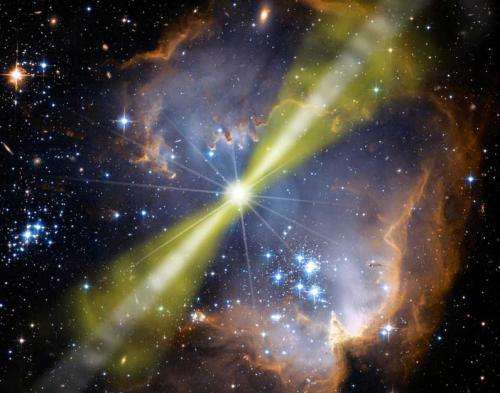
Gamma-ray bursts. We tend to think of them as big explosions - but it has been suggested that they might actually be Small Bangs. Credit: NASA.

Most gamma-ray bursts come in two flavors. Firstly, there are long duration bursts which form in dense star-forming regions and are associated with supernovae – which would understandably generate a sustained outburst of energy. The technical definition of a long duration gamma-ray burst is one that is more than two seconds in duration – but bursts lasting over a minute are not unusual.

Short duration gamma-ray bursts more often occur in regions of low star formation and are not associated with supernovae. Their duration is technically less than 2 seconds, but a duration of only a few milliseconds is not unusual. These are assumed to result from collisions between massive compact objects – perhaps neutron stars or black holes – producing a short, sharp outburst of energy.

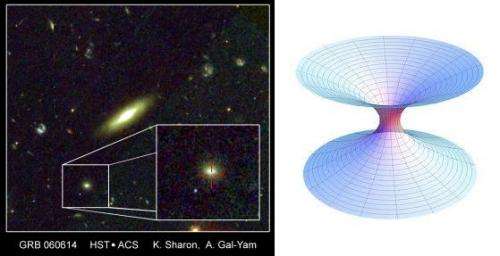
But there are also rare instances of gamma-ray bursts that don’t really fill either category. GRB 060614 is such a beast – and has been referred to as a hybrid burst. It had a long duration (102 seconds) but was not associated with a supernova. This finding was significant enough to warrant an article in Nature – with the lead author Gehrels stating "This is brand new territory; we have no theories to guide us."

We should be grateful that no-one decided to call it a dark burst. And we are yet to see another such confirmed hybrid that might verify whether these are hybrid bursts are really something extraordinary.

Nonetheless, Retter and Heller have suggested we should consider the possibility that GRB 060614 might have been a white hole. A white hole is a theoretical entity – and arguably just an artifact of the mathematics of general relativity. Assuming a black hole is an object from which nothing can escape – then its symmetrical opposite would be a white hole into which nothing can enter – but which can radiate light and from which matter can and does escape.

Arguably the whole idea just arises because general relativity abhors sharp edges. So the argument goes that the space-time continuum should ideally extend indefinitely – being curved by massive objects, but never brought to an edge. However, represent a pinch in space-time where everything is supposedly dragged into a point-like singularity. So, one solution to this problem is to suggest that a black hole is not an interruption to the continuum, but instead the space-time around a black hole is drawn into a narrow-necked funnel – essentially a wormhole – which then feeds through to a white hole somewhere else.
Small bangs and white holes
Enlarge

Left image: The mysterious hybrid gamma ray burst GRB 060614. Right image: The 'what goes in must come out' model of white holes - where a black hole is connected to a white hole - and the white hole is time-reversed so that it expels material in the past. This was an initially proposed as a solution to explain quasars in the early universe, but better explanations have come along since (e.g. supermassive black holes with jets).

Being opposites, a black hole in the present would be connected to a white hole in the past – perhaps a white hole that existed in the early universe, emitting light and matter for a period and then exploding – kind of like a film of the formation of a black hole run backwards. It’s been suggested that such white holes might have created the first anisotropies in the early isotropic universe – creating the ‘clumpiness’ that later led to galaxies and galaxy clusters.

Alternatively, the Big Bang might be seen as the ultimate white hole which expelled a huge amount of mass/energy in one go – and any subsequent white holes might then be ‘lagging cores’ or Small Bangs.

There are substantial theoretical problems with white hole physics though – for example, the matter it ejects should immediately collapse back down on itself through self-gravity – meaning it just becomes a black hole anyway, or perhaps it explodes. If the latter possibility is correct, maybe this is one possible explanation of GRB 060614 seen back in 2006. But it’s probably best to wait for another hybrid burst to appear and get some more data before getting too carried away here.

Source: Universe Today

4.4 /5 (16 votes)  

Filter


Move the slider to adjust rank threshold, so that you can hide some of the comments.


Display comments: newest first

spectator
May 23, 2011

Rank: 3 / 5 (4)
There are substantial theoretical problems with white hole physics though for example, the matter it ejects should immediately collapse back down on itself through self-gravity meaning it just becomes a black hole anyway


Gets five stars for that statement alone. First time I've seen anyone else actually mention that.

There is, of course, an exception. If all or most of the mass coming out of a white hole was in the form of energy as EM radiation, then the energy, moving presumably as gamma rays at the speed of light, could escape any given gravitational shell over substantially long time periods before enough solid "matter" accumulated in the lower shells to produce an event horizon.

So the higher percentage of a white hole's energy appears as pure EM radiation, the longer it's life time before it would collapse, and the more energy would be able to totally escape.

If all of the escaping energy was as 100% EM radiation, then there would never be a gravity well.
spectator
May 23, 2011

Rank: 2.5 / 5 (2)
One of the problems with the physical theoretical explaination above is that it creates a partial time loop, in which some events in the past are partially influenced by the future, and potentially even events outside their own light horizons.

The result of this is that some events, as seen from inside the system, would appear to have no rational or logical relationship, and LOCALLY, conservation laws would not be maintained.

For example, if a small white hole tied to a small black hole of several quadrillion kg mass had formed in the core of a planet, it would heat the planet substantially through pure gamma radiation, but an observer would initially not be able to tell whether the heat was coming from an ordinary nuclear process from an abnormally high radio isotope concentration, or whether some other process was at work. The only way to tell the difference would require extremely long time scales to prove the nuclear energy should have dissipated.
spectator
May 23, 2011

Rank: 2 / 5 (3)
Its been suggested that such white holes might have created the first anisotropies in the early isotropic universe creating the clumpiness that later led to galaxies and galaxy clusters.


Something more than that.

If you had a rotating super massive white hole which is old enough, you would not be able to tell the difference as compared to a supermassive black hole. Both would appear at the center of galaxies, and the white hole will have ejected enough matter over a long enough time that it would have become a black hole as well, with some of it's original ejected matter having had the fortune of having the exact angular momentum to form stable orbits, while other portions of it's ejected matter would appear as jets, or else would have been moving with such high velocity that they totally escaped the white hole before it became a black hole, and thus expanded into intergalactic space and became indistinguishable from the intergalactic medium of gas.
spectator
May 23, 2011

Rank: 2 / 5 (3)
One other paradox this would create.

If time is continuous (yet relative to the observer,) and white holes tied to any given black hole can be created at a random point in space-time determined somehow through time reverse quantum mechanics; then it would stand to reason that some white holes could be created so far back in time that they would appear "older" than the universe itself in any given reference frame, and with no logical way for an observer to prove or disprove one way or the other, whether it was a white hole galaxy formed by a time loop, or whether black hole galaxy formed by accretion.

Thus, the existence of white hole galaxies which subsequently collapsed to black hole galaxies would artificially inflate the age of the universe in a feedback mechanism, by making "new" galaxies farther and farther in the past.
spectator
May 23, 2011

Rank: 2 / 5 (3)
So that produces an "open" causality loop, which then undermines the practice of "time reversing" the universe to study it's history.

If white holes exist, then you can't tell what aspects of the past were caused by the past, or what aspects of the past were caused by the future.

The universe would still not be a closed time loop, because some of the EM radiation from any white hole would always manage to escape before the mass reached a critical state to make a "new" black hole for the same reason some radiatin escapes a collapsing star just before it becomes a black hole. Most of this radiation just ends up traveling through empty space for all eternity until it hits the light horizon.
chthonic
May 23, 2011

Rank: 5 / 5 (8)
Jeez, where's the 'neutron repulsion' guy to explain things when you need him? ^_^
LKD
May 23, 2011

Rank: 5 / 5 (2)
ephemeral,
Yes. This is right up his alley. I can't wait to read the response.
Crazy_council
May 23, 2011

Rank: 3.3 / 5 (7)

was interested untill this point

-
------Being opposites, a black hole in the present would be connected to a white hole in the past perhaps a white hole that existed in the early universe, ---------


i beleive in mechanics not magic
spectator
May 23, 2011

Rank: 5 / 5 (5)
i beleive in mechanics not magic


It's a valid, real numbers solution to general relativity.
71STARS
May 23, 2011

Rank: 1 / 5 (4)
Yes. Where is the "neutron guy" to explain it all, and where is that "Ethelred" guy that takes each point someone says and explains how wrong it is?? I thought these were the experts on the subjects of black holes, GR, and now "white holes"?
Pyle
May 24, 2011

Rank: 3.7 / 5 (6)
Nerlich's articles are awesome.

QC, while you seem to have a lot to say, you should try running your ideas by somebody before wasting all of our time here. Maybe it is just the latent anger that irritates me. Not too bad on this article though.

71: at least TRY to add something to the conversation. (So sayeth the pot.)
Mahal_Kita
May 24, 2011

Rank: 3 / 5 (4)
So that produces an "open" causality loop, which then undermines the practice of "time reversing" the universe to study it's history.

If white holes exist, then you can't tell what aspects of the past were caused by the past, or what aspects of the past were caused by the future. ..


In essence what is suggested in this article is part of my theory of the "Mobius Universe." It's time we discover what space actualy consists of.
TabulaMentis
May 24, 2011

Rank: 1 / 5 (2)
Why were they not called 'little bangs' instead of small bangs?
Rank 4.4 /5 (16 votes)
Relevant PhysicsForums posts
  • revamping general concept and cosmological principle
    createdMay 25, 2012
  • Transiting Exoplanet Light Curve
    createdMay 25, 2012
  • Math behind Theoretical Physics
    createdMay 24, 2012
  • Do we know whats at the center of galaxies yet?
    createdMay 23, 2012
  • Structure of the Milky Way?
    createdMay 20, 2012
  • What would it take to terraform Pluto and Charon?
    createdMay 19, 2012
  • More from Physics Forums - General Astronomy

More news stories

SpaceX capsule has 'new car' smell, astronauts say (Update)

SpaceX's Dragon cargo vessel smells like a new car, said astronauts at the International Space Station after opening the hatches Saturday following the spacecraft's landmark mission to the orbiting lab.

Space & Earth / Space Exploration

created 22 hours ago | popularity 4.5 / 5 (20) | comments 2

Australia hails surprise super-telescope decision

Australia has hailed a surprise decision giving it a role in a radio telescope project aimed at revolutionising astronomy, vowing to draw on its decades of experience in space science.

Space & Earth / Astronomy

created 22 hours ago | popularity 5 / 5 (4) | comments 2

Astronomers seize last chance in lifetime for Venus Transit

Astronomers are gearing for one the rarest events in the Solar System: an alignment of Earth, Venus and the Sun that will not be seen for another 105 years.

Space & Earth / Astronomy

created 22 hours ago | popularity 5 / 5 (3) | comments 2

Astronauts enter world's 1st private supply ship

(AP) -- Space station astronauts floated into the Dragon on Saturday, a day after its heralded arrival as the world's first commercial supply ship.

Space & Earth / Space Exploration

created 22 hours ago | popularity 5 / 5 (6) | comments 0

Sophisticated simulations predict future warming

The chances of our planet being hit by a global warming of 3 degrees Celsius by 2050 is as likely as it being hit by an increase of 1.4 degrees, new research shows. Presented in the journal Nature Geoscience, the British study ...

Space & Earth / Earth Sciences

created May 22, 2012 | popularity 4.4 / 5 (9) | comments 51


Browser wars flare in mobile space

The browser wars are heating up again, but this time the fight is for dominance of the mobile Internet.

Nvidia trumpets Tegra 3 phone design wins for 2012

(Phys.org) -- Nvidia’s competitive war paint has a name, Tegra 3. On the heels of Nvidia announcements about lowering costs of its Tegra 3 processors and Nvidia-enabled tablets running Android Ice Cream ...

Scientist: Evolution debate will soon be history

(AP) -- Richard Leakey predicts skepticism over evolution will soon be history. Not that the avowed atheist has any doubts himself.

Dell tablet leak: 10.1-inch display, two-battery choice

(Phys.org) -- Headline after headline talks about vendors’ tablets in the wings as likely number-one contenders for the iPad. Such claims have justifiably been taken with a grain of salt, considering ...

SpotterRF debuts Radar Backpack Kit (w/ Video)

(Phys.org) -- SpotterRF has announced a special radar backpack kit designed to enhance situational awareness for soldiers on the ground. The company says its special radar is designed for warfighters as part ...

Thousands of shellfish found dead in Peru

Thousands of crustaceans were found dead off the coast of Lima following the mystery mass death of dolphins and pelicans, the Peruvian Navy said Friday.