Salmon swim again in Czech Elbe river
May 13, 2011 by Jan Marchal
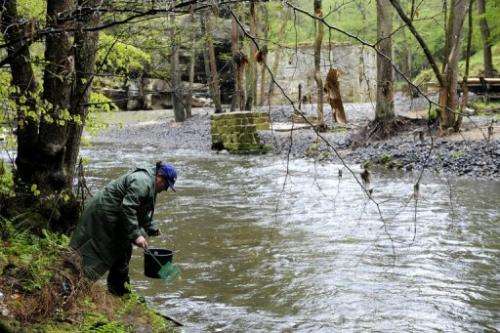
A worker of the 'Czech Switzerland' national park is pictured releasing young salmon fish into Kamenice river, near Jetrichovice village, North Bohemia. Salmon disappeared from the river after World War II as a result of massive industrial pollution.
Salmon are flashing silver again in the Elbe river and its many tributaries in the Czech Republic as the waterway slowly bounces back from four decades of communist-era pollution.
"The salmon symbolises the remarkable efforts that are needed today to put right the sins committed by our predecessors," says Tomas Salov, a wildlife manager at the "Czech Switzerland" national park.
"Today, this fish is the flagship of our reintroduction programmes," Salov told AFP in the village of Jetrichovice, tucked away in the mountains of the northern Czech Republic.
Salmon is considered a "bio-indicator" whose presence in the river suggests improved water purity.
Once abundant in the Elbe, the fish vanished from the picturesque waterway after World War II as communist-era heavy industry dumped tonnes of toxic waste into it between 1948-1989, making it a stinking sewer in some areas.
Salmon were last recorded in the Czech part of the 1,165-kilometre (724-mile)-long Elbe river in 1954.
Locals from the cosy summer resort of Hrensko near the German border recall that during communism the once crystal-clear Kamenice river, a narrow tributary of the Elbe, changed colours depending on the colour of paper produced in a factory in Ceska Kamenice, a town about 20 kilometres (12.4 miles) up-stream.
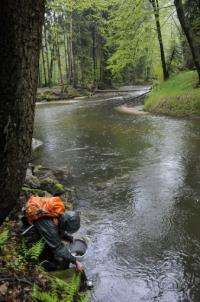
A worker of the 'Czech Switzerland' national park is pictured releasing young salmon fish into Kamenice river, near Jetrichovice village, North Bohemia. Salmon disappeared from the river after World War II as a result of massive industrial pollution.
"Today we can say that the quality of water here is good," says Pavel Benda, head of the national park, which covers an area of 79 square kilometres (30.5 square miles). It was established in 2000 as the youngest of the country's four national parks."The Kamenice was polluted by local industrial production which is no longer active. Larger towns have also received subsidies to build water treatment plants" since the demise of communism, he added.
With its sandstone rock, lush forests and picturesque rivers and brooks, the national park bordered on one side by the Elbe is a strategic spot for the reintroduction of salmon to Czech waters, Benda said.
Fish steps allowing the salmon to migrate up-river across dams were also part of the conservation programme kicked-off in 1998.
By 2006, a fisherman caught a huge salmon that measured 1.04 metres (1.13 yards) in Hrensko, but after photographing the impressive catch, he released the strictly protected fish back into the wild, in line with regulations.
According to Tomas Kava from the Czech Fishing Union, two to 10 adult salmon have been observed annually in the Czech part of the Elbe since then. Neighbouring Germany started a similar salmon repopulation project in 2002.
"The programme is aimed at stabilising the salmon population in the Czech Republic and at reintroducing the fish to rivers after almost 50 years of absence caused by human activity," says Kava.
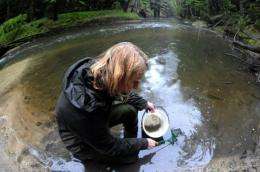
A worker of the 'Czech Switzerland' national park is pictured releasing young salmon fish into Kamenice river, near Jetrichovice village, North Bohemia. Salmon disappeared from the river after World War II as a result of massive industrial pollution.
Each May, dozens of enthusiasts carefully release salmon fry into the tiny Czech tributaries of the Elbe, a major European river."Over the years, we have released 100,000-200,000 fish fry annually," says Kava, who marvels at the epic journey salmon make during their lifetime.
After two or three years, they swim down the Elbe to the North Sea and the Atlantic Ocean, and then after several years in the open sea, those that survive return to the Elbe's sweet waters to spawn.
"Their sense of direction is unique. There are a myriad of methods they use in the sea and in rivers -- among others, salmon find their way using the earth's magnetic field and the sea's currents but also the position of stars," Kava said.
(c) 2011 AFP
-
From lemons to lemonade: Reaction uses carbon dioxide to make carbon-based semiconductor,
32 comments
-
Thioridazine kills cancer stem cells in human while avoiding toxic side-effects of conventional cancer treatments,
3 comments
-
SpaceX private rocket blasts off for space station (Update),
42 comments
-
Climate scientists say they have solved riddle of rising sea,
31 comments
-
Research team claims to have found evidence Lake Cheko is impact crater for Tunguska Event,
18 comments
-
What would stain as translucent on light-coloured fabric?
12 hours ago
-
How do I identify different bacteria on culture plates?
22 hours ago
-
Why Do Dogs do Strange things...
May 25, 2012
-
What does exophillic and endophillic mean in terms of mosquito and their control?
May 24, 2012
-
Semen stains glows under black lights (uv light)?
May 23, 2012
-
Question on Human Chromosome 2
May 23, 2012
- More from Physics Forums - Biology
More news stories
Scientist: Evolution debate will soon be history
(AP) -- Richard Leakey predicts skepticism over evolution will soon be history. Not that the avowed atheist has any doubts himself.
11 hours ago |
3.5 / 5 (11) |
29
It's in the genes: Research pinpoints how plants know when to flower
Scientists believe they've pinpointed the last crucial piece of the 80-year-old puzzle of how plants "know" when to flower.
May 25, 2012 |
3.9 / 5 (9) |
1
|
Researchers solve structure of human protein critical for silencing genes
In a study published in the journal Cell on May 24, Cold Spring Harbor Laboratory (CSHL) scientists describe the three-dimensional atomic structure of a human protein bound to a piece of RNA that "guides" the pr ...
May 25, 2012 |
4.7 / 5 (7) |
0
|
Thousands of shellfish found dead in Peru
Thousands of crustaceans were found dead off the coast of Lima following the mystery mass death of dolphins and pelicans, the Peruvian Navy said Friday.
21 hours ago |
4.8 / 5 (4) |
6
Copy of the genetic makeup travels in a protein suitcase
Scientists from the Institute for Physical and Theoretical Chemistry at the University of Bonn have succeeded for the first time in the real time filming of the transport of an important information carrier in biological ...
May 25, 2012 |
not rated yet |
0
|
Nvidia trumpets Tegra 3 phone design wins for 2012
(Phys.org) -- Nvidias competitive war paint has a name, Tegra 3. On the heels of Nvidia announcements about lowering costs of its Tegra 3 processors and Nvidia-enabled tablets running Android Ice Cream ...
Browser wars flare in mobile space
The browser wars are heating up again, but this time the fight is for dominance of the mobile Internet.
Dell tablet leak: 10.1-inch display, two-battery choice
(Phys.org) -- Headline after headline talks about vendors tablets in the wings as likely number-one contenders for the iPad. Such claims have justifiably been taken with a grain of salt, considering ...
SpaceX capsule has 'new car' smell, astronauts say (Update)
SpaceX's Dragon cargo vessel smells like a new car, said astronauts at the International Space Station after opening the hatches Saturday following the spacecraft's landmark mission to the orbiting lab.
Of mice and mental models: Neuroscientific implications of risk-optimized behavior in the mouse
(Medical Xpress) -- Regardless of an organism’s biological complexity, every encephalized animal continuously makes under-informed behavioral choices that can have serious consequences. Despite its ubiquity, ...
SpotterRF debuts Radar Backpack Kit (w/ Video)
(Phys.org) -- SpotterRF has announced a special radar backpack kit designed to enhance situational awareness for soldiers on the ground. The company says its special radar is designed for warfighters as part ...

