Oxygenation and life in the Baltic Sea
Can you bring something back from the dead? Scientists in Sweden say that if it's at the bottom of the sea and oxygenation is present, you can. Oxygenation gives ecosystems the boost they need to come to life and helps nature deal with eutrophication, the bloom of phytoplankton in water.
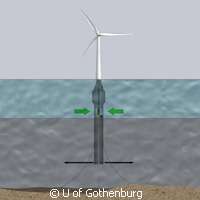
University of Gothenburg researchers carried out pilot studies in two Swedish fjords and determined that pumping oxygen-rich surface water down to the bottom of the sea gave them the results they were searching for. The team is now gearing up to test a large wind-driven pump in open water in the Baltic Sea.
'Today everyone is focused on reducing nutrient inputs to the sea in order to reduce eutrophication in the Baltic, but by helping nature itself to deal with the phosphorus that is discharged we can create a turbo effect in the battle against eutrophication,' explained Anders Stigebrandt, Professor Emeritus at the Department of Earth Sciences at the University of Gothenburg.
Oxygenating dead sea bottoms is not a novel idea. Researchers suggest that the idea of oxygenating dead sea bottoms comes from nature itself. For instance, oxygenating the deep water in the Baltic Sea is like creating wetlands on land, they say. In order for both of these methods to succeed, conditions must be created to give ecosystems what they need. And this is made possible by setting up new ecosystems that can bind the nutrients successfully.
"If oxygen-free bottoms in the Baltic are oxygenated, it can be anticipated that every square kilometre of bottom surface will be able to find 3 tonnes of phosphorus in a short time, which is a purely geochemical effect," Professor Stigebrandt said. "If the bottoms are then kept oxygenated for a prolonged period, fauna becomes established on and in the bottoms. This leads to the bottom sediments being oxygenated down to a depth of several centimetres, and the new ecosystem probably contributes to the possibility of further phosphorus being bound to the sediment."
The Baltic Deepwater Oxygenation (BOX) project, led by Professor Stigebrandt, is testing the theory that prolonged oxygenation of the Baltic deep water triggers extended and intensified binding of phosphorus in bottom sediment. What researchers want to know is how the oxygenated deep-water areas can bind phosphorus in the longer term. So they have launched pilot studies in Kanholmsfjärden on the east coast and in Byfjorden in the west coast, and conducted laboratory experiments. BOX is tackling the colonisation of oxygenated bottoms and its impact on phosphorus uptake.
For the open water test, the team will use a pump that can pump 30 cubic metres of water per second. Contained in a 60-metre high and 100-metre deep tubular buoy anchored in an open location, the pump is not affected by wave motions.
"The pump is to have [the] capacity to pump 30 cubic metres of water per second, which is 15 times more than the pump in the Byfjord experiment," Professor Stigebrandt said. "If this works, using a five times larger pump in a buoy around 120 metres deep should not pose major problems. This is the size we anticipate pumps needing to have in a future large-scale system for oxygenation of the Baltic deep water."
More information: http://www.marsys. … enation-box/
Provided by CORDIS
-
From lemons to lemonade: Reaction uses carbon dioxide to make carbon-based semiconductor,
32 comments
-
Thioridazine kills cancer stem cells in human while avoiding toxic side-effects of conventional cancer treatments,
3 comments
-
SpaceX private rocket blasts off for space station (Update),
42 comments
-
Climate scientists say they have solved riddle of rising sea,
31 comments
-
Research team claims to have found evidence Lake Cheko is impact crater for Tunguska Event,
18 comments
-
Hypothetical desert earth
7 hours ago
-
More human population = greater mass?
May 25, 2012
-
Conversion from aircraft bearing to normal degrees
May 23, 2012
-
Interpretation/Analysis of the Lab results(HEPA filter)
May 22, 2012
-
Has anyone here attended the The Urbino Summer School in Paleoclimatology?
May 22, 2012
-
Earthquakes: Mag 6 N. Italy and Mag 5.6 W. Bulgaria
May 21, 2012
- More from Physics Forums - Earth
More news stories
SpaceX capsule has 'new car' smell, astronauts say (Update)
SpaceX's Dragon cargo vessel smells like a new car, said astronauts at the International Space Station after opening the hatches Saturday following the spacecraft's landmark mission to the orbiting lab.
Space & Earth / Space Exploration
21 hours ago |
4.5 / 5 (20) |
1
Australia hails surprise super-telescope decision
Australia has hailed a surprise decision giving it a role in a radio telescope project aimed at revolutionising astronomy, vowing to draw on its decades of experience in space science.
21 hours ago |
5 / 5 (4) |
2
Astronomers seize last chance in lifetime for Venus Transit
Astronomers are gearing for one the rarest events in the Solar System: an alignment of Earth, Venus and the Sun that will not be seen for another 105 years.
21 hours ago |
5 / 5 (3) |
2
Astronauts enter world's 1st private supply ship
(AP) -- Space station astronauts floated into the Dragon on Saturday, a day after its heralded arrival as the world's first commercial supply ship.
Space & Earth / Space Exploration
21 hours ago |
5 / 5 (6) |
0
Sophisticated simulations predict future warming
The chances of our planet being hit by a global warming of 3 degrees Celsius by 2050 is as likely as it being hit by an increase of 1.4 degrees, new research shows. Presented in the journal Nature Geoscience, the British study ...
Space & Earth / Earth Sciences
May 22, 2012 |
4.4 / 5 (9) |
51
Browser wars flare in mobile space
The browser wars are heating up again, but this time the fight is for dominance of the mobile Internet.
Scientist: Evolution debate will soon be history
(AP) -- Richard Leakey predicts skepticism over evolution will soon be history. Not that the avowed atheist has any doubts himself.
Dell tablet leak: 10.1-inch display, two-battery choice
(Phys.org) -- Headline after headline talks about vendors tablets in the wings as likely number-one contenders for the iPad. Such claims have justifiably been taken with a grain of salt, considering ...
SpotterRF debuts Radar Backpack Kit (w/ Video)
(Phys.org) -- SpotterRF has announced a special radar backpack kit designed to enhance situational awareness for soldiers on the ground. The company says its special radar is designed for warfighters as part ...
Thousands of shellfish found dead in Peru
Thousands of crustaceans were found dead off the coast of Lima following the mystery mass death of dolphins and pelicans, the Peruvian Navy said Friday.
Keep food safety in mind this memorial day weekend
(HealthDay) -- Picnics, parades and cookouts are as much a part of Memorial Day weekend as tributes to the United States' war veterans.
May 17, 2011
Rank: 4 / 5 (1)
May 17, 2011
Rank: 5 / 5 (1)
The only reason i can think of is that so the bound nutrients wont be released into the air this way.
May 17, 2011
Rank: not rated yet
First what came to my mind is that probably it's easier to pump water down than air. Pressures needed to pump air into 100 meters is ten bars, or ten times atmospheric pressure. Also the air would bubble out of water, creating water flow with it, making in essence air driven water pump. One can observe this effect in aquariums that use air pump.
May 18, 2011
Rank: not rated yet
Pumping air costs less energy than a water pump for the same water flow. Plus air has more oxygen in it.
The reason i posted below was the only reason i could think off. All the bound nutrients will release into the air otherwise would allow organism to absorb them... And it would basically just pollute the air...
However i doubt there is not life in it, its just life that is "invisible" or "useless" to humans...