NASA's Spaceward Bound takes teachers trekking across the Mojave desert
What clues found on Earth do NASA scientists use to help them deduce that there may be life on other planets? Can the same process be applied in the classroom to inspire and motivate the next generation of explorers?
This spring, Spaceward Bound, a NASA education program, took teachers and education students on a high desert expedition across the dry, hot plains of the Mojave Desert. Students, teachers and scientists travelled to the Mojave National Preserve, Death Valley National Park and surrounding regions, including Cima Crater and the Kelso Dunes, March 21-25 and April 18-22. Their mission was to find microbial life that also may be found on other planets.
Developed at NASA's Ames Research Center, Moffett Field, Calif., Spaceward Bound's mission is to train the next generation of space explorers. Led by science teams from NASA and its research partners, students and teachers are given real planetary research experience by conducting field experiments at planetary analogue sites throughout the world. California State University's (CSU) Desert Studies Center, Zzyzx, Calif., served as the base camp for the 2011 expeditions.
"My experience was fantastic! After talking with scientists, working in the field and analyzing samples in the lab, I remembered why I fell in love with science," said Jan Winter, a science teacher from Stanley Middle School, Lafayette, Calif. "It also reminded me to ask my students more open-ended questions."
Teachers sometimes use "cookbook" experiments in their classrooms. By collaborating with scientists to analyze their data and formulate hypotheses after a long day of field research, teachers experienced an alternative method for teaching science. They noted significant differences between the highly structured techniques used in the classroom, and the less-structured approach of fieldwork, where results and indications from one day's work guided decisions about what to do the next day. As part of any investigation, "Students need to be told that we don't always know the 'right' answer," Winter said.
During the expedition, teachers from Las Vegas, Nev., Spaceward Bound alumni teachers and science education majors from California Polytechnic State University, and CSU's San Bernardino and San Francisco universities were taught how to evaluate microbes in the desert soil crusts, make batteries out of "dry" lake bed mud, launch instrumented high altitude balloons, remotely control rovers, and conduct other geology and soil experiments.
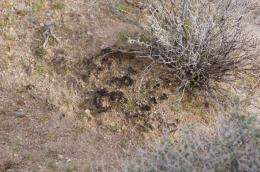
During field research, the group headed for the Kelso Dunes and Cima Dome and Lava Tubes to find and collect samples of biological soil crusts (BSC), complex communities of cyanobacteria, moss and lichen that are studied for their ability to survive extreme environments. Driving along desert plains, the expedition found samples large enough to collect without harming the viability of the colony. Their next task was to find a section of barren land and compare it to the life found in the BSC samples.
"Looking at soil crusts and hypoliths are tangible activities that can be incorporated into the school curricula," said Paula Mills, a teacher and curriculum leader from Prince Alfred College, Kent Town, South Australia. "I am currently thinking about including more Earth science in the middle school curricula. This program has enabled me to find new, exciting and real activities that students can participate in."
The desert group also travelled a rocky road to the Lava Tubes, where they observed gaps in the Earth formed by geologically "young" (approximately 10,000-15,000 years old) magma. After descending into the depths of the caves, they explored the interiors and took thermographic images as future satellites and astronauts might to identify potential habitats on other planets.
"This experience changed my view of how to teach science one hundred percent," said Leyla Morison, a science teacher from Valley High School, Las Vegas, Nev. "The most rewarding part of the experience was meeting with scientists and their crews every night after dinner. I was able to participate, as well as witness scientists justifying their empirical data, theories, paradigms, hypotheses, and data analysis to their peers."
As part of the field research experience, teachers and students were given time to practice laboratory techniques using field samples they had gathered during the day.
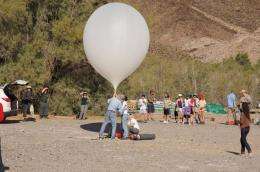
They also were given the opportunity to watch students from Valley View Middle School, Pleasanton, Calif., launch an instrumented weather balloon designed and built by Columbus High School, Ga., students in the Doing Research at Extreme Altitudes by Motivated Students (DREAMS) program. Mission objectives included investigating various perchlorates in Mars-like conditions, testing a full flight video system, using remote sensing to survey the Mojave National Preserve, collecting Geiger counter samples for full flight, performing an algae ultraviolet exposure experiment, and logging environmental data for full flight.
"We need to emphasize to our students the importance of working as a group. My students saw the videos I took of daily meetings, where scientists discuss their findings each day and their plans for the next day. It takes all types of scientists working together to solve problems," said Winter.
"I definitely feel that I have a better understanding of science practices. Now I can better motivate students in the classroom to be science professionals," said Morrison.
More information: dreams.columbus2space.org/
Provided by JPL/NASA


