Nanosilver for therapy and diagnostics
(PhysOrg.com) -- Nowadays, everyday life would be inconceivable without nanotechnology. It is also ever-present in medical technology – both in therapy and diagnostics. Researchers from ETH Zurich have now prepared silver nanoparticles in an interdisciplinary study in such a way that they offer further potential in this field.
Nanoparticles made of silver, smaller than a ten thousandth of a millimetre, have special optical properties that particularly harbour promising applications for medical technology. The only problem: nanosilver particles give off silver ions, which are toxic for cells. Scientists led by Sotiris Pratsinis, a professor at ETH Zurich’s Particle Technology Laboratory of the Institute of Process Engineering, have now succeeded in preparing the silver particles in such a way that prevents them from releasing toxic ions but leaves their optical – so-called plasmonic – properties intact. This means the particles can be used in medicine as plasmonic sensors to identify pathogens or for therapeutic purposes.
Layer of silicon dioxide protects cells
To get around the problem of toxicity, the scientists coated the nanoparticles with a two-nanometre-thick layer of silicon dioxide in a special procedure. In his doctoral thesis supervised by Pratsinis, Georgios Sotiriou compared the impact of untreated silver nanoparticles with only partially and completed coated nanoparticles in a series of experiments.
In the case of the completely coated particles, the transparent shell does not affect the special light properties of these biosensors. And as silver ions cannot penetrate the shell, there is no danger to the cells. To demonstrate this, the scientists teamed up with Sven Panke, a professor from the Department of Biosystems at ETH Zurich, and added Eschericha coli bacteria to the particles, which continued to reproduce unscathed.
Using quantum effects
The particular plasmonic properties stem from quantum effects of the electrons in the silver nanoparticles: light interacts with the electrons in the surface of the plasmonic sensors, causing them to oscillate. The incoming light is thus absorbed heavily and scattered. The plasmonic sensors therefore glow under the so-called dark-field illumination. Consequently, they are just the ticket for detecting viruses, bacteria or cancer cells, for instance, or transporting medication applied to the sensors to a specific place in the human body.
Equipped with an antibody, the particles can be attached to predetermined biomolecules. Moreover, in collaboration with Janos Vörös, a professor from ETH Zurich’s Institute for Biomedical Engineering, the scientists were able to show that they can also be used as so-called label-free sensors. This means any protein molecules in the bloodstream stick to the sensor through the physical absorption between the molecule and sensor surface alone and can thus be detected. This was revealed in experiments using bovine serum albumin as the model protein molecule. The protein molecules stuck to the sensors trigger a local change in the refractive index on the plasmonic sensors. The higher refractive index of the solution causes the optical absorption of the sensor to shift to a higher light wavelength. This makes the biomolecules visible, which means they can be detected easily.
But the prepared silver nanoparticles also have another advantage, stresses Sotiriou: ‘The coated nanoparticles are stable in serum suspensions, without us having to add substances that could interrupt the experiment.’
Transport also possible
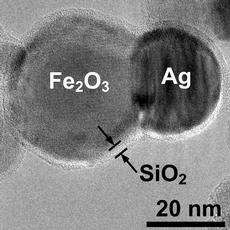
In a recently published follow-up study in Chemistry of Materials, Pratsinis’ team describes how the functionality of the silicon-dioxide-coated silver nanoparticles can be improved even further: in collaboration with Ann Hirt, a professor from ETH Zurich’s Institute of Geophysics, the researchers coat an iron oxide and a silver particle together, thus making the biosensor magnetic also.
These multifunctional particles can bind to particular cells (e.g.cancer cells like HeLa cells) and thus detect them, as was demonstrated in experiments conducted at ETH Zurich’s Institute of Biochemistry in collaboration with Pierre-Yves Lozach. The magnetic properties of the particles now also mean the particles can be guided to a certain place. The nanosilver particles could latch onto cancer cells and could eliminate them there locally using heat from a high-energy magnetic field or infrared radiation. ‘This constitutes an extremely interesting alternative for the non-invasive destruction of tumours,’ stresses Pratsinis.
More information: Sotiriou GA et al.: Non-Toxic Dry-Coated Nanosilver for Plasmonic Biosensors, Advanced Functional Materials (2010), 20, 4209–4399, DOI: 10.1002/adfm.201000985
Sotiriou GA et al: Hybrid, Silica-Coated, Janus-Like Plasmonic-Magnetic Nanoparticles, Chemistry of Materials (2011), 23, 1985–1992, DOI: 10.1021/cm200399t
Sotiriou GA et al.: Nanosilver on nanostructured silica: Antibacterial activity and Ag surface area, Chemical Engineering Journal (2011), in press, DOI: 10.1016/j.cej.2011.01.099
Provided by ETH Zurich


