Researchers create nanopatch for the heart
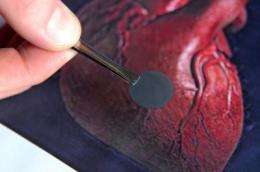
Engineers at Brown University have created a nanopatch for the heart that tests show restores areas that have been damaged, such as from a heart attack. Credit: Frank Mullin, Brown University
When you suffer a heart attack, a part of your heart dies. Nerve cells in the heart's wall and a special class of cells that spontaneously expand and contract keeping the heart beating in perfect synchronicity are lost forever. Surgeons can't repair the affected area. It's as if when confronted with a road riddled with potholes, you abandon what's there and build a new road instead.
Needless to say, this is a grossly inefficient way to treat arguably the single most important organ in the human body. The best approach would be to figure out how to resuscitate the deadened area, and in this quest, a group of researchers at Brown University and in India may have an answer.
The scientists turned to nanotechnology. In a lab, they built a scaffold-looking structure consisting of carbon nanofibers and a government-approved polymer. Tests showed the synthetic nanopatch regenerated natural heart tissue cells called cardiomyocytes as well as neurons. In short, the tests showed that a dead region of the heart can be brought back to life.
"This whole idea is to put something where dead tissue is to help regenerate it, so that you eventually have a healthy heart," said David Stout, a graduate student in the School of Engineering at Brown and the lead author of the paper published in Acta Biomaterialia.
The approach, if successful, would help millions of people. In 2009, some 785,000 Americans suffered a new heart attack linked to weakness caused by the scarred cardiac muscle from a previous heart attack, according to the American Heart Association. Just as ominously, a third of women and a fifth of men who have experienced a heart attack will have another one within six years, the researchers added, citing the American Heart Association.
What is unique about the experiments at Brown and at the India Institute of Technology Kanpur is the engineers employed carbon nanofibers, helical-shaped tubes with diameters between 60 and 200 nanometers. The carbon nanofibers work well because they are excellent conductors of electrons, performing the kind of electrical connections the heart relies upon for keeping a steady beat. The researchers stitched the nanofibers together using a poly lactic-co-glycolic acid polymer to form a mesh about 22 millimeters long and 15 microns thick and resembling "a black Band Aid," Stout said. They laid the mesh on a glass substrate to test whether cardiomyocytes would colonize the surface and grow more cells.
In tests with the 200-nanometer-diameter carbon nanofibers seeded with cardiomyocytes, five times as many heart-tissue cells colonized the surface after four hours than with a control sample consisting of the polymer only. After five days, the density of the surface was six times greater than the control sample, the researchers reported. Neuron density had also doubled after four days, they added.
The scaffold works because it is elastic and durable, and can thus expand and contract much like heart tissue, said Thomas Webster, associate professor in engineering and orthopaedics at Brown and the corresponding author on the paper. It's because of these properties and the carbon nanofibers that cardiomyocytes and neurons congregate on the scaffold and spawn new cells, in effect regenerating the area.
The scientists want to tweak the scaffold pattern to better mimic the electrical current of the heart, as well as build an in-vitro model to test how the material reacts to the heart's voltage and beat regime. They also want to make sure the cardiomyocytes that grow on the scaffolds are endowed with the same abilities as other heart-tissue cells.
Provided by
Brown University
-
From lemons to lemonade: Reaction uses carbon dioxide to make carbon-based semiconductor,
32 comments
-
Thioridazine kills cancer stem cells in human while avoiding toxic side-effects of conventional cancer treatments,
3 comments
-
SpaceX private rocket blasts off for space station (Update),
42 comments
-
Climate scientists say they have solved riddle of rising sea,
31 comments
-
Research team claims to have found evidence Lake Cheko is impact crater for Tunguska Event,
18 comments
-
What would stain as translucent on light-coloured fabric?
12 hours ago
-
How do I identify different bacteria on culture plates?
22 hours ago
-
Why Do Dogs do Strange things...
May 25, 2012
-
What does exophillic and endophillic mean in terms of mosquito and their control?
May 24, 2012
-
Semen stains glows under black lights (uv light)?
May 23, 2012
-
Question on Human Chromosome 2
May 23, 2012
- More from Physics Forums - Biology
More news stories
Dopant gives graphene solar cells highest efficiency yet
(Phys.org) -- By taking advantage of graphenes favorable electrical and optical properties, and then adding an organic dopant, researchers have achieved the highest power conversion efficiency yet for ...
Nanomedicine: Quantum dots appear safe in pioneering study on primates
A pioneering study to gauge the toxicity of quantum dots in primates has found the tiny crystals to be safe over a one-year period, a hopeful outcome for doctors and scientists seeking new ways to battle diseases ...
Nanotechnology / Bio & Medicine
May 20, 2012 |
4.3 / 5 (3) |
8
|
In nanorod crystal growth, nanoparticles seen as artificial atoms
In the growth of crystals, do nanoparticles act as "artificial atoms" forming molecular-type building blocks that can assemble into complex structures? This is the contention of a major but controversial theory ...
May 24, 2012 |
4.8 / 5 (6) |
0
|
First direct observation of oriented attachment in nanocrystal growth
Berkeley Lab researchers have reported the first direct observation of nanoparticles undergoing oriented attachment, the critical step in biomineralization and the growth of nanocrystals. A better understanding ...
May 24, 2012 |
4.7 / 5 (3) |
0
|
Synthetic nano-waste does not disappear
(Phys.org) -- Tiny particles of cerium oxide do not burn or change in the heat of a waste incineration plant. They remain intact on combustion residues or in the incineration system, as a new study by Swiss ...
Nanotechnology / Bio & Medicine
May 25, 2012 |
5 / 5 (2) |
1
|
Browser wars flare in mobile space
The browser wars are heating up again, but this time the fight is for dominance of the mobile Internet.
Scientist: Evolution debate will soon be history
(AP) -- Richard Leakey predicts skepticism over evolution will soon be history. Not that the avowed atheist has any doubts himself.
Dell tablet leak: 10.1-inch display, two-battery choice
(Phys.org) -- Headline after headline talks about vendors tablets in the wings as likely number-one contenders for the iPad. Such claims have justifiably been taken with a grain of salt, considering ...
SpotterRF debuts Radar Backpack Kit (w/ Video)
(Phys.org) -- SpotterRF has announced a special radar backpack kit designed to enhance situational awareness for soldiers on the ground. The company says its special radar is designed for warfighters as part ...
SpaceX capsule has 'new car' smell, astronauts say (Update)
SpaceX's Dragon cargo vessel smells like a new car, said astronauts at the International Space Station after opening the hatches Saturday following the spacecraft's landmark mission to the orbiting lab.
Thousands of shellfish found dead in Peru
Thousands of crustaceans were found dead off the coast of Lima following the mystery mass death of dolphins and pelicans, the Peruvian Navy said Friday.
May 19, 2011
Rank: not rated yet
May 19, 2011
Rank: not rated yet
Understatement of the century.
If this technology is fully developed and becomes affordable, then this could potentially extend average human life span in developed nations by decades, if not longer.
Imagine a time when something like this could be mass produced just like an ordinary band-aid, in assorted shapes and sizes, and implanted on anyone suspected of a heart attack, in a minimally invasive surgery.