A better way to see molecular structures
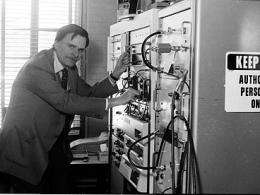
In laboratories at MIT and around the world, scientists are deciphering the molecular structures of proteins involved in Alzheimer’s and Parkinson’s diseases, diabetes, and many other disorders. Much of that research would not be possible without the pioneering nuclear magnetic resonance (NMR) work of John Waugh, MIT Institute Professor Emeritus.
When Waugh first came to MIT, in 1953, NMR was already a valuable tool for the study of molecular structure — but only for liquid samples. In the 1960s Waugh developed a way to use it to study solids, making it useful for analyzing things that don’t dissolve in water, including proteins, nucleic acids (such as DNA) and some drugs. That technique eventually played a role in many of the past half-century’s discoveries in chemistry, physics, biology and materials science; it is now one of science’s most widely used tools.
“He basically started this whole business,” says Robert Griffin, professor of chemistry, director of MIT’s Francis Bitter Magnet Laboratory and a former postdoc of Waugh’s. “None of what goes on in a few hundred labs around the world would be going on without his seminal contribution.”
Earlier this month, for his work on NMR, Waugh was named the 2011 recipient of the Welch Award — given for contributions to basic research that benefits humankind — which carries a $300,000 prize.
‘One of those magic moments’
Waugh became interested in nuclear magnetic resonance as a graduate student at the California Institute of Technology (Caltech). At that time, around 1949, NMR was still very new. “It was a physicists’ plaything,” recalls Waugh, who recently turned 82.
He joined the lab of Caltech chemistry professor Don Yost, whose specialty was “getting interested in some new phenomenon and then learning about it by conning a student into doing work on it. That’s what happened to me. I became the nuclear magnetic resonance student,” Waugh says. He read up on NMR in physics journals and built his own system with a borrowed magnet and “all sorts of World War II surplus electronics.”
After finishing his PhD, Waugh spent another year as a research associate at Caltech and then accepted a job as a chemistry instructor at MIT. He taught freshman chemistry, but had no space to do his own research.
“The way things are now, they hire a young person and expect him or her to do research, and they provide money and lab space. They didn’t do that in those days,” Waugh recalls. “I had no lab, and no money. When I asked about this I was told, ‘Well, you’ve got a fume hood in your office, you can do research there.’”
Luckily for Waugh, physicist Francis Bitter, for whom MIT’s magnet lab is now named, took an interest in his career. Bitter let him borrow a magnet, found him a small lab in the basement of Building 6 and got him a membership in the Research Laboratory of Electronics — the successor to the wartime Radiation Lab.
Once settled in his new lab, Waugh set out to overcome the limitation of NMR structural studies to the liquid state. “I remember trying to figure out how to do that for a long time. I drove myself nuts trying to think of how to do it,” Waugh says.
One day in the late 1960s, while eating breakfast, he suddenly realized that it could be done by applying a very special sequence of sharp, intense pulses of radiofrequency power. “It was one of those magic moments,” he recalls. Waugh then demonstrated and developed the technique along with his student Lee Huber and postdoc Ulrich Haeberlen. Fundamental contributions
Enthusiasm for the new technique, dubbed WAHUHA in honor of its discoverers, spread all the way to Washington University in St. Louis, where Griffin was then a grad student. “Everybody knew about John Waugh and all the exciting things that were happening at MIT. So I started trying to come here,” he says.
Griffin joined Waugh’s lab as a postdoc in 1970, and worked on ways to improve the sensitivity of NMR. He stayed on at MIT and in 1992 became director of the Francis Bitter Magnet Lab, where he now oversees 100 researchers in six labs. Much of the Magnet Lab’s research focuses on biological pursuits, such as determining the structure of proteins — for example, the amyloid proteins found in the brains of Alzheimer’s patients.
“NMR spectroscopy, thanks to Dr. Waugh’s insights, continues to profoundly influence the way we do science today,” says James Kinsey, chair of the scientific advisory board for the Welch Foundation, which will present Waugh with the Welch Award this fall. “His contributions have been absolutely fundamental to many past and current additions to our scientific understanding.”
As for Waugh, he says he never anticipated the wide impact his work has turned out to have.
“I think that’s the way most [scientists] are,” he says. “You start off doing some limited kind of stuff that makes use of any particular talents or knowledge you happen to have. You don’t think of it as being something that’s going to revolutionize the world. It’s just something interesting to do, and might be fun. That’s what motivates most of us, when you start off.”
This story is republished courtesy of MIT News (web.mit.edu/newsoffice/), a popular site that covers news about MIT research, innovation and teaching.
Provided by Massachusetts Institute of Technology


