A mammoth task -- sorting out mammoth evolution
May 30, 2011

Researchers solve mammoth evolutionary puzzle: The woollies weren't picky, happy to interbreed

Enlarge

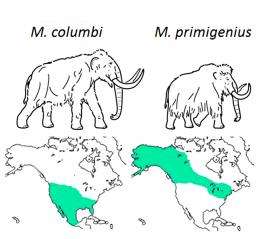
An illustrated figure of the Columbian mammoth and the woolly mammoth

Mammoths were a diverse genus that roamed across Eurasia and North America during the Pleistocene era. In continental North America, at least two highly divergent species have long been recognized – woolly mammoths (Mammuthus primigenius) and Columbian mammoths (M. columbi). But new genetic evidence published in BioMed Central's open access journal Genome Biology suggests that these species may have been closely related enough to mate when they had the chance.

Remains of woolly mammoths have been found across the glacial tundra-steppe of Eurasia and northern North America, while the much physically larger Columbian mammoths inhabited the savannah environments of temperate southern and central North America. The differences between the species have long been considered as unique adaptations to the environments where they evolved. But by piecing together trace fragments of DNA from an 11 thousand year-old Columbian mammoth from Fairview, Utah, a team of Canadian, American and French researchers found that surprisingly the mitochondrial genome from this mammoth was nearly indiscernible from that of its northern woolly counterparts.

But the group does not suspect that this requires a re-write of North American mammoth evolution. "We think this individual may have been a woolly-Columbian hybrid," says Jacob Enk of the McMaster Ancient DNA Centre, the group that led the research. "Living African elephant species interbreed where their ranges adjoin, with males of the bigger species out-competing the smaller for mates. This results in mitochondrial genomes from the smaller species showing up in populations of the larger. Since woolly and Columbian ranges periodically overlapped in time and space, it's likely that they engaged in similar behaviour and left a similar genetic signal." The team goes on to suggest that interbreeding may explain some mammoth fossils that have intermediate physical characteristics, between woollies and Columbians, sometimes assigned to the M. jeffersonii.

They do not rule out other explanations however, and note that the only way to know for sure whether their was a hybrid is to sequence nuclear DNA from it and other mammoths. For poorly-preserved remains like those of southern-ranging Columbians, this will be a challenge. But they expect that by exploiting new cutting-edge sequencing technologies, the nuclear genomes of these amazing animals are within reach.

More information: The Complete Columbian mammoth mitogenome suggests interbreeding with woolly mammoths, Jacob Enk, Regis Debruyne, Alison Devault, Christine E King, Todd Treangen, Dennis O'Rourke, Steven L Salzberg, Daniel Fisher, Ross MacPhee and Hendrik Poinar, Genome Biology (in press)

Provided by BioMed Central search and more info website

4.3 /5 (6 votes)  

Filter


Move the slider to adjust rank threshold, so that you can hide some of the comments.


Display comments: newest first

kevinrtrs
May 31, 2011

Rank: 1 / 5 (10)
This is more like sorting out Mammoth relations rather than evolution. The researchers are on a hiding to nothing if they think they can find out the ancestoral path of the Mammoths.
By the way, notice the language which clearly points out just how shaky the ground is for any origins research: "We think this...", "it's likely that...", "that interbreeding may..." and so on. There's absolutely no way that certainty can be obtained when speculating about things that happened in the past because you just cannot go back there to observe it. No one was there to observe and carefully document how a reptile changed into a mammoth. That is why you have to take it all on faith. And hence evolution[the one-ancestor for all type] is a religion.
Tseihta
May 31, 2011

Rank: 3.5 / 5 (4)
Haha you religious nut-cases are all the same. Only smart people can claim they don't know everything. Not like the delusional... who have the answer "it's my imaginary friend, whom I both fear and love upon punishment of an eternity of pain and burning, that made these animals... individually unique!" Next time you talk to your Gawd can you ask her why you have tonsils and an appendix. I always wanted to know that.

What they are finding here isn't the answer to the evolutionary sequence of Mammoths in the world. They are finding is that the two species might have bumped uglies and produced the mammoth that they found. The behaviour can be seen today with African elephants. So it's possible that this can show how this particular 'hybrid' developed.

When scientists are learning they ALWAYS use language like "We think this..", "it's likely that...", "that interbreeding may..." because only MORONS use absolutes when talking about something they don't know.
whoyagonacal
May 31, 2011

Rank: 5 / 5 (2)
Oh, why complain about @kvtrs? He amuses himself with his "I hate science" posts and everyone else amuses themselves by giving him one star. (One wishes there were zero or less stars, but that would lead to a the race to negative infinity.) Certainly no sensible person would think there was
any SERIOUS point to the game.

I turn off my filtering momentarily just to add a ding. Yes, it's a very low-value entertainment, but given the negligible cost the laughs have their value.
Dobbin
May 31, 2011

Rank: 1 / 5 (3)
That species distinctions are frequently arbitrary enters into this discussion. We use artificial selection to select for characteristics we want in our livestock and pets but we don't claim to be creating new species. What evidence do we have that all elephants living and extinct aren't as closely related as domestic dogs?

That things evolved over time isn't in dispute. The "I believe in evolution" orthodoxy is thick in this piece with it's characterisation of the interbreeding of varieties of elephant as resulting in a "hybrid"

Is a Doberman/Collie cross a hybrid? I
FrankHerbert
May 31, 2011

Rank: 1 / 5 (51)
Oh, why complain about @kvtrs?


Now that Quantum_Conundrum (Spectator) admitted to getting banned for religious nuttery, I've redoubled my efforts to report kevin everytime he mentions evolution. It's scientific fact and this is a science website. Go elsewhere. Become a street preacher. Anything.
whoyagonacal
May 31, 2011

Rank: not rated yet
Now that Quantum_Conundrum (Spectator) admitted to getting banned for religious nuttery, I've redoubled my efforts to report kevin everytime he mentions evolution.


Good idea. It's more constructive than complaining. And I would suspect, more fun.

whoyagonacal
May 31, 2011

Rank: 5 / 5 (2)
Well, I added my "inappropriate" vote on @kvtrs ... possibly it might be useful to add a comment on any thread he posts to suggest others might enjoy doing likewise.

Next, we deal with Ollie Manuel and his attempts to use Physorg to spam his crackpot science.
Tseihta
Jun 02, 2011

Rank: not rated yet
Yeah he even cut and pastes his posts now. Anything to do with stars you can always count on poor Ollie to try and swede us with his nerd cred as a PI for NASA (the very institution he blames for being a part of a giant conspiracy against neutron repulsion).
Hmmm a bit off topic... maybe we should continue this over on the Astronomy section?
CSharpner
Jun 06, 2011

Rank: 5 / 5 (1)
That is why you have to take it all on faith. And hence evolution[the one-ancestor for all type] is a religion.

Let me explain this to you yet again, Kev:

Science follows the LOGICAL steps:
1. I don't know.
2. I observe.
3. I speculate and theorize.
4. I test/experiment.
5. I analyze results.
6. I update my theories to conform to experimental results rather than emotional pondering.
7. I repeat.

The results are fact and observation based. There's no "faith" required. Worst case is "best guess" based on observation and experimentation.

Now that you know that (and we already know you did because it's been explained to you ad infinitum), we will rightly call you a liar and I'll refer you back to this thread to remind you that we know you know.

Answer me this: If the universe is only 6000 years old, why is it that we see objects more than 6000 light years away?

Poof! I just made Kev disappear.

@whoyougonacal: Dark entertainment value and to cover the bases.
Rank 4.3 /5 (6 votes)
Relevant PhysicsForums posts

More news stories

Manufacturing genes to attack flu virus

An international research team has manufactured a new protein that can combat deadly flu epidemics.

Biology / Biotechnology

created 12 hours ago | popularity not rated yet | comments 0 | with audio podcast

Scientist: Evolution debate will soon be history

(AP) -- Richard Leakey predicts skepticism over evolution will soon be history. Not that the avowed atheist has any doubts himself.

Biology / Evolution

created May 26, 2012 | popularity 3.4 / 5 (22) | comments 98

More plant species responding to global warming than previously thought

(Phys.org) -- Far more wild plant species may be responding to global warming than previous large-scale estimates have suggested.

Biology / Ecology

created May 22, 2012 | popularity 4.6 / 5 (14) | comments 18 | with audio podcast

For monogamous sparrows, it doesn't pay to stray (but they do it anyway)

It's quite common for a female song sparrow to stray from her breeding partner and mate with the male next door, but a new study shows that sleeping around can be costly.

Biology / Plants & Animals

created May 22, 2012 | popularity 5 / 5 (2) | comments 8 | with audio podcast

Thousands of shellfish found dead in Peru

Thousands of crustaceans were found dead off the coast of Lima following the mystery mass death of dolphins and pelicans, the Peruvian Navy said Friday.

Biology / Ecology

created May 26, 2012 | popularity 4.7 / 5 (7) | comments 7


Stunning image of smallest possible five-ringed structure

Scientists have created and imaged the smallest possible five-ringed structure – about 100,000 times thinner than a human hair – and you'll probably recognise its shape.

'Unzipped' carbon nanotubes could help energize fuel cells, batteries

Multi-walled carbon nanotubes riddled with defects and impurities on the outside could replace some of the expensive platinum catalysts used in fuel cells and metal-air batteries, according to scientists at ...

Change in developmental timing was crucial in the evolutionary shift from dinosaurs to birds: study

At first glance, it's hard to see how a common house sparrow and a Tyrannosaurus Rex might have anything in common. After all, one is a bird that weighs less than an ounce, and the other is a dinosaur that ...

Computer model used to pinpoint prime materials for efficient carbon capture

When power plants begin capturing their carbon emissions to reduce greenhouse gases – and to most in the electric power industry, it's a question of when, not if – it will be an expensive undertaking.

T cells 'hunt' parasites like animal predators seek prey, study shows

By pairing an intimate knowledge of immune-system function with a deep understanding of statistical physics, a cross-disciplinary team at the University of Pennsylvania has arrived at a surprising finding: T cells use a movement ...

Yale study concludes public apathy over climate change unrelated to science literacy

Are members of the public divided about climate change because they don't understand the science behind it? If Americans knew more basic science and were more proficient in technical reasoning, would public consensus match ...