Image: Exploring the wonders of the universe
May 23, 2011
Image Credit: NASA

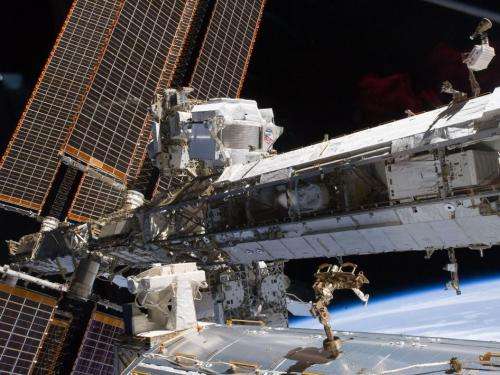
(PhysOrg.com) -- The newly-installed Alpha Magnetic Spectrometer-2 is visible at center of the International Space Station's starboard truss.

The Alpha Magnetic Spectrometer, or AMS, is the largest scientific collaboration to use the orbital laboratory.

This investigation is sponsored by the U.S. Department of Energy and made possible by funding from 16 nations.

Led by Nobel Laureate Samuel Ting, more than 600 physicists from around the globe will be able to participate in the data generated from this particle physics detector.

The mission of the AMS is, in part, to seek answers to the mysteries of antimatter, and cosmic ray propagation in the universe.

Explore further: Astronomers detect dust feature in comet ISON's inner coma

add to favorites email to friend print save as pdf

Related Stories

AMS is ready to discover the particle universe

May 20, 2011

(PhysOrg.com) -- The largest and most complex scientific instrument yet to be fitted to the International Space Station was installed today. Taken into space by the Space Shuttle, the Alpha Magnetic Spectrometer ...

Alpha Magnetic Spectrometer arrives at launch site

Aug 26, 2010

(PhysOrg.com) -- One of the most complex space scientific instruments ever built, the Alpha Magnetic Spectrometer (AMS-02) arrived at the Kennedy Space Center in Florida, escorted by astronauts who will fly ...

Recommended for you

User comments : 0

More news stories

Space drives e-mobility

An ESA business incubation start-up company is helping major car manufacturers to develop electric vehicle concepts and improve safety systems by turning ideas quickly into virtual prototypes.

New factor to control oncogene-induced senescence

An article published on the journal Nature describes the major role that Pyruvate dehydrogenase (PDH) —an enzyme of cellular energy metabolism— plays in the regulation of the cellular senescence induce ...