Ground-effect 'plane-train' flies inches above the ground (w/ video)
May 12, 2011 by Lisa Zyga weblog

ground-effect vehicles

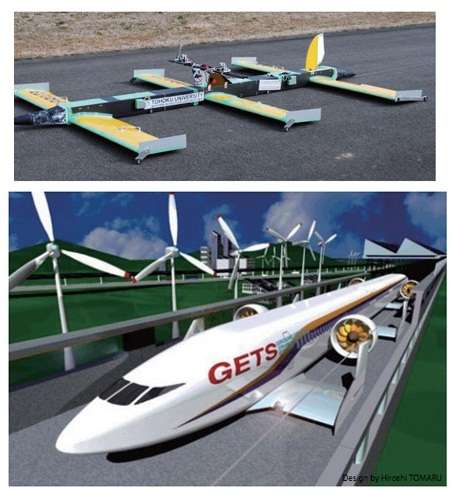
(Top) The robotic ground-effect vehicle is being tested by researchers at Tohoku University. (Bottom) Illustration of the Aero Train concept. Image credit: IEEE Spectrum.

(PhysOrg.com) -- By building a robotic ground-effect vehicle that flies inches above the ground, researchers from Japan may be offering a glimpse into the future of high-speed rail. The researchers, led by Yusuke Sugahara at Tohoku University, are currently testing the robotic prototype, which they have described earlier this week at the IEEE International Conference on Robotics and Automation (ICRA) in Shanghai.

As a ground-effect , the prototype uses the fast-moving air between the bottom of the vehicle and its track to fly above the ground. Usually, this air produces drag on planes as they’re landing, as well as on maglev trains, which levitate using electromagnets. But by taking advantage of this fast-moving air, the ground-effect vehicle can avoid the friction associated with rail contact, as well as avoid ground-effect drag.

With its stubby wings, the ground-effect vehicle is controlled more like a plane than a train, since factors such as pitch, roll, and yaw need to be accounted for. The researchers are testing the prototype to better understand autonomous stabilization in a ground-effect vehicle.

If the unmanned prototype works well, the researchers will develop a dynamic model of how ground-effect vehicles operate, and then use it to design and build a manned experimental prototype. Such a vehicle could travel at speeds of up to 200 kph (125 mph) around a U-shaped concrete channel.

In the future, the researchers envision building a large commuter rail system that they call the Aero Train. Ideally, such a system would be less expensive and more efficient than today’s maglev trains.

More information: via: IEEE Spectrum

© 2010 PhysOrg.com

4.2 /5 (6 votes)  

Filter


Move the slider to adjust rank threshold, so that you can hide some of the comments.


Display comments: newest first

gunslingor1
May 12, 2011

Rank: 5 / 5 (4)
Such a vehicle could travel at speeds of up to 200 kph (125 mph) around a U-shaped concrete channel.

-Based on what I know of mag lev trains, I think that means it should go about 700mph on straight lines. But I could be wrong.

-FIX THE VIDEO!!.

-BUILD THE FLYING TRAIN!!!!! I would be happy to be the first test passenger. Get her done~! Plane travel sucks these days!!!
ryggesogn2
May 12, 2011

Rank: 5 / 5 (3)
I can envision all sorts of spectacular crashes caused by something as simple as a rock or too much snow/ice.
TabulaMentis
May 12, 2011

Rank: 1 / 5 (1)
I can envision all sorts of spectacular crashes caused by something as simple as a rock or too much snow/ice.
Birds, OBL followers, suicide nuts, etc., etc., etc.. These things need a firmer hold to the ground to prevent disasters.
Deadbolt
May 12, 2011

Rank: 3 / 5 (2)
A 700mph crash would definitely be wince worthy.
that_guy
May 12, 2011

Rank: not rated yet
-Based on what I know of mag lev trains, I think that means it should go about 700mph on straight lines. But I could be wrong.

I might be wrong, but I suspect that they mean that instead of being flat, the track for it has a depression in the center of it, with high walls at the side rather than the geography of the 'rail' line.

@rygg - seriously, do you hate everything on this whole site? I don't think I've ever seen you post a positive comment. I'd like to point out that snow/ice is unlikely to affect a ground affect machine. They would fly over it, and ground effect is powerful, so weight would not be a big deal - see ekranoplane.

Maglev trains have been safe if not expensive. I think this machine has a lot of potential and does away with the magnets and tracks. The main caveats I see are control, and how expensive is the propulsion. I think it would still be a good idea to have some kind of guide track tho.
mrlewish
May 12, 2011

Rank: 5 / 5 (2)
Look it's 1950's popular science magazine.
arosjoa
May 12, 2011

Rank: 5 / 5 (1)
Actually everyone its not seeing the BIG picture. A combination of actual train tech and these could make them faster and even cheaper if not more efficent. Imagine...

I could say that the japanese wanna break all their current records.
Vendicar_Decarian
May 12, 2011

Rank: 3.3 / 5 (4)
I think that high speed rail is impossible in America due to the prevalence of WhackTard "Patriots" who would undoubtedly do their best to derail the things.

In Japan and China you don't have the same kind of mental disease as you do in America.
zevkirsh
May 12, 2011

Rank: 5 / 5 (1)
ground effect flight is crazy efficient. however it never worked for trans-oceanic transport, because ocean waves are too choppy and any moderate waves would destroy the craft.

doing this on a train line sounds like a good idea in principle, as the surface it traverses is quite flat. however, you CANNOT have a train that is unstable in any manner whatsoever, or people will call it an airplain and they will never build this thing. the 'tests' in the video make the thing look unstable and destined to be a failure. ground effect flight is in theory by far the most efficient though.

why not power this thing with a magnetic rail , like a rail gun, instead of onboard engines?
antialias
May 13, 2011

Rank: 4 / 5 (2)
Neat idea, but I think in practice it won't work. High speed rail (and maglev) systems can handle a degree of variability in the terrain. When this thing goes at full tilt the track would have to be almost perfectly flat with next to no incline whatsoever.

Maybe in the far future this could eb used in a transoceanic tunnel. But I don't see it working on ordinary, continental terrain other than in very few locations.

epsi00
May 13, 2011

Rank: 3 / 5 (2)
I think that high speed rail is impossible in America due to the prevalence of WhackTard "Patriots" who would undoubtedly do their best to derail the things.

In Japan and China you don't have the same kind of mental disease as you do in America.


while america is too busy spending billions of borrowed money on wars against poor countries to make them poorer, china and japan are conducting research into transportation of the future ( and many other things just as important ).
epsi00
May 13, 2011

Rank: 5 / 5 (1)
ground effect flight is crazy efficient. however it never worked for trans-oceanic transport, because ocean waves are too choppy and any moderate waves would destroy the craft.


I am pretty sure you are wrong because birds already do that over the pacific and do not seem to be bothered by the "choppiness" of the waves. read about albatross and what they can do.
hooloovoo
May 13, 2011

Rank: 3 / 5 (2)
@epsi00, they don't fly at 700kph. They don' have to worry about turning into red mist if they crash, unlike the passengers of a train. Also, bird have near infinitely adjustable wings and tail feathers. I don't think that's a good comparison.
NotParker
May 13, 2011

Rank: 4.7 / 5 (3)
I think that high speed rail is impossible in America due to the prevalence of WhackTard "Patriots" who would undoubtedly do their best to derail the things.

In Japan and China you don't have the same kind of mental disease as you do in America.


The US is the 179th densest country in the world. Japan is #38.

Even the continental US is is on 94 persons/sqkm, still ware too sparsely populated for rail to work economically.
http://en.wikiped..._density

Rail works best in densely populated countries.
Moose_Dr
May 13, 2011

Rank: not rated yet
This reminds me of the "cars" in Star Wars.
that_guy
May 13, 2011

Rank: not rated yet
ground effect flight is crazy efficient. however it never worked for trans-oceanic transport, because ocean waves are too choppy and any moderate waves would destroy the craft.


I am pretty sure you are wrong because birds already do that over the pacific and do not seem to be bothered by the "choppiness" of the waves. read about albatross and what they can do.


I have to agree with epsi - birds will commonly skim the surface of the ocean or other bodies of water to take advantage of the ground effect.

There's an ekranoplan called the "sea eagle" that is primarily for ocean use.
The USSR used one called the caspian sea monster in order to transport supplies quickly across the caspian.
class c ground effect craft fly up to 150m (appx 450 feet) with ground effect.

antialias, I'm pretty sure your concern is over stated or wrong. From my research, it appears that a ground effect vehicle is capable of covering at least as much ground as the highway system.
that_guy
May 13, 2011

Rank: not rated yet
@epsi00, they don't fly at 700kph. They don' have to worry about turning into red mist if they crash, unlike the passengers of a train. Also, bird have near infinitely adjustable wings and tail feathers. I don't think that's a good comparison.


I think that 700 kph figure was a false extrapolation from one of the first commenters. The article says 200kph.

Epsi's point is valid - antialias said waves are too choppy for ground effect to work. Antialias's point is untrue whether a small bird, or an ekranoplan.
MrPhysOrg
May 13, 2011

Rank: not rated yet
The track will be as impressive as an interstate. A maglev track for a hanging train - the 21st century version of the trains in Wuppertal - would be easier to maintain. For Americans the stations would load cars, everyone else would walk on. Americans don't have a mental disease, but they are a little "different".
Rank 4.2 /5 (6 votes)
Relevant PhysicsForums posts

More news stories

Browser wars flare in mobile space

The browser wars are heating up again, but this time the fight is for dominance of the mobile Internet.

Technology / Software

created 1 hour ago | popularity 5 / 5 (1) | comments 1

SpotterRF debuts Radar Backpack Kit (w/ Video)

(Phys.org) -- SpotterRF has announced a special radar backpack kit designed to enhance situational awareness for soldiers on the ground. The company says its special radar is designed for warfighters as part ...

Technology / Hi Tech & Innovation

created 22 hours ago | popularity 5 / 5 (5) | comments 12 | with audio podcast report

Probability of contamination from severe nuclear reactor accidents is higher than expected: study

Catastrophic nuclear accidents such as the core meltdowns in Chernobyl and Fukushima are more likely to happen than previously assumed. Based on the operating hours of all civil nuclear reactors and the number ...

Technology / Energy & Green Tech

created May 22, 2012 | popularity 3.6 / 5 (21) | comments 56 | with audio podcast

HyperSolar shows dirty water no barrier to power world

(Phys.org) -- The Santa Barbara, California, company, HyperSolar, is set to transparently share the ups and downs of its research experiences toward the company’s ultimate vision, successfully producing ...

Technology / Energy & Green Tech

created May 24, 2012 | popularity 4.8 / 5 (15) | comments 17 | with audio podcast report

Tesla to launch electric sedan in US on June 22

Tesla Motors said Tuesday it would begin deliveries of "the world's first premium electric sedan" on June 22, slightly ahead of schedule.

Technology / Energy & Green Tech

created May 22, 2012 | popularity 4.5 / 5 (11) | comments 18


Nvidia trumpets Tegra 3 phone design wins for 2012

(Phys.org) -- Nvidia’s competitive war paint has a name, Tegra 3. On the heels of Nvidia announcements about lowering costs of its Tegra 3 processors and Nvidia-enabled tablets running Android Ice Cream ...

Scientist: Evolution debate will soon be history

(AP) -- Richard Leakey predicts skepticism over evolution will soon be history. Not that the avowed atheist has any doubts himself.

Dell tablet leak: 10.1-inch display, two-battery choice

(Phys.org) -- Headline after headline talks about vendors’ tablets in the wings as likely number-one contenders for the iPad. Such claims have justifiably been taken with a grain of salt, considering ...

SpaceX capsule has 'new car' smell, astronauts say (Update)

SpaceX's Dragon cargo vessel smells like a new car, said astronauts at the International Space Station after opening the hatches Saturday following the spacecraft's landmark mission to the orbiting lab.

Thousands of shellfish found dead in Peru

Thousands of crustaceans were found dead off the coast of Lima following the mystery mass death of dolphins and pelicans, the Peruvian Navy said Friday.

Australia hails surprise super-telescope decision

Australia has hailed a surprise decision giving it a role in a radio telescope project aimed at revolutionising astronomy, vowing to draw on its decades of experience in space science.