Great snipe is the fastest migratory bird ever discovered
May 25, 2011 By Tamera Jones

Great snipe is the fastest migratory bird ever discovered

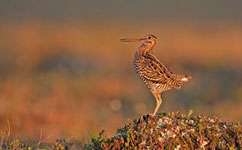
Great snipe displaying.

Apart from its long, elegant beak, the great snipe looks just like any other wading bird. But researchers have found that this ordinary-looking creature could well be the fastest bird on Earth – over long distances at least.

After following the birds' migration south from Sweden to central Africa using tiny tracking devices, Swedish scientists found that the birds fly non-stop over a distance of around 4,200 miles at a phenomenal 60 mph.

A lot of birds can fly either very far or very fast, but it's rare to find one that can do both. The peregrine falcon is possibly the fastest bird on the planet: it reaches a startling 200 mph, but only while diving to catch its prey. And the Arctic tern flies further than any other bird during its migration – around 50,000 miles from the Arctic to the Antarctic and back again. Although this is an incredible feat for such a small bird, it doesn't fly at great speed.

"We know of no other animal that travels this rapidly over such a long distance," write the authors in their report, published in the Royal Society journal Biology Letters today.

What's also unusual is that its migration route takes it over land that is perfectly suitable for a stopover.

"We never expected record-breaking flights for this ordinary bird. Along its routes, the snipes have plenty of opportunity to stop over and feed on earthworms, insects and other invertebrates and this is exactly what land birds normally do," says Dr Raymond Klaassen from Lund University in Sweden, lead author of the study.

Migratory birds almost always choose to stop over during their migrations if they can, at a place where they can rest and re-fuel before continuing their epic journeys.

Even though Arctic terns fly over the Atlantic, they still stop to re-fuel on surface fish on the way. On the other hand, the bar-tailed godwit flies from Alaska to New Zealand with no stopover, 'because it has no choice,' says Klaassen.

Flying long distances has its costs. need to have the necessary fuel onboard before they set off. This invariably means they're not agile, because they have to be so fat, which could make them vulnerable to predators. But that doesn't seem to put the great snipe off.

Before this study, scientists had almost no idea where the endangered birds go once they leave Scandinavia.

"We thought they might go to Africa, but we didn't know where. Also, nobody sees the great snipe over the rest of Europe. We put this down to them being so elusive and thought tracking them would reveal the other places they hide," says Klaassen.

The only real way to find out was to fit them with tiny tracking devices, called geolocators.

These devices – developed at the British Antarctic Survey – weigh just 1.1 grams and, including attachments, make up a fraction of a per cent of an adult bird's body weight. They record light intensity; when this data is fed into a computer program, scientists can figure out when and where the birds travelled.

After the breeding season, but before the annual migration, the researchers fitted 10 male great snipes at Jämtland in Sweden with a geolocator each. Exactly a year later, the scientists managed to retrieve three geolocators from three birds when they returned to Sweden after their northward migration.

Klaassen and his colleagues found that one bird flew 4,225 miles from Sweden to central Africa in just 3.5 days. The other two birds flew 3,833 miles in three days, and 2,870 miles in two days.

"We think maybe the feeding conditions are so good in Scandinavia, the birds take advantage of the opportunity to feed up," Klaassen says.

Indeed one report says that come autumn, the birds are so fat, they're barely recognisable from how they looked in May.

The great snipe is an endangered species. "Its numbers have gone down a lot, and it's almost disappeared from mainland Europe. It's now restricted to the mountainous regions of Norway and Sweden," adds Klaassen.

The feeding grounds seem to be more important than researchers realized. "We need to find out exactly where they're feeding and what they're feeding on. It would be good to see them before they migrate, when they're really fat," he says.

Scientists have long known that snipes are incredibly fast birds. The word 'sniper' originated in the 1770s among soldiers in British India: if a hunter was skilled enough to kill an elusive snipe, he was called a sniper.

Great snipes breed in Scandinavia from mid-May to early-July. The leave their breeding ground from early-August onwards. The return northward migration happens between March and April.

Other fast creatures

• The Arctic tern tops the list for furthest ever migration, flying 50,000 miles from the Arctic to the Antarctic and back again every year
• Cheetahs are the fastest creature on land (over short distances), reaching speeds of 75 mph within three seconds of a standing start - faster than most sports cars
• Peregrine falcons dive through the air at speeds of around 200 mph to catch their prey
• The sailfish is the fastest fish, reaching speeds in excess of 70 mph
• Dragonflies are the fastest flying insect on Earth, sometimes flying at 40 mph


This story is republished courtesy of Planet Earth online, a free, companion website to the award-winning magazine Planet Earth published and funded by the Natural Environment Research Council (NERC).

More information: Raymond H. G. Klaassen, et al., Great flights by great snipes: long and fast non-stop migration over benign habitats, Biology Letters, published 25 May 2011, doi:10.1098/rsbl.2011.0343

Provided by PlanetEarth Online search and more info website

Filter


Move the slider to adjust rank threshold, so that you can hide some of the comments.


Display comments: newest first

Physki101
May 25, 2011

Rank: not rated yet
But do they like Chocolate?
kevinrtrs
May 25, 2011

Rank: 1 / 5 (9)
Notice the total absense of any evolutionary talk in this article. I guess the researchers know that there's really no evolutionary explanation for this phenomenal ability and so they keep their minds focused on what works in reality. No side-tracking into nonsense speculation of evolutionary origins here.
The real mystery is how the birds know where to migrate to, given that they possibly haven't been there before. In other words - how did the first bird know? The only answer that comes to mind is that terribly hard one to accept - the creator programmed it.
Physmet
May 25, 2011

Rank: 5 / 5 (6)
@kevin, they didn't discuss it since it wasn't pertinent to the intent of the article. Since you're obviously hoping to stir up controversy again, let's consider your statement. "The only answer [is God]".

I personally don't know if they have any ideas as to how it knows where to go. We certainly wouldn't have guessed as to why the tropical carpenter ant bites into a fungus at solar noon, causing their body to atrophy with its mandibles lodged into the fungus allowing it to flower out of the ant's head. Turns out the plant releases spores that infect the ant and cause it to perform this gruesome suicide against it's will. Or, is that a result of a loving God also? Oh sorry, it's because there's sin in the world, right? That's the answer I usually hear if there's something bad in the world.

If science doesn't know what the answer is doesn't mean that an invisible being you've never talked to or interacted with actually exists. It just sounds juvenile.
Ethelred
May 26, 2011

Rank: 5 / 5 (2)
The aggressively ignorant Kevin again makes the same stupid post,

"We don't know everthing therefor the word is 6000 years old and Jehovah exists and is the only god."

By Kevin's non-standard thus nearly anything can be claimed. So here goes.

We don't know everything so you are wrong claiming Jehovah is a the only god or that he even exists. Clearly there are many gods and they are all Norse since the world was created by a giant cow licking a huge block of ice. Soon Odin will send his ravens to pluck out Kevin's eyes for lunch.

We don't know everything therefor we are dream in the mind of Brahma and when Brahma awakes Kevin will snuff it.

Of course if Kevin wasn't completely full of bovine fertilizer he would be willing to tell us when the Great Flood was. So when was it Kevin. The closest century will do.

Ethelred
Au-Pu
May 27, 2011

Rank: not rated yet
The swallow is faster than most you have listed not to mention the other migratory bird the Swift.
The authors appear to have very limited sources of reference.
CSharpner
May 29, 2011

Rank: 5 / 5 (2)
Notice the total absense of any evolutionary talk in this article

They also didn't discuss shy I got a really bad sunburn yesterday during a 1/2 go-cart ride with my kids yesterday, therefore, sunburn must not really be for real, nor my kids for that matter, since they weren't mentioned in the article. They didn't mention religion either, therefore religion is clearly not real. In fact, they only mentioned a handful of things, so logically, nothing else in the universe exists except for the things explicitly mentioned in this article. Who knew, the meaning of life and everything was this very article. All praise the Great Snipe article! Oh wait! The article didn't mention itself, therefore, the article doesn't exist.

Oh! I'm so confused!
Rank 5 /5 (3 votes)
Relevant PhysicsForums posts

More news stories

Scientist: Evolution debate will soon be history

(AP) -- Richard Leakey predicts skepticism over evolution will soon be history. Not that the avowed atheist has any doubts himself.

Biology / Evolution

created 12 hours ago | popularity 3.5 / 5 (11) | comments 30

Thousands of shellfish found dead in Peru

Thousands of crustaceans were found dead off the coast of Lima following the mystery mass death of dolphins and pelicans, the Peruvian Navy said Friday.

Biology / Ecology

created 22 hours ago | popularity 4.8 / 5 (4) | comments 7

More plant species responding to global warming than previously thought

(Phys.org) -- Far more wild plant species may be responding to global warming than previous large-scale estimates have suggested.

Biology / Ecology

created May 22, 2012 | popularity 4.6 / 5 (14) | comments 18 | with audio podcast

For monogamous sparrows, it doesn't pay to stray (but they do it anyway)

It's quite common for a female song sparrow to stray from her breeding partner and mate with the male next door, but a new study shows that sleeping around can be costly.

Biology / Plants & Animals

created May 22, 2012 | popularity 5 / 5 (1) | comments 7 | with audio podcast

Study uncovers secret to speedy burrowing by razor clams

(Phys.org) -- If you look at a razor burrowing clam sitting in a bucket, you’d never guess that it could burrow itself down into the soil, much less do it with any speed. Razor clams look like fat straws, ...

Biology / Plants & Animals

created May 25, 2012 | popularity 1 / 5 (1) | comments 3 | with audio podcast report


Nvidia trumpets Tegra 3 phone design wins for 2012

(Phys.org) -- Nvidia’s competitive war paint has a name, Tegra 3. On the heels of Nvidia announcements about lowering costs of its Tegra 3 processors and Nvidia-enabled tablets running Android Ice Cream ...

Browser wars flare in mobile space

The browser wars are heating up again, but this time the fight is for dominance of the mobile Internet.

Dell tablet leak: 10.1-inch display, two-battery choice

(Phys.org) -- Headline after headline talks about vendors’ tablets in the wings as likely number-one contenders for the iPad. Such claims have justifiably been taken with a grain of salt, considering ...

SpotterRF debuts Radar Backpack Kit (w/ Video)

(Phys.org) -- SpotterRF has announced a special radar backpack kit designed to enhance situational awareness for soldiers on the ground. The company says its special radar is designed for warfighters as part ...

SpaceX capsule has 'new car' smell, astronauts say (Update)

SpaceX's Dragon cargo vessel smells like a new car, said astronauts at the International Space Station after opening the hatches Saturday following the spacecraft's landmark mission to the orbiting lab.

Australia hails surprise super-telescope decision

Australia has hailed a surprise decision giving it a role in a radio telescope project aimed at revolutionising astronomy, vowing to draw on its decades of experience in space science.