Dawn probe reaches milestone approaching asteroid Vesta
May 3, 2011

Dawn probe reaches milestone approaching asteroid Vesta

Enlarge

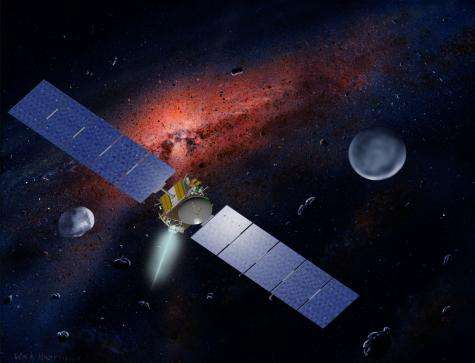
NASA's Dawn spacecraft, illustrated in this artist's concept, is propelled by ion engines. Image credit: NASA/JPL

(PhysOrg.com) -- NASA's Dawn spacecraft has reached its official approach phase to the asteroid Vesta and will begin using cameras for the first time to aid navigation for an expected July 16 orbital encounter. The large asteroid is known as a protoplanet – a celestial body that almost formed into a planet.

At the start of this three-month final approach to this massive body in the , Dawn is 1.21 million kilometers (752,000 miles) from Vesta, or about three times the distance between Earth and the moon. During the approach phase, the spacecraft's main activity will be thrusting with a special, hyper-efficient ion engine that uses electricity to ionize and accelerate xenon. The 12-inch-wide ion thrusters provide less thrust than conventional engines, but will provide propulsion for years during the mission and provide far greater capability to change velocity.

"We feel a little like Columbus approaching the shores of the New World," said Christopher Russell, Dawn principal investigator, based at the University of California in Los Angeles (UCLA). "The Dawn team can't wait to start mapping this Terra Incognita."

Dawn previously navigated by measuring the radio signal between the spacecraft and Earth, and used other methods that did not involve Vesta. But as the spacecraft closes in on its target, navigation requires more precise measurements. By analyzing where Vesta appears relative to stars, navigators will pin down its location and enable engineers to refine the spacecraft's trajectory. Using its ion engine to match Vesta's orbit around the sun, the spacecraft will spiral gently into orbit around the asteroid. When Dawn gets approximately 16,000 kilometers (9,900 miles) from Vesta, the asteroid's gravity will capture the spacecraft in orbit.

"After more than three-and-a-half years of interplanetary travel, we are finally closing in on our first destination," said Marc Rayman, Dawn's chief engineer, at NASA's Jet Propulsion Laboratory in Pasadena, Calif. "We're not there yet, but Dawn will soon bring into focus an entire world that has been, for most of the two centuries scientists have been studying it, little more than a pinpoint of light."

Scientists will search the framing camera images for possible moons around Vesta. None of the images from ground-based and Earth-orbiting telescopes have seen any moons, but Dawn will give scientists much more detailed images to determine whether small objects have gone undiscovered.

The gamma ray and neutron detector instrument also will gather information on cosmic rays during the approach phase, providing a baseline for comparison when Dawn is much closer to Vesta. Simultaneously, Dawn's visible and infrared mapping spectrometer will take early measurements to ensure it is calibrated and ready when the spacecraft enters orbit around Vesta.

Dawn's odyssey, which will take it on a journey of 4.8-billion kilometers (3-billion miles), began on Sept. 27, 2007, with its launch from Cape Canaveral Air Force Station in Florida. It will stay in orbit around Vesta for one year. After another long cruise phase, Dawn will arrive at its second destination, an even more massive body in the asteroid belt, called Ceres, in 2015.

These two icons of the asteroid belt will help scientists unlock the secrets of our solar system's early history. The mission will compare and contrast the two giant bodies, which were shaped by different forces. Dawn's science instrument suite will measure surface composition, topography and texture. In addition, the will measure the tug of gravity from Vesta and Ceres to learn more about their internal structures.

More information: To learn more about Dawn's approach phase, read the latest Dawn Journal at http://blogs.jpl.n … vesta-phase/

Provided by JPL/NASA search and more info website

Filter


Move the slider to adjust rank threshold, so that you can hide some of the comments.


Display comments: newest first

Jonseer
May 03, 2011

Rank: 3 / 5 (2)
Enough on Vesta, keep firing the rockets and make her skip that boring rock and head straight to Ceres, where truly amazing discoveries never imagined will be found.
that_guy
May 04, 2011

Rank: not rated yet
I want to agree with you because I really want to see ceres too, but from the scientist point of view, Vesta is probably the bigger prize, because it's a piece of a differentiated body (with a core, solidified mantle, top surface, etc) - a piece a proto planet all cracked open and easy to see. it will help them gather evidence for or against various theories of the formation of the solar system.
exequus
May 16, 2011

Rank: not rated yet
"We feel a little like Columbus approaching the shores of the new world."
IMHO that's the wrong analogy given that Columbus 1] Never set out to find a 'new world' but a shorter route to the land of spices which was known at the time as 'the Indies' 2] His caravel didn't knowingly approach the shoreline, it stumbled upon it and none too soon for after two months at sea without seeing any land the crew was on the verge of mutiny and wanted to return home.
Rank 5 /5 (11 votes)
Relevant PhysicsForums posts
  • revamping general concept and cosmological principle
    createdMay 25, 2012
  • Transiting Exoplanet Light Curve
    createdMay 25, 2012
  • Math behind Theoretical Physics
    createdMay 24, 2012
  • Do we know whats at the center of galaxies yet?
    createdMay 23, 2012
  • Structure of the Milky Way?
    createdMay 20, 2012
  • What would it take to terraform Pluto and Charon?
    createdMay 19, 2012
  • More from Physics Forums - General Astronomy

More news stories

SpaceX capsule has 'new car' smell, astronauts say (Update)

SpaceX's Dragon cargo vessel smells like a new car, said astronauts at the International Space Station after opening the hatches Saturday following the spacecraft's landmark mission to the orbiting lab.

Space & Earth / Space Exploration

created 22 hours ago | popularity 4.5 / 5 (20) | comments 2

Australia hails surprise super-telescope decision

Australia has hailed a surprise decision giving it a role in a radio telescope project aimed at revolutionising astronomy, vowing to draw on its decades of experience in space science.

Space & Earth / Astronomy

created 22 hours ago | popularity 5 / 5 (4) | comments 2

Astronomers seize last chance in lifetime for Venus Transit

Astronomers are gearing for one the rarest events in the Solar System: an alignment of Earth, Venus and the Sun that will not be seen for another 105 years.

Space & Earth / Astronomy

created 22 hours ago | popularity 5 / 5 (3) | comments 2

Astronauts enter world's 1st private supply ship

(AP) -- Space station astronauts floated into the Dragon on Saturday, a day after its heralded arrival as the world's first commercial supply ship.

Space & Earth / Space Exploration

created 22 hours ago | popularity 5 / 5 (6) | comments 0

Sophisticated simulations predict future warming

The chances of our planet being hit by a global warming of 3 degrees Celsius by 2050 is as likely as it being hit by an increase of 1.4 degrees, new research shows. Presented in the journal Nature Geoscience, the British study ...

Space & Earth / Earth Sciences

created May 22, 2012 | popularity 4.4 / 5 (9) | comments 51


Browser wars flare in mobile space

The browser wars are heating up again, but this time the fight is for dominance of the mobile Internet.

Nvidia trumpets Tegra 3 phone design wins for 2012

(Phys.org) -- Nvidia’s competitive war paint has a name, Tegra 3. On the heels of Nvidia announcements about lowering costs of its Tegra 3 processors and Nvidia-enabled tablets running Android Ice Cream ...

Scientist: Evolution debate will soon be history

(AP) -- Richard Leakey predicts skepticism over evolution will soon be history. Not that the avowed atheist has any doubts himself.

Dell tablet leak: 10.1-inch display, two-battery choice

(Phys.org) -- Headline after headline talks about vendors’ tablets in the wings as likely number-one contenders for the iPad. Such claims have justifiably been taken with a grain of salt, considering ...

SpotterRF debuts Radar Backpack Kit (w/ Video)

(Phys.org) -- SpotterRF has announced a special radar backpack kit designed to enhance situational awareness for soldiers on the ground. The company says its special radar is designed for warfighters as part ...

Thousands of shellfish found dead in Peru

Thousands of crustaceans were found dead off the coast of Lima following the mystery mass death of dolphins and pelicans, the Peruvian Navy said Friday.