Ancient bacterial mats may have been key to first mobile animals
May 16, 2011 by Bob Yirka
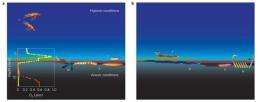
Modern animal-biomat associations from Los Roques. b, Potential Upper Ediacaran and Lower Cambrian associations. Image illustration: Nature Geoscience, doi:10.1038/ngeo1142
(PhysOrg.com) -- Researchers from Canada studying the highly salty coastal lagoons at Los Roques, Venezuela and the microbial mats found at the bottom of the sea there, have discovered that oxygen levels in the mats, at least in the day time, are high enough to support the development of mobile life forms. Led by University of Alberta palaeontologist, Murray Gingras, the team writes in Nature Geoscience, that levels of oxygen on the ocean floor were up to four times as high as that near the surface; high enough to support the development of mobile sea life; which the team believes could explain how early life forms could have evolved in waters with high salt concentrations.
The mats, which the researchers believe are likely similar to the type that evolved in some early lagoons during the Ediacaran Period, some 542 million years ago (the time most agree multicellular animals first began to appear) are comprised of a bottom layer of sulphide-oxidizing bacteria, which is covered by a top layer of blue green algae, which produces the oxygen through photosynthesis. They found oxygen levels of between 0.25 and 0.45 atm near the mats, compared to 0.10 at or near the surface.
The findings are important because fossil evidence suggests mobile animals first evolved in early salty lagoons that should have been too salty to produce normal plant growth.
Of course there is one hiccup in the theory, and that is the fact that the mats only produce oxygen during the day when the sun is shining; oxygen levels around the mats plunge at night, leaving the lagoons a very inhospitable place. However, at Los Roques, there are some insect larvae that exist inside the mats that for the most part shut down at night; hibernating, if you will, and thus can survive with almost no oxygen when its dark. Gingras and his team support the notion that perhaps some early life forms could have done the same, though others are not quite ready to jump on that bandwagon.
Another issue is that the results are based on the notion that the mats that exist today are in fact the same as the mats that existed way back then; a bit of a leap seeing as how there is really no evidence to support such a supposition. Thus, in order for the ideas suggested in this paper to gain credence, evidence of some similarity will have to be found through further research.
More information: Possible evolution of mobile animals in association with microbial mats, Nature Geoscience (2011) doi:10.1038/ngeo1142
Abstract
Complex animals first evolved during the Ediacaran period, between 635 and 542 million years ago, when the oceans were just becoming fully oxygenated. In situ fossils of the mobile forms of these animals are associated with microbial sedimentary structures1, 2, 3, and the animals trace fossils generally were formed parallel to the surface of the seabed, at or below the sedimentwater interface4, 5. This evidence suggests the earliest mobile animals inhabited settings with high microbial populations, and may have mined microbially bound sediments for food resources6, 7, 8. Here we report the association of mobile animalsinsect larvae, oligochaetes and burrowing shore crabswith microbial mats in a modern hypersaline lagoon in Venezuela. The lagoon is characterized by low concentrations of dissolved O2 and pervasive biomats dominated by oxygen-producing cyanobacteria, both analogous to conditions during the Ediacaran. We find that, during the day, O2 levels in the biomats are four times higher than in the overlying water column. We therefore conclude that the animals harvest both food and O2 from the biomats. In doing so, the animals produce horizontal burrows similar to those found in Ediacaran-aged rocks. We suggest that early mobile animals may have evolved in similar environments during the Ediacaran, effectively exploiting oases rich in O2 that formed within low oxygen settings.
© 2010 PhysOrg.com
-
From lemons to lemonade: Reaction uses carbon dioxide to make carbon-based semiconductor,
32 comments
-
Thioridazine kills cancer stem cells in human while avoiding toxic side-effects of conventional cancer treatments,
3 comments
-
SpaceX private rocket blasts off for space station (Update),
42 comments
-
Climate scientists say they have solved riddle of rising sea,
30 comments
-
Research team claims to have found evidence Lake Cheko is impact crater for Tunguska Event,
18 comments
-
Hypothetical desert earth
7 hours ago
-
More human population = greater mass?
May 25, 2012
-
Conversion from aircraft bearing to normal degrees
May 23, 2012
-
Interpretation/Analysis of the Lab results(HEPA filter)
May 22, 2012
-
Has anyone here attended the The Urbino Summer School in Paleoclimatology?
May 22, 2012
-
Earthquakes: Mag 6 N. Italy and Mag 5.6 W. Bulgaria
May 21, 2012
- More from Physics Forums - Earth
More news stories
SpaceX capsule has 'new car' smell, astronauts say (Update)
SpaceX's Dragon cargo vessel smells like a new car, said astronauts at the International Space Station after opening the hatches Saturday following the spacecraft's landmark mission to the orbiting lab.
Space & Earth / Space Exploration
20 hours ago |
4.5 / 5 (20) |
1
Astronomers seize last chance in lifetime for Venus Transit
Astronomers are gearing for one the rarest events in the Solar System: an alignment of Earth, Venus and the Sun that will not be seen for another 105 years.
20 hours ago |
5 / 5 (3) |
2
Australia hails surprise super-telescope decision
Australia has hailed a surprise decision giving it a role in a radio telescope project aimed at revolutionising astronomy, vowing to draw on its decades of experience in space science.
20 hours ago |
5 / 5 (4) |
1
Astronauts enter world's 1st private supply ship
(AP) -- Space station astronauts floated into the Dragon on Saturday, a day after its heralded arrival as the world's first commercial supply ship.
Space & Earth / Space Exploration
20 hours ago |
5 / 5 (6) |
0
Sophisticated simulations predict future warming
The chances of our planet being hit by a global warming of 3 degrees Celsius by 2050 is as likely as it being hit by an increase of 1.4 degrees, new research shows. Presented in the journal Nature Geoscience, the British study ...
Space & Earth / Earth Sciences
May 22, 2012 |
4.4 / 5 (9) |
51
Scientist: Evolution debate will soon be history
(AP) -- Richard Leakey predicts skepticism over evolution will soon be history. Not that the avowed atheist has any doubts himself.
Dell tablet leak: 10.1-inch display, two-battery choice
(Phys.org) -- Headline after headline talks about vendors tablets in the wings as likely number-one contenders for the iPad. Such claims have justifiably been taken with a grain of salt, considering ...
SpotterRF debuts Radar Backpack Kit (w/ Video)
(Phys.org) -- SpotterRF has announced a special radar backpack kit designed to enhance situational awareness for soldiers on the ground. The company says its special radar is designed for warfighters as part ...
Thousands of shellfish found dead in Peru
Thousands of crustaceans were found dead off the coast of Lima following the mystery mass death of dolphins and pelicans, the Peruvian Navy said Friday.
Keep food safety in mind this memorial day weekend
(HealthDay) -- Picnics, parades and cookouts are as much a part of Memorial Day weekend as tributes to the United States' war veterans.
Family history of Alzheimer's affects functional connectivity
(HealthDay) -- Cognitively normal individuals with a family history of late-onset Alzheimer's disease (AD) may display lower resting state functional connectivity in the default mode network (DMN) of the brain, ...
May 16, 2011
Rank: 1 / 5 (8)
So no proof for this evolutionary spoof, they admit it themselves. Sea animals were created on day 5. The land animals were created on day 6, no "bacterial mats" needed, just the Word of the Lord.
May 16, 2011
Rank: 5 / 5 (2)
What evident do you have for this argument? We should start thinking outside the box as "Gregor Mendel".
May 16, 2011
Rank: 5 / 5 (1)
May 16, 2011
Rank: 5 / 5 (4)
Clever. First you accuse the authors of not supplying proof, then you counter by supplying a 'theory' without proof.
It must really hurt to contradict yourself within the space of 2 sentences and not realize it.
May 16, 2011
Rank: 1 / 5 (4)
All matter is basically empty space. Some scientists say that everything consists of cosmic strings, like soundwaves. It reminds me of Ps 33:6 "by the words of the Lord were the heavens made...for he spake and it was done, he commanded and it stood fast." Our reality is supported by another invisible reality that is spiritual.
Until then you will have to continue a neverending, fruitless and barron search in the dust. It is all the result of the curse that was laid on Adam. God will Himself give those that deny Him over to all kinds of delusions. It can be some form of perversion or wrong doctrine. That is why Jesus said: you shall know the truth and the truth shall set you free.
May 17, 2011
Rank: 5 / 5 (1)
Ah, so you are an unnatural man - that explains a lot. (And I thought god only created natural things...silly me. /sarcasm )
I think you should really try to read a book on string theory. Just snapping up a few words and thinking you 'know' something about the subject isn't good enough (and certainly convinces no one here). Certainly your naive comparison of strings and sound waves shows it
And in another thread you wanted explanations - not links to outside articles. Yet all you do is link to an outside article (your book of inane sayings AKA Bible).
At the risk of repeating myself:
"It must really hurt to contradict yourself within the space of 2 sentences and not realize it."
Proof?
May 18, 2011
Rank: 5 / 5 (1)
A book full of contradictions is cannot be considered divinely revealed truth even if it matched the physical evidence which it doesn't.
Then there all the problems with the nonexistent Great Flood.
Ethelred
May 18, 2011
Rank: 1 / 5 (1)
You are regurgitating a tired old argument against the book of Genesis. There is no discrepancy between Gen 1 and 2. Genesis 2 puts the focus on day 6, and the role of Adam in creation. Now in some translations it may seem like the order of events is different, but that is easily solved. Its about the use of perfect in the word "formed" or yatsar in Hebrew. Most translations use plusperfect, "had formed", which is consistent with older translations. The confusion was brought in by the translators of the KJV. Pusperfect removes that whole issue.
May 18, 2011
Rank: 5 / 5 (1)
There is difference in the order. This is due to them being from two sources. One has Jehovah and the other has Elohim which is the plural form of god.
In the original Hebrew that is what the order is.
You mean changed to patch a flaw.
Which still has the same meaning as the whole thing was in past tense.
Of course there is also the problem that G2 says
>>
May 18, 2011
Rank: 5 / 5 (1)
Here it is AFTER Day 7. A rather large bit of a discrepancy there.
Hmm. Seems the New KJV doesn't agree with you either. Changing to YOUR version with 'had formed' won't change the meaning or the timing. Nor fix Man being created AFTER the SEVENTH day.
Want another go? I can find more errors.
Now what fantasy would you like to use to explain the failed curse on Cain? Marrying, producing children that are followed for many generations and founding a city just doesn't match the curse of wandering for the rest of his life.
Ethelred