Another universe tugging on ours? Maybe not, researchers say
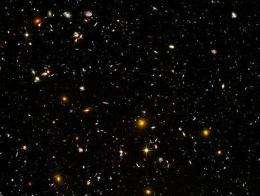
Image credit: Hubble/NASA
(PhysOrg.com) -- A new study from the University at Buffalo contradicts the dark flow theory, showing that exploding stars in different parts of the universe do not appear to be moving in sync. Working with data on 557 such stars, called supernovae, UB scientists deduced that while the supernovae closest to Earth all shared a common motion in one direction, supernovae further out were heading somewhere else. An article announcing the research results will appear in a forthcoming edition of the peer-reviewed Journal of Cosmology and Astroparticle Physics.
In 2008, a research team led by a NASA scientist announced a startling discovery: Clusters of galaxies far apart from one another appeared to be traveling in the same direction.
The findings contradicted the standard model of the universe, which predicts that, as a whole, mass within our universe should flow randomly, in all directions, relative to the background radiation of the cosmos.
The one-way "dark flow" that the NASA-led group discovered created a mystery. What could account for the unexpected motion? Maybe another universe existed beyond the bounds of ours, dragging our stars ever closer through the pull of gravity.
Then again, maybe not.
A new study from the University at Buffalo contradicts the dark flow theory, showing that exploding stars in different parts of the universe do not appear to be moving in sync.
Working with data on 557 such stars, called supernovae, UB scientists deduced that while the supernovae closest to Earth all shared a common motion in one direction, supernovae further out were heading somewhere else. The difference in motion became pronounced for stars 680 million or more light years away from Earth.
An article announcing the research results will appear in a forthcoming edition of the peer-reviewed Journal of Cosmology and Astroparticle Physics.
Though the findings disagree with the "dark flow" hypothesis, they coincide with the predictions of another model of the universe: Lambda-Cold Dark Matter, the standard model of cosmology.
"Our result is boring, in a way, because it matches your expectation for the standard cosmological model," said UB physicist William Kinney. "If it turns out that the NASA team led by Alexander Kashlinsky is right, it would be exciting because there would be some crazy thing going on that nobody understood. There would have to be something very radical, like a big mass outside of our universe that's pulling on stuff inside our universe. That would be big news."
"But our data do not match theirs," Kinney continued. "With our study, we're muddying the water. It's not yet clear who is right. We have to do more figuring to build up a more detailed and accurate picture of the universe."
Kinney, an associate professor, completed the study on supernovae with De-Chang Dai, a UB postdoctoral researcher who has since joined the University of Cape Town, and Dejan Stojkovic, an assistant professor of physics at UB.
The supernova data the team used to complete their study came from the Union2 data set, which the Supernova Cosmology Project at the Lawrence Berkeley National Laboratory released in 2010. Though Union2 incorporates astronomical observations from different telescopes and different times, the data set controls carefully for systematic bias and serves as a useful check for the possible presence of systematic errors in the work of Kashlinsky and others, Kinney said.
Provided by
University at Buffalo
-
From lemons to lemonade: Reaction uses carbon dioxide to make carbon-based semiconductor,
32 comments
-
Thioridazine kills cancer stem cells in human while avoiding toxic side-effects of conventional cancer treatments,
3 comments
-
SpaceX private rocket blasts off for space station (Update),
42 comments
-
Climate scientists say they have solved riddle of rising sea,
30 comments
-
Research team claims to have found evidence Lake Cheko is impact crater for Tunguska Event,
18 comments
-
revamping general concept and cosmological principle
May 25, 2012
-
Transiting Exoplanet Light Curve
May 25, 2012
-
Math behind Theoretical Physics
May 24, 2012
-
Do we know whats at the center of galaxies yet?
May 23, 2012
-
Structure of the Milky Way?
May 20, 2012
-
What would it take to terraform Pluto and Charon?
May 19, 2012
- More from Physics Forums - General Astronomy
More news stories
SpaceX capsule has 'new car' smell, astronauts say (Update)
SpaceX's Dragon cargo vessel smells like a new car, said astronauts at the International Space Station after opening the hatches Saturday following the spacecraft's landmark mission to the orbiting lab.
Space & Earth / Space Exploration
20 hours ago |
4.5 / 5 (20) |
0
Astronomers seize last chance in lifetime for Venus Transit
Astronomers are gearing for one the rarest events in the Solar System: an alignment of Earth, Venus and the Sun that will not be seen for another 105 years.
20 hours ago |
5 / 5 (3) |
2
Australia hails surprise super-telescope decision
Australia has hailed a surprise decision giving it a role in a radio telescope project aimed at revolutionising astronomy, vowing to draw on its decades of experience in space science.
20 hours ago |
5 / 5 (4) |
1
Astronauts enter world's 1st private supply ship
(AP) -- Space station astronauts floated into the Dragon on Saturday, a day after its heralded arrival as the world's first commercial supply ship.
Space & Earth / Space Exploration
20 hours ago |
5 / 5 (6) |
0
Sophisticated simulations predict future warming
The chances of our planet being hit by a global warming of 3 degrees Celsius by 2050 is as likely as it being hit by an increase of 1.4 degrees, new research shows. Presented in the journal Nature Geoscience, the British study ...
Space & Earth / Earth Sciences
May 22, 2012 |
4.4 / 5 (9) |
51
Scientist: Evolution debate will soon be history
(AP) -- Richard Leakey predicts skepticism over evolution will soon be history. Not that the avowed atheist has any doubts himself.
Dell tablet leak: 10.1-inch display, two-battery choice
(Phys.org) -- Headline after headline talks about vendors tablets in the wings as likely number-one contenders for the iPad. Such claims have justifiably been taken with a grain of salt, considering ...
SpotterRF debuts Radar Backpack Kit (w/ Video)
(Phys.org) -- SpotterRF has announced a special radar backpack kit designed to enhance situational awareness for soldiers on the ground. The company says its special radar is designed for warfighters as part ...
Thousands of shellfish found dead in Peru
Thousands of crustaceans were found dead off the coast of Lima following the mystery mass death of dolphins and pelicans, the Peruvian Navy said Friday.
Keep food safety in mind this memorial day weekend
(HealthDay) -- Picnics, parades and cookouts are as much a part of Memorial Day weekend as tributes to the United States' war veterans.
Family history of Alzheimer's affects functional connectivity
(HealthDay) -- Cognitively normal individuals with a family history of late-onset Alzheimer's disease (AD) may display lower resting state functional connectivity in the default mode network (DMN) of the brain, ...
Apr 14, 2011
Rank: 5 / 5 (2)
Apr 14, 2011
Rank: 2.8 / 5 (5)
From certain perspective even the single electron theory of Universe becomes relevant: we can occasionally see the examples of all categories at the most distant universe, which we are observing in our neighbourhood. This is simply how the fuzzy reality and wild human imagination is working (especially if you pay some money for it..).
http://en.wikiped...universe
Apr 14, 2011
Rank: 5 / 5 (1)
Apr 14, 2011
Rank: 5 / 5 (2)
Apr 14, 2011
Rank: 4.5 / 5 (4)
Correlated motion on scales of hundreds of megaparsecs results from primordial inhomogeneities within spacetime, going back to the era of Inflation. Small inhomogeneities got inflated into large structures, and the same inflation also smoothed out the gradient of inhomogeneity. Inflation stretched out the narrow and tall peaks and valleys in mass/energy distributions and momenta of the pre-inflation quantum foam, so we end up with very wide but shallow ones. As a result, on smaller (megaparsec) scales you end up with fairly similar values (after ignoring noise), on larger (hundreds of megaparsecs) scales you observe smoothly changing values, and this cumulative change becomes dramatic by the time you get to gigaparsecs.
Apr 14, 2011
Rank: not rated yet
Apr 15, 2011
Rank: 5 / 5 (2)
If there is any interaction (for instance a dragging pull of gravity) between different regions of spacetime then these regions belong to one and the same universe.
The assumption of the existence of another universe is non-falsifiable and therefore non-scientific.
Apr 15, 2011
Rank: not rated yet
Apr 15, 2011
Rank: not rated yet