Trapping threatens near-extinct Philippine eagle
April 28, 2011

The giant forest-dwelling Philippines eagle is considered one of the largest and most powerful eagles in the world

Enlarge

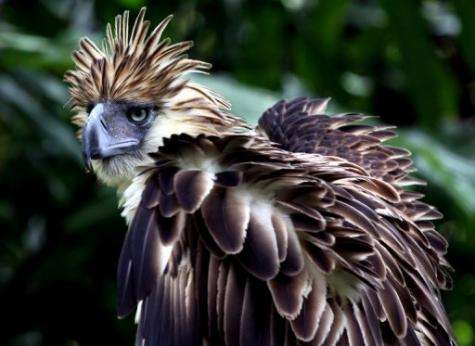
A Philippine Eagle is seen at the Philippine Eagle Center in the southern island of Mindanao. Conservationists have raised alarm over the future of the near-extinct animal after several maimed or diseased birds were retrieved from captivity over recent months.

Conservationists raised alarm Thursday over the future of the near-extinct Philippine eagle after several maimed or diseased birds were retrieved from captivity over recent months.

The Philippine Eagle Foundation said that since last December it had rescued four of the one-metre (3.3-foot) , which are among the world's largest raptors, suggesting conservation laws had not deterred trapping.

"The continue to be harmed and poached," said Tatit Quiblat, development manager with the foundation which has a programme for birds to be later returned to the wild.

"We are extremely distressed about these events," he added.

The foundation said the retrieved birds, all recovered from the large southern island of Mindanao, included a female eagle that was missing two out of three toes on one foot when it was recovered in December.

The government in January handed over a year-old male to the Mindanao-based foundation which it had received from villagers.

This month, a year-old eagle with just two primary feathers remaining on its right wing was turned over by local residents while a juvenile retrieved from another community died from a .

The Philippine eagle is one of the world's rarest and most critically endangered birds
Enlarge

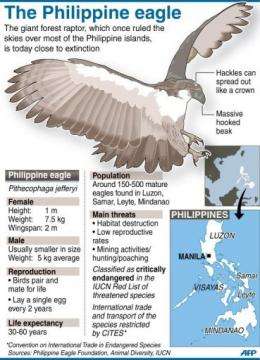
Fact file on the Philippine eagle. The bird can grow one metre in height with a wing span of up to seven feet (two metres).

The International Union for the Conservation of Nature (IUCN) says there are just 180-500 mature Philippine eagles in Mindanao, Luzon, Leyte and Samar islands, with forest loss and poaching the main threats to their survival.

It said the captive breeding programme had so far failed. The first released bird electrocuted on a transmission line nine months after it was sent into the wild in 2004.

Another captive-bred eagle was killed by a hunter four months after being released in 2008.

The species is listed as critically endangered by the IUCN.

While the Philippines has laws banning the killing, collection, and maltreatment of wildlife as well as activities that threaten critical habitats, the eagles continue to be prime targets, it said.

It also called for a stop to the practice of bounty-hunting Philippine eagles that are then turned over to the government or the foundation with the expectation of a reward.

(c) 2011 AFP


Rank not rated yet
Relevant PhysicsForums posts

More news stories

Scientist: Evolution debate will soon be history

(AP) -- Richard Leakey predicts skepticism over evolution will soon be history. Not that the avowed atheist has any doubts himself.

Biology / Evolution

created 10 hours ago | popularity 3.3 / 5 (10) | comments 22

Thousands of shellfish found dead in Peru

Thousands of crustaceans were found dead off the coast of Lima following the mystery mass death of dolphins and pelicans, the Peruvian Navy said Friday.

Biology / Ecology

created 20 hours ago | popularity 4.8 / 5 (4) | comments 6

More plant species responding to global warming than previously thought

(Phys.org) -- Far more wild plant species may be responding to global warming than previous large-scale estimates have suggested.

Biology / Ecology

created May 22, 2012 | popularity 4.6 / 5 (14) | comments 18 | with audio podcast

Totally rad: Scientists create rewritable digital data storage in DNA

(Phys.org) -- Scientists from Stanford's Department of Bioengineering have devised a method for repeatedly encoding, storing and erasing digital data within the DNA of living cells.

Biology / Biotechnology

created May 21, 2012 | popularity 4.9 / 5 (17) | comments 11 | with audio podcast

For monogamous sparrows, it doesn't pay to stray (but they do it anyway)

It's quite common for a female song sparrow to stray from her breeding partner and mate with the male next door, but a new study shows that sleeping around can be costly.

Biology / Plants & Animals

created May 22, 2012 | popularity 5 / 5 (1) | comments 7 | with audio podcast


Dell tablet leak: 10.1-inch display, two-battery choice

(Phys.org) -- Headline after headline talks about vendors’ tablets in the wings as likely number-one contenders for the iPad. Such claims have justifiably been taken with a grain of salt, considering ...

SpotterRF debuts Radar Backpack Kit (w/ Video)

(Phys.org) -- SpotterRF has announced a special radar backpack kit designed to enhance situational awareness for soldiers on the ground. The company says its special radar is designed for warfighters as part ...

SpaceX capsule has 'new car' smell, astronauts say (Update)

SpaceX's Dragon cargo vessel smells like a new car, said astronauts at the International Space Station after opening the hatches Saturday following the spacecraft's landmark mission to the orbiting lab.

Astronomers seize last chance in lifetime for Venus Transit

Astronomers are gearing for one the rarest events in the Solar System: an alignment of Earth, Venus and the Sun that will not be seen for another 105 years.

Australia hails surprise super-telescope decision

Australia has hailed a surprise decision giving it a role in a radio telescope project aimed at revolutionising astronomy, vowing to draw on its decades of experience in space science.

Keep food safety in mind this memorial day weekend

(HealthDay) -- Picnics, parades and cookouts are as much a part of Memorial Day weekend as tributes to the United States' war veterans.