Bang goes that theory!
Apr 29, 2011
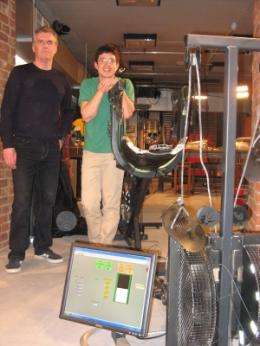
Dr. Ian Swaine and Dr. Yan in the 'Bang goes the theory studios.'

An academic from Canterbury Christ Church University has disproved the theory 'you need water to swim' on a prime time television show.

Dr. Ian Swaine, a Reader in Sport and Science in the Department of Sport Science, Tourism and Leisure, has invented, and built a whole-body, front-crawl, swimming training machine which can be used as a land-training aid for improving the strength and fitness of swimmers and triathletes.

Last month Dr. Swaine took his dry-land swimming training machine along to television studios to prove to Dr. Yan, from the BBC One program, ‘Bang goes the theory’, that the water isn’t a necessity when swimming. And you can see the results this Monday (May 2) on BBC One at 7.30pm.

Dr. Swaine said:”It was a great opportunity for the swimming training machine to appear on national television.

“I am a former competitive swimmer and have been interested in developing dry-land swimming machine to test the mechanical efficiency of swimming, for years. It isn’t possible to get an accurate measure of this in the water, because the water ‘moves away’ when the limbs apply forces. So, I realized that the only way to find out how efficient swimmers are is by creating a machine. This particular machine has had two prototypes built, over the last 15 years. It’s fantastic to finally be able to show it to people and prove my theory that dry-land training for swimming is not only possible, but also helpful in understanding how efficient swimmers are”

The machine involves four resistance air-dynes, which are driven by the arms and legs, using pulley ropes. It also involves a freely-moving suspended ‘body cradle’ in which the swimmers lay down, allowing the body to roll, as it does in water. The swimmer places their hands into ‘hand paddles’ and their feet into ‘foot plates’ to drive the air-dynes. The leg air-dynes are driven in the ‘down’ and ‘up’ phases of the kicking action for each leg in exactly the same way as in the water.

The power being generated at each air-dyne is monitored by ‘sensors’ and fed into a computer where it is displayed as ‘individual limb power output’ for the swimmer. Power output can then be used to calculate mechanical efficiency. Also, each air-dyne can be operated independently and therefore this machine is suitable for use by paraplegics or amputees.

The data collected so far using the machine has been used in research on the efficiency of and  how they  adapt to different training practices, some of which has been already been presented at various conferences. Last year Dr. Swaine presented work he has done using this unique machine in Oslo (Sweden), Indianapolis (USA) and Verona (Italy).

Explore further: Sensitive bomb detector to rove in search of danger

Provided by Canterbury Christ Church University

not rated yet
add to favorites email to friend print save as pdf

Related Stories

Virtual swimmer to speed up athletes

Mar 30, 2006

CSIRO and the Australian Institute of Sport are using mathematics in a bid to speed up our top swimmers by testing changes to swimming strokes. The research will make use of the same software CSIRO uses for other fluid simulations ...

Modern society made up of all types

Nov 04, 2010

Modern society has an intense interest in classifying people into ‘types’, according to a University of Melbourne Cultural Historian, leading to potentially catastrophic life-changing outcomes for those typed – ...

Breathing is secret weapon in sports performance: study

Apr 11, 2011

(PhysOrg.com) -- A ‘secret weapon’ used by a minority of sportsmen and women and which could make the difference between winning and losing at sport has been revealed by a scientist at the University of Portsmouth.

Groundwater threat to rivers worse than suspected

Nov 02, 2010

Excessive groundwater development represents a greater threat to nearby rivers and streams during dry periods (low flows) than previously thought, according to research released today by CSIRO.

Recommended for you

Sensitive bomb detector to rove in search of danger

11 hours ago

European researchers have developed and tested a light-weight device capable of detecting extremely minute quantities of explosives from up to 20 metres away, providing an invaluable law-enforcement tool ...

How soon could car seats enter the 3-D comfort zone?

May 23, 2013

New 3D textiles made of recyclable polyester fibres could contribute help cars be easier to recycle. But recycling technology has yet to progress in separating seat material from other car components.

NASA: Austin, calling Austin. 3-D pizzas to go

May 22, 2013

(Phys.org) —The idea of living with 3-D printed food is neither unthinkable nor new; designers and futurists have been looking to 3-D printing as food's next frontier. In 2012, there was news that the Thiel ...

User comments : 2

Adjust slider to filter visible comments by rank

Display comments: newest first

Slapnoodles
5 / 5 (1) Apr 29, 2011
Oslo is not in Sweden. It is rather the capital of Norway.
rgwalther
not rated yet Apr 29, 2011
Roman Moroni deported to Sweden complains to press, "but I'm not from there!"

More news stories

Google eyes emerging markets networks

Google has become deeply involved in a series of projects to build and operate wireless networks in emerging markets including sub-Saharan Africa and Southeast Asia, a report said Friday.

Facial-recognition technology proves its mettle

(Phys.org) —In a study that evaluated some of the latest in automatic facial recognition technology, researchers at Michigan State University were able to quickly identify one of the Boston Marathon bombing ...

Drones may violate international law

(Phys.org) —As President Obama gives a speech on national security—including defending U.S. use of drones to combat terrorism—Leila Sadat, JD, international law expert and professor of law at Washington University in ...

Galaxies fed by funnels of fuel

(Phys.org) —Computer simulations of galaxies growing over billions of years have revealed a likely scenario for how they feed: a cosmic version of swirly straws.