Simpler woodland strawberry genome aids research on more complex fruits
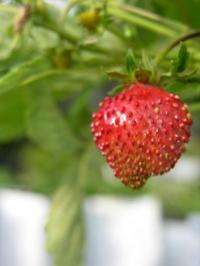
Although the apple genome has already been sequenced, it can still take years for an apple breeder to see the first actual piece of fruit on a tree. That's why University of Illinois plant molecular geneticist Schuyler Korban jumped at the chance to help sequence the genome of the woodland strawberry – a close relative of the apple that blooms in a mere 15 weeks, making his work much more efficient.
"The woodland strawberry is a good surrogate system for genetic studies of other fruits in the same Rosaceae family," said Korban. "With the complete genome sequence of the woodland strawberry in hand, we can use the strategy of comparative genomics to investigate similarities and/or differences between strawberry and apple or strawberry and peach, among others, to learn more about genes involved in various traits, such as fruiting and fruit quality. We can also use the strawberry to do functional genomic studies. It also provides us with a larger tool box to do more targeted breeding.
"The woodland strawberry genome can be compared side-by-side with the already sequenced genome of the apple to identify genes that control certain traits such as flavor, nutritional composition, and flowering time," Korban said.
The woodland strawberry, Fragaria vesca, or F. vesca, becomes the second smallest plant genome to be sequenced. The smallest plant genome sequenced is that of Arabidopsis.
"Arabidopsis is used a lot as a model plant species for pursuing genetic and physiological studies because you can get results very quickly, but it produces pods, called siliques, rather than fruit," Korban said. "I wanted a fruit model system so that I can evaluate the function of apple genes that control various fruit traits such as those for flavor, texture, aroma, and other characteristics in a short period of time, and strawberry is a great model to pursue such studies."
The cultivated variety of the strawberry has not been sequenced yet. And although it may seem like an obvious choice, Korban explained the difficulties. "The reason we chose the woodland strawberry is because it is a diploid, that is, it has two sets of chromosomes, whereas the garden or cultivated strawberry is an octoploid with eight sets of chromosomes so it's much more difficult to sequence."
"The genome of woodland strawberry (Fragaria vesca)" was published in a 2011 issue of Nature Genetics.
"This was a large project," Korban said. "And one thing that made it unique is that we did not have a large grant from any one funding source. It started out with Vladimir Shulaev, who at the time was at Virginia Tech, asking me and other fellow scientists if they were interested in participating and contributing to this project. Shulaev and Kevin Folta, of the University of Florida, rallied the community. We wound up with 75 investigators at 38 institutions, each contributing different skills and expertise, and some providing small amounts of funds to the project."
Another aspect that made this project interesting, according to Korban, is that the sequencing was done using what is called "short-reads" or short fragments of the strawberry genome.
"We actually used three different technologies that all produced short-reads of the sequence," Korban said. "Previous genomes were sequenced using a combination of long-reads and short-reads." The short-reads are difficult to assemble—like stitching together a series of photos to create one panoramic view.
"After the fragments are strung together, you anchor them against the chromosomes—the genetic map of the strawberry—to make sure that that they are in the correct order." Korban said that this "short-read" approach was used to save money, but, also it was a way to create partnerships with sequencing companies that expressed an interest in the project and wanted to provide in-kind support."
Korban said that by knowing genes, their structure and function, researchers can control and/or regulate how these genes are expressed in a plant.
"If one fruit has a higher sugar-acid ratio, for example, we can focus on the gene(s) that produce this variation." He said that this information will help the strawberry industry develop a better strawberry that can ultimately be delivered to the consumer. Also, this will help in improving the apple as well, as we will acquire valuable information on how apple genes function and then use this information to develop apples having a variety of desirable characteristics.
Provided by University of Illinois at Urbana-Champaign


