Far sighted space technology finds practical uses on Earth
April 20, 2011

Far sighted space technology finds practical uses on Earth

Enlarge

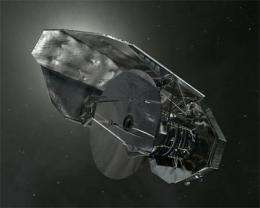
Herschel in space, close up on its mirror. Credits: ESA (Image by AOES Medialab)

(PhysOrg.com) -- Technology developed for space missions to study the most distant objects in the Universe is now finding a host of practical applications back on Earth. QMC Instruments Ltd., in partnership with the Astronomical instrumentation Group at Cardiff University, has built instruments for many major space missions, including Herschel and Planck. Now, expanding on that experience they are developing KIDCAM, a kind of detector that could have applications in hospitals, factories and airports. Ken Wood will present the project at the RAS National Astronomy Meeting in Llandudno, Wales, on Tuesday 19th April.

The part of the including the far infra red and microwave is also called 'terahertz' radiation.  Astronomers use this kind of radiation to study the Cosmic Microwave Background and the huge dust clouds where stars are born.  The sensitive detectors they use will only operate at temperatures very close to absolute zero (minus 273C.) In Terahertz cameras like KIDCAM, those low temperatures are accessible in compact and less expensive ways using relatively new cooler technology. KIDCAM therefore has many potential day-to-day applications.
 
"We are all familiar with optical images of the surface of objects and X-ray images which penetrate through soft tissue to reveal bone structure.  Terahertz observations give us something in between the two. For example, most clothing and packaging materials are transparent to Terahertz radiation, whereas skin, water, metal and a host of other interesting materials are not. This gives rise to some important day-to-day applications: detecting weapons concealed under clothing or inside parcels; distinguishing skin and breast cancer tissue; quality control of manufactures items and processes in factories.  Our KIDCAM detectors are also very sensitive, and so we can look at the natural radiation emitted by the target. This means there are no safety issues like those associated with other imaging techniques which shine radiation, including X-rays, at the target," said Wood.
 
Until recently, there have been many practical obstacles to using terahertz detectors.  Terahertz sources have only become available to the non-specialist in the last 10 years and cooling the detectors to very low temperatures using liquid cryogens is costly and complicated.
 
"The instruments aboard the and Planck satellites need to be cooled to temperatures close to absolute zero so that emissions from the spacecraft don’t drown out the faint signals that come from the very edge of the observable Universe," said Ken Wood.  "For KIDCAM, we have developed a kind of detector that can be operated in electrical coolers and therefore without the use of liquified gases.  KIDCAM can be tuned to specific frequencies for specific applications, for instance to enhance the contrast between skin and plastic explosive for airport security scanners.  Unwanted frequencies can be blocked to increase the camera's sensitivity. The experience that we gained working on astronomical missions has been invaluable in helping us do this.  The race is now on around the world to produce devices that will realise the enormous potential of terahertz science and thanks to the ingenuity of UK astronomers we have made a great start."

Provided by Royal Astronomical Society search and more info website

4.5 /5 (2 votes)  

Rank 4.5 /5 (2 votes)
Relevant PhysicsForums posts
  • revamping general concept and cosmological principle
    createdMay 25, 2012
  • Transiting Exoplanet Light Curve
    createdMay 25, 2012
  • Math behind Theoretical Physics
    createdMay 24, 2012
  • Do we know whats at the center of galaxies yet?
    createdMay 23, 2012
  • Structure of the Milky Way?
    createdMay 20, 2012
  • What would it take to terraform Pluto and Charon?
    createdMay 19, 2012
  • More from Physics Forums - General Astronomy

More news stories

SpaceX capsule has 'new car' smell, astronauts say (Update)

SpaceX's Dragon cargo vessel smells like a new car, said astronauts at the International Space Station after opening the hatches Saturday following the spacecraft's landmark mission to the orbiting lab.

Space & Earth / Space Exploration

created 21 hours ago | popularity 4.5 / 5 (20) | comments 1

Australia hails surprise super-telescope decision

Australia has hailed a surprise decision giving it a role in a radio telescope project aimed at revolutionising astronomy, vowing to draw on its decades of experience in space science.

Space & Earth / Astronomy

created 21 hours ago | popularity 5 / 5 (4) | comments 2

Dragon arrives at space station in historic 1st (Update 2)

The privately bankrolled Dragon capsule made a historic arrival at the International Space Station on Friday, triumphantly captured by astronauts wielding a giant robot arm.

Space & Earth / Space Exploration

created May 25, 2012 | popularity 5 / 5 (10) | comments 19

Astronomers seize last chance in lifetime for Venus Transit

Astronomers are gearing for one the rarest events in the Solar System: an alignment of Earth, Venus and the Sun that will not be seen for another 105 years.

Space & Earth / Astronomy

created 21 hours ago | popularity 5 / 5 (3) | comments 2

Organic carbon from Mars, but not biological

(Phys.org) -- Molecules containing large chains of carbon and hydrogen--the building blocks of all life on Earth--have been the targets of missions to Mars from Viking to the present day. While these molecules ...

Space & Earth / Space Exploration

created May 24, 2012 | popularity 4.4 / 5 (5) | comments 2 | with audio podcast


Nvidia trumpets Tegra 3 phone design wins for 2012

(Phys.org) -- Nvidia’s competitive war paint has a name, Tegra 3. On the heels of Nvidia announcements about lowering costs of its Tegra 3 processors and Nvidia-enabled tablets running Android Ice Cream ...

Browser wars flare in mobile space

The browser wars are heating up again, but this time the fight is for dominance of the mobile Internet.

Dell tablet leak: 10.1-inch display, two-battery choice

(Phys.org) -- Headline after headline talks about vendors’ tablets in the wings as likely number-one contenders for the iPad. Such claims have justifiably been taken with a grain of salt, considering ...

Scientist: Evolution debate will soon be history

(AP) -- Richard Leakey predicts skepticism over evolution will soon be history. Not that the avowed atheist has any doubts himself.

Of mice and mental models: Neuroscientific implications of risk-optimized behavior in the mouse

(Medical Xpress) -- Regardless of an organism’s biological complexity, every encephalized animal continuously makes under-informed behavioral choices that can have serious consequences. Despite its ubiquity, ...

SpotterRF debuts Radar Backpack Kit (w/ Video)

(Phys.org) -- SpotterRF has announced a special radar backpack kit designed to enhance situational awareness for soldiers on the ground. The company says its special radar is designed for warfighters as part ...