Scientists: Soot may be key to rapid Arctic melt
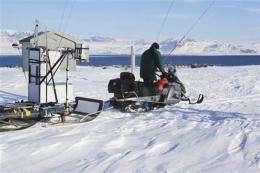
An international research team is in the land of snow and ice, in search of soot.
Though the Arctic is often pictured as a vast white wasteland, scientists believe a thin layer of soot - mostly invisible - is causing it to absorb more heat. They want to find out if that's the main reason for the recent rapid warming of the Arctic, which could have a long-term impact on the world's climate.
Soot, or black carbon, is produced by auto and truck engines, aircraft emissions, burning forests and the use of wood- or coal-burning stoves.
"The Arctic serves as the air conditioner of the planet," explained Patricia Quinn of the National Oceanic and Atmospheric Administration, one of the research participants. Heat from other parts of the Earth moves to the Arctic in the circulating air and ocean water, and at least some of that warmth can radiate into space.
At the same time, some of the incoming heat from the sun that tends to be absorbed in other locations is reflected by the ice and snow, allowing the polar regions to serve as cooling agents for the planet.
But that may be changing.
In recent years, the Arctic has been warming more rapidly than other regions and, Quinn pointed out, the "warming of the Arctic has implications not just for polar bears, but for the entire planet."
Cutting carbon dioxide and other greenhouse gases is the backbone of any effort to combat warming, both globally and within the Arctic, Quinn said.
But studies indicate that cutting the concentration of short-lived pollutants, such as soot, will reduce the rate of warming in the Arctic faster than cuts in carbon dioxide and other greenhouse gases, which last far longer in the atmosphere, she said. "This is a buying-time approach."
In February, the United Nations Environmental Program urged cuts in soot emissions for a variety of reasons, including the threat to human health from inhaling it and the potential warming of the polar regions. And others have also raised concerns about pollution from soot.
The Arctic Council, which represents the eight countries that border the Arctic, is deciding whether to seek reductions in soot from other nations and will be using data from the international research project in its deliberations.
The research team includes scientists from Norway, Russia, Germany, Italy and China. They are working from Svalbard, Norway, a group of nine mountainous, ice- and snow-covered islands inside the Arctic Circle, about halfway between the northern tip of Norway and the North Pole. Once used for whaling, the islands are now home to seals, reindeer and Arctic foxes as well as about 2,000 people who make a living mining coal, hosting researchers and greeting hardy tourists.
The scientists will track carbon's movement through the atmosphere, its deposit on snow and ice surfaces, and its effect on warming in the Arctic. Two NOAA unmanned research aircraft will collect aerosol soot in the air and a Norwegian craft will study the reflectivity of the surface. Researchers also will collect snow samples and send up balloons to study atmospheric chemistry.
Soot warms the atmosphere by absorbing heat from the sun, explained Quinn, who works in NOAA's Pacific Marine Environmental Laboratory in Seattle. And while it may not be visible like a black scar on the snow surface, even a little soot can mean less energy is reflected.
Tim Bates, co-leader of the NOAA contingent with Quinn, likened the process to wearing a black shirt on a sunny day. "If you want to be cooler, you would wear a light-colored shirt that would reflect the sun's warmth." When carbon covers snow and ice, the radiation is absorbed and not reflected.
The surface air temperature in the Arctic has increased about twice as fast as the global average rate over the past 100 years, Quinn said in an interview by email. "Over the past 50 years, annual average surface air temperatures have increased from 2 to 3 degrees Celsius (3.6 to 5.4 degrees Fahrenheit) in Alaska and Siberia. The annual average temperature globally has increased by about 0.7 degree C (1.3 F) over the same time period."
That Arctic warming has resulted in an earlier spring melt, a longer melt season, and a decrease in sea ice extent, she said. That has raised concerns for polar bears, which depend on ice to hunt.
The warming problem is compounded because, when the highly reflective snow and ice melt, the dark surfaces of land and ocean that were beneath absorb more heat, further heating the atmosphere.
Jack Dibb, an atmospheric chemist at the University of New Hampshire, said he thinks soot's greatest effect in the Arctic is likely to be warming caused by the particles floating in the atmosphere. It may also reduce the reflectivity of the snow and ice enough to cause warming, but that is going to be harder to document, he said in a telephone interview.
Either way, the research is important, Dibb said, because soot has a short life span in the air, so reducing it can have a faster effect than other efforts to slow climate change.
Will the research lead to action? "I would hope," he said cautiously. There are a lot of concerned parties, particularly in Europe, he said, noting he recently attended a conference in St. Petersburg, Russia, where there were discussions of the soot produced by widespread forest fires in that country last summer.
The Norway research will continue through mid-May. The teams then will spend months analyzing their data and report the results at scientific meetings and in journals.
More information: http://www.noaa.gov
NOAA's Pacific Marine Environmental Laboratory: http://www.pmel.noaa.gov/
Cooperative Institute for Research in Environmental Sciences: http://cires.colorado.edu/
Arctic Vision and Strategy: http://www.arctic.noaa.gov/docs/NOAAArctic
©2010 The Associated Press. All rights reserved. This material may not be published, broadcast, rewritten or redistributed.


