NASA's Global Hawks mark year of science flights
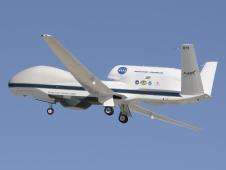
This week marks the first anniversary of the NASA Global Hawk project’s initial science mission. On April 7, 2010, Global Hawk No. 872 took off from NASA’s Dryden Flight Research Center on Edwards Air Force Base, Calif., for its first science foray over the Pacific Ocean in the Global Hawk Pacific 2010 - or GloPac - science campaign.
Since that first science flight a year ago, NASA's Global Hawks have flown 12 science missions totaling 330 flight hours. The aircraft traveled more than 107,000 nautical miles to as far south as the equator, to 85 degrees north latitude and west toward Hawaii.
"The Global Hawk's early missions have provided some exciting insights into its potential Earth system science use," said Randy Albertson, deputy director of the Airborne Science Program in NASA's Earth Science Division. "It's range and endurance enables observations over parts of the globe that are difficult to reach for extended measurements over vast areas, particularly over the oceans and polar regions."
A full house of flight crew and scientists occupy the Global Hawk Operations Center at NASA Dryden during the GRIP science mission in fall 2010. (NASA photo / Tom Tschida) The first science flight, one of several in the GloPac campaign, lasted just over 14 hours. The high-altitude, long-endurance aircraft flew to an altitude of 60,900 feet and approximately 4,500 nautical miles. The flight path took the aircraft to 150.3 degrees west longitude and 54.6 degrees north latitude, just south of Alaska's Kodiak Island.
The aircraft carried 11 instruments that allowed GloPac researchers to measure and sample greenhouse gases, ozone-depleting substances, aerosols and air quality in the upper troposphere and lower stratosphere. A joint project of the National Oceanic and Atmospheric Administration and NASA, the Global Hawk flew several tracks under NASA's Earth-observing satellites.
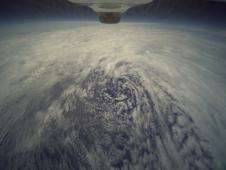
The GloPac mission paved the way for the multi-aircraft Genesis and Rapid Intensification hurricane mission of late summer 2010. That six-week NASA mission was a study of the formation and strengthening of tropical storms in the Gulf of Mexico and western Atlantic Ocean. Twenty passes were completed over the eye of Hurricane Earl during one Global Hawk flight. NASA's DC-8, WB-57 and Global Hawk flew simultaneously on several data-collection flights.
The swirling circulation pattern of tropical storm Frank off the southwestern coast of Baja California was captured in August 2010 by Ames Research Center's HDVis camera mounted on the aft fuselage of NASA's Global Hawk unmanned research aircraft. (NASA/NOAA image) "The Global Hawk's early missions have provided some exciting insights into its potential Earth system science use," said Randy Albertson, deputy director of the Airborne Science Program in NASA's Earth Science Division. "It's range and endurance enables observations over parts of the globe that are difficult to reach for extended measurements over vast areas, particularly over the oceans and polar regions."
A third science campaign in early 2011, the Winter Storms and Pacific Atmospheric Rivers mission, or WISPAR, explored atmospheric rivers and arctic weather and collected targeted observations designed to improve operational weather forecasts. Led by NOAA, WISPAR successfully evaluated the capabilities of an automated dropsonde system, dispensing 177 sondes over the mission's three flights.
"To take a military asset, like Global Hawk, and modify it to enable Earth science research is a great accomplishment for the NASA Global Hawk team," said Chris Naftel, Global Hawk project manager at NASA Dryden. "The completion of three very complex science campaigns during the first year demonstrates the ability of this team to conquer a vast array of challenges."
The coming years will find NASA's Global Hawk flight activity and scientific outreach grow considerably with two Earth Venture series missions. The Airborne Tropical Tropopause Experiment, or ATTREX, will allow scientists to study chemical and physical processes that control the flow of atmospheric gases at different times of the year. The Global Hawk will deploy to several bases in the Pacific Ocean region during the course of the ATTREX campaign.
The second Earth Venture mission, dubbed Hurricane and Severe Storm Sentinel, will study hurricanes in the Atlantic basin from a temporary base at NASA’s Wallops Flight Facility in Virginia during the 2012 – 14 Atlantic hurricane seasons.
"The Global Hawk's potential is sparking innovative development of new Earth observation strategies among the nation's scientists and the international community as well," Albertson added. "It's a new catalyst for international scientific collaboration, facilitating substantial gains in our understanding of our planet, as well as providing societal benefits around the world."
Provided by JPL/NASA


