Miniature invisibility 'carpet cloak' hides more than its small size implies
April 19, 2011

Miniature invisibility 'carpet cloak' hides more than its small size implies

Enlarge

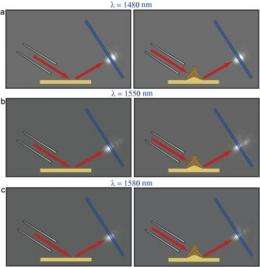
The measured output image from a flat surface (left) and a cloaked protruded surface (right) at 1,480 nm (a), 1,550 nm (b), and 1,580 nm (c). Credit: Technical University of Denmark/Optics Express

Invisibility cloaks are seemingly futuristic devices capable of concealing very small objects by bending and channeling light around them. Until now, however, cloaking techniques have come with a significant limitation—they need to be orders of magnitude larger than the object being cloaked.

This places serious constraints on practical applications, particularly for the optoelectronics industry, where size is a premium and any cloaking device would need to be both tiny and delicate.

An international team of physicists from the Technical University of Denmark (DTU), the University of Birmingham, UK, and Imperial College London, however, may have overcome this size limitation by using a technology known as a "carpet cloaks," which can conceal a much larger area than other cloaking techniques of comparable size. The researchers achieved their result by using metamaterials, artificial materials engineered to have optical properties not found in nature. They describe their approach in the Optical Society's (OSA) open-access journal Optics Express.

Jingjing Zhang, a postdoctoral researcher at DTU's Fotonik Department of Photonics Engineering and Structured Electromagnetic Materials, and an author of the Optics Express paper, explains that the team's new carpet cloak, which is based on an alternating-layer structure on a silicon-on-insulator (SOI) platform, introduces a flexible way to address the size problem.

"This new cloak, consisting of metamaterials, was designed with a that is simpler than previous metamaterial structures for cloaks," she says.

Grating structures channel light of a particular wavelength around an object. A grating structure is simply a series of slits or openings that redirect a beam of light.

"The highly anisotropic material comprising the cloak is obtained by adopting semiconductor manufacturing techniques that involve patterning the top silicon layer of an SOI wafer with nanogratings of appropriate filling factor. This leads to a cloak only a few times larger than the cloaked object," says Zhang. In this case, filling factor simply refers to the size of the grating structure and determines the wavelengths of light that are affected by the cloak.

By precisely restoring the path of the reflecting wave from the surface, the cloak creates an illusion of a flat plane for a triangular bump on the surface—hiding its presence over wavelengths ranging from 1480nm to 1580nm (see figure).

In less technical terms, the carpet cloaks work by essentially disguising an object from light, making it appear like a flat ground plane.

"The cloak parameters can be tweaked by tuning the filling factor and the orientation of the layers," says Zhang. "Therefore, layered materials bypass the limitation of natural materials at hand and give us extra freedom to design the devices as desired." In contrast to previous works based on nanostructures, the cloaking carpet used in this work also shows advantages of easier design and fabrication.

The cloak is made exclusively of dielectric materials that are highly transparent to infrared light, so the cloak itself is very efficient and absorbs a negligible fraction of energy.

Zhang and her colleagues are also looking at ways of improving the technology. They report in their Optics Express paper that even though the cloaking ensures that the beam shape is unaffected by the presence of the object, the beam intensity is slightly reduced. They attribute this to reflection at the cloak's surface, and partly by imperfections of the fabrication. They also determined that adding an additional layer of material around the cloak and improving uniformity of the grating would help eliminate reflection and scattering issues.

"Although our experiment was carried out at near-infrared frequencies, this design strategy is applicable in other frequency ranges," notes Zhang. "We anticipate that with more precise fabrication, our technique should also yield a true invisibility carpet that works in the microwave and visible parts of the spectrum and at a larger size—showing promise for many futuristic defense and other applications."

More information: "Homogenous optical cloak constructed with uniform layered structures," Jingjing Zhang, Liu Liu, Yo Luo, Shuang Zhang, and Niels Asger Mortensen, Optics Express, Volume 19, Issue 9, pp. 8625-8631. Available at: http://www.opticsi … oe-19-9-8625

Provided by Optical Society of America search and more info website

Filter


Move the slider to adjust rank threshold, so that you can hide some of the comments.


Display comments: newest first

WarRoom
Apr 19, 2011

Rank: 5 / 5 (1)
"futuristic defense and other applications." Sweet, I can't wait to go outside a not see a cloaked North Korean UAV hovering over my house. This technology will surely be better for us all.
Norezar
Apr 20, 2011

Rank: 5 / 5 (1)
Well at least they won't be trying to sell us cheaply made sandals and handbags.
Mahal_Kita
Apr 20, 2011

Rank: not rated yet
Well at least they won't be trying to sell us cheaply made sandals and handbags.


Of course 'they' will and US based importers will profit. Just as it has always been the case. Most Nike's are produced for a few dollars and resold for big bucks. The weird thing is.. That you buy them for big bucks and seem to be comfortable with doing so.
ZephirAWT
Apr 20, 2011

Rank: 1 / 5 (1)
This cloak appears to be very effective (it's sorta ideal prototype of carpet cloak) - but it works only at the plane perpendicular to cloak.

http://arxiv.org/...1584.pdf
Rank 5 /5 (3 votes)
Relevant PhysicsForums posts
  • Writing a book so im learning about things, i have some general questions please read
    created1 hour ago
  • Question about induced E field.
    created2 hours ago
  • Charging a capacitor in a tesla coil
    created2 hours ago
  • Water Rocket
    created6 hours ago
  • why do trucks have bigger brakes?
    created10 hours ago
  • Solar Sail Physics - Do they work on a large scale?
    created11 hours ago
  • More from Physics Forums - General Physics

More news stories

Landmark calculation clears the way to answering how matter is formed

(Phys.org) -- An international collaboration of scientists, including Thomas Blum, associate professor of physics, is reporting in landmark detail the decay process of a subatomic particle called a kaon – ...

Physics / General Physics

created May 25, 2012 | popularity 4.4 / 5 (20) | comments 47 | with audio podcast

Is a classical electrodynamics law incompatible with special relativity?

(Phys.org) -- The laws of classical electromagnetism that were developed in the 19th century are the same laws that scientists use today. They include Maxwell’s four equations along with the Lorentz la ...

Physics / General Physics

created May 24, 2012 | popularity 4.7 / 5 (15) | comments 36 | with audio podcast feature

Lying in wait for WIMPs: Researchers seek to dramatically increase sensitivity of Large Underground Xenon detector

Although it's invisible, dark matter accounts for at least 80 percent of the matter in the universe. No one knows what it is, but most scientists would bet on weakly interacting massive particles, or WIMPs.

Physics / General Physics

created May 23, 2012 | popularity 4 / 5 (7) | comments 15 | with audio podcast

Hall effect at the speed of light: How can you demonstrate relativistic effects with your mobile phone?

The relativistic Hall effect describing objects rotating at speeds comparable with the speed of light has been reported.

Physics / General Physics

created May 21, 2012 | popularity 4.3 / 5 (3) | comments 8

Cloak of invisibility: Engineers use plasmonics to create an invisible photodetector

A team of engineers at Stanford and the University of Pennsylvania has for the first time used "plasmonic cloaking" to create a device that can see without being seen - an invisible machine that detects light. It is the first ...

Physics / General Physics

created May 21, 2012 | popularity 4.8 / 5 (16) | comments 7 | with audio podcast


Scientist: Evolution debate will soon be history

(AP) -- Richard Leakey predicts skepticism over evolution will soon be history. Not that the avowed atheist has any doubts himself.

Dell tablet leak: 10.1-inch display, two-battery choice

(Phys.org) -- Headline after headline talks about vendors’ tablets in the wings as likely number-one contenders for the iPad. Such claims have justifiably been taken with a grain of salt, considering ...

SpotterRF debuts Radar Backpack Kit (w/ Video)

(Phys.org) -- SpotterRF has announced a special radar backpack kit designed to enhance situational awareness for soldiers on the ground. The company says its special radar is designed for warfighters as part ...

SpaceX capsule has 'new car' smell, astronauts say (Update)

SpaceX's Dragon cargo vessel smells like a new car, said astronauts at the International Space Station after opening the hatches Saturday following the spacecraft's landmark mission to the orbiting lab.

Thousands of shellfish found dead in Peru

Thousands of crustaceans were found dead off the coast of Lima following the mystery mass death of dolphins and pelicans, the Peruvian Navy said Friday.

Astronomers seize last chance in lifetime for Venus Transit

Astronomers are gearing for one the rarest events in the Solar System: an alignment of Earth, Venus and the Sun that will not be seen for another 105 years.