Lollipops with side effects: Plant's sugary offering betrays caterpillars to predatory ants
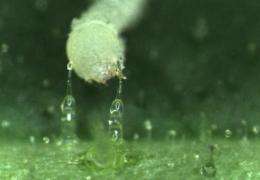
Trichomes, hair-like projections on leaves, are part of a plant's defense against herbivores: they can be obstacles, traps, or reservoirs for toxic substances. The hairs of wild tobacco Nicotiana attenuata contain primarily acyl sugars, which are composed of the common sugar, sucrose, bound to branched chain aliphatic acids, compounds that give baby vomit its distinctive odor. Tiny, freshly hatched caterpillars consume these sweet secretions.
However, consuming the sugary exudations from the plant hairs has unwanted side effects for the insects: the caterpillars develop a distinctive body odor, and so does their frass (the term entomologists use for "caterpillar poop"). The Max Planck researchers discovered that ants recognize the caterpillar's body odor and use the aliphatic acids excreted by the caterpillars after ingestion of acyl sugars to locate their prey. These predatory ants locate the tiny larvae on the plants and carry them back to their nests to feed their young and co-workers. Thus plants use acyl sugars not only as sticky traps against aphids, leaf fleas or spider mites; they can also skillfully utilize them to tag voracious caterpillars with a distinctive smell which makes them easy prey to locate. (PNAS Early Edition, April 25-29, 2011, DOI: 10.1073/pnas.1101306108).
Striking features of animals can be fateful, because they may betray them to their enemies. Colorful feathers or incautious courtship behavior are examples of such attributes, as are involuntary body odors emitted by the organism itself or its excretions. Larvae of the silver-spotted skipper, Epargyreus clarus, are punctilious about removing feces from their shelter, so that predators won't find them due to their telltale odors. Some plant species, on the other hand, take advantage of the predators' preferences when they produce their compelling "green leaf volatiles" to protect themselves indirectly against herbivores. In a recent study, Ian Baldwin, head of the Department of Molecular Ecology at the Max Planck Institute for Chemical Ecology in Jena, Germany, and his colleagues showed that Manduca sexta larvae have a substance in their oral secretions that catalyzes the transformation of green leaf volatiles into dangerous attractants – with fatal consequences for the caterpillars. The attractant called (E)-2-hexenal lures predatory bugs that feed on Manduca sexta larvae and eggs. (see "Lethal Backfire: Green Odor with Fatal Consequences for Voracious Caterpillars")
Knowing that trichomes are supposed to be defensive structures, replete with poisons and sticky substances, the researchers were surprised to observe that freshly hatched Manduca sexta larvae as well as larvae of two Spodoptera species did not just start feeding on the leaf tissue of wild tobacco Nicotiana attenuata; they directly consumed the hairs on the leaves and their contents. The reason for this behavior is probably that the trichomes contain large amounts of sucrose bound to fatty acids. This diet is rich in calories and the larvae thrive and prosper; toxic effect could not be discovered. However, when Alexander Weinhold, a PhD student in Ian Baldwin's group studied the animals and their excretions, he found that their odor profile had significantly changed after digesting the sweet trichome secretions: the larvae's bodies and excretions evaporated four volatile branched-chain aliphatic acids into the air; within two hours the considerable amount of 0.03 milligram emitted by the feces could be measured. Chemical analyses revealed that these aliphatic acids in the larvae's midgut originated from the acyl sugars that the larvae had consumed with the trichomes.
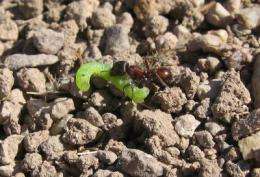
"We were actually pretty sure that the volatile fatty acids would attract predators like bugs of the Geocoris genus, which would feed on the Manduca larvae and eggs," says Baldwin. But control experiments that included Nicotiana glauca, a species which completely lacks trichomes on its leaves, did not confirm a significantly increased occurrence of the bugs. However, tiny larvae on leaves that had been additionally perfumed with branched-chain aliphatic acids became easier prey for predators, even though it was unclear who the attackers were. The scientists now suspected the many ant species, which are abundant in the Utah habitat.
To test the responses of the many different ant species which inhabit Nicotiana attenuata's native habitat to branch-chain aliphatic acids, Ian Baldwin laid out cooked rice grains that had been marked with 0.03 milligram of volatile fatty acids – the exact amount that had been measured from the larval excretions. The result: ants from five different nests specifically headed for the rice grains and carried them away. The ants belonged to the Pogonomyrmex rugosus species; they feed on plant seeds as well as cicadas and small caterpillars. In further extensive experiments, designed to exclude the influence of visual features of the larvae, Baldwin used fresh versus heated (= free of aliphatic acids) frass as well as "aliphatic acid perfume" and thereby demonstrated that the ants respond specifically to the aliphatic acid scent of the young larvae - an odor with fateful consequences for the herbivores.
The scientists assume that wild tobacco plants trick their enemies by providing tasty sugar molecules with branched-chain aliphatic acids. This trick is beneficial for the plants because it betrays the herbivores to their own enemies. Experiments in the planning stages will examine whether this molecular strategy is an "indirect defense" in the ecological sense. These studies will include transgenic plants which can no longer produce acylated sugars in their trichomes.
More information: A. Weinhold, I. T. Baldwin: Trichome-derived O-acyl sugars are a first meal for caterpillars that tags them for predation. Proceedings of the National Academy of Sciences, Early Edition, April 25-29, 2011, DOI: 10.1073/pnas.1101306108
Provided by Max-Planck-Gesellschaft


