Largest spider fossil found in China

April 21, 2011 by Deborah Braconnier report

Largest spider fossil found in China
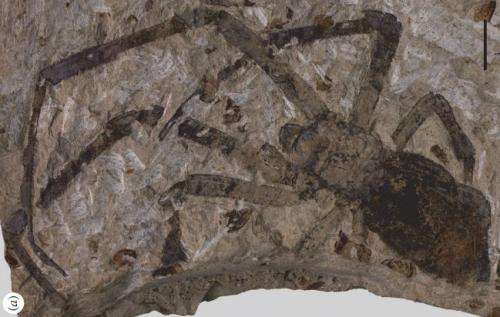
Enlarge

Nephila jurassica sp. nov. holotype, scale bar, 5 mm. Image credit: Biology Letters, doi:10.1098/rsbl.2011.0228

(PhysOrg.com) -- According to Paul Selden, the director of the Paleontological Institute at the University of Kansas, he and his team members have discovered the largest spider fossil. The fossil was discovered within ancient volcanic ash located in Inner Mongolia in the Daohugoa fossil beds. The new spider, named Nephila Jurassica, is around two inches long and dates back to Middle Jurassic around 165 million years ago.

Published in Biology Letters, Selden and his team say this would have lived in a more tropical climate than the one it was discovered in, suggesting the area has undergone great climate change. They believe the spider originated on Pangaea (the ). The Nephila jurassica, like modern day golden orb-weavers, would have lived within its orb web, probably in the clearing of a forest or close to source of water.

Until this discovery, the oldest known Nephila fossil was 34 million years old, making this fossil and the origin of the Nephila spiders much older than originally thought. While it is the largest spider fossil ever found, it is not the oldest. Other spider fossils found have been as old as 310 million years (Eocteniza silvicola and Protoctenzia Britannica), but they were not the Nephila genus.

The spider’s spinnerets, or silk spinning organs, were visible on the spider’s legs, suggesting that it, like its modern day orb-weavers, were capable of spinning large, durable webs capable of trapping a variety of insects. The larger Nephila spiders of today, growing as large as four or five inches, are able to spin webs strong enough to trap small birds and bats.

More information: A golden orb-weaver spider (Araneae: Nephilidae: Nephila) from the Middle Jurassic of China, Biol. Lett. Published online before print April 20, 2011, doi:10.1098/rsbl.2011.0228

Abstract
Nephila are large, conspicuous weavers of orb webs composed of golden silk, in tropical and subtropical regions. Nephilids have a sparse fossil record, the oldest described hitherto being Cretaraneus vilaltae from the Cretaceous of Spain. Five species from Neogene Dominican amber and one from the Eocene of Florissant, CO, USA, have been referred to the extant genus Nephila. Here, we report the largest known fossil spider, Nephila jurassica sp. nov., from Middle Jurassic (approx. 165 Ma) strata of Daohugou, Inner Mongolia, China. The new species extends the fossil record of the family by approximately 35 Ma and of the genus Nephila by approximately 130 Ma, making it the longest ranging spider genus known. Nephilidae originated somewhere on Pangaea, possibly the North China block, followed by dispersal almost worldwide before the break-up of the supercontinent later in the Mesozoic. The find suggests that the palaeoclimate was warm and humid at this time. This giant fossil orb-weaver provides evidence of predation on medium to large insects, well known from the Daohugou beds, and would have played an important role in the evolution of these insects.

© 2010 PhysOrg.com

4.2 /5 (9 votes)  

Filter


Move the slider to adjust rank threshold, so that you can hide some of the comments.


Display comments: newest first

Mayday
Apr 21, 2011

Rank: 5 / 5 (1)
As Ed McMahon would have said: "How big was it?"
If the scale bar is 5mm, the bugger doesn't seem that large. In September in Florida one can find Banana Spiders as big as your hand. I have seen them hang webs high across a two lane road -- easily spanning 30-40 feet. Have Golden Orb Weavers gotten larger over the eons?
that_guy
Apr 21, 2011

Rank: not rated yet
The article states a number of times it's relative size (Not that big) and the fact that it is 2 inches long (Not sure if that includes the legs), and that modern spiders of that genus are bigger.

It seems that the Dinosaurs had it pretty good as far as the spider problem...our spiders are bigger.
Decimatus
Apr 21, 2011

Rank: 5 / 5 (3)
"The larger Nephila spiders of today, growing as large as four or five inches, are able to spin webs strong enough to trap small birds and bats."

I have seen spiders cast webs so big I could have swore they were trying to catch me and not something so "small" as a bird or bat.
rwinners
Apr 22, 2011

Rank: not rated yet
The article states 'largest spider fossil'. That's 2 adjectives and one noun.
Rank 4.2 /5 (9 votes)
Relevant PhysicsForums posts

More news stories

Social welfare cuts ultimately come with heavy price, researchers say

(Phys.org) -- Slashing government funding for Medicaid, food stamps and other programs that serve the poor – while politically popular with some lawmakers and many conservatives – may do more harm ...

Other Sciences / Social Sciences

created May 24, 2012 | popularity 4.1 / 5 (14) | comments 124

Ancient Bethlehem seal unearthed in Jerusalem

Israeli archaeologists have discovered a 2,700-year-old seal that bears the inscription "Bethlehem," the Israel Antiquities Authority announced Wednesday, in what experts believe to be the oldest artifact ...

Other Sciences / Archaeology & Fossils

created May 23, 2012 | popularity 3.5 / 5 (14) | comments 23

Oldest Jewish archaeological evidence on the Iberian Peninsula

German archaeologists of the Friedrich Schiller University Jena found one of the oldest archaeological evidence so far of Jewish Culture on the Iberian Peninsula at an excavation site in the south of Portugal, ...

Other Sciences / Archaeology & Fossils

created May 25, 2012 | popularity 4.3 / 5 (4) | comments 12

Dollars and sense: Why are some people morally against tax?

As the U.S. presidential election campaigns heat up, the economic debate is dominated by bailouts, austerity and, inevitably, taxation. Now a new study published in Symbolic Interaction asks why tax is such an important issue ...

Other Sciences / Social Sciences

created May 23, 2012 | popularity 3 / 5 (2) | comments 12

Oldest art even older

New dates from Geißenklösterle Cave in Southwest Germany document the early arrival of modern humans and early appearance of art and music.

Other Sciences / Archaeology & Fossils

created May 24, 2012 | popularity 5 / 5 (2) | comments 6


Scientist: Evolution debate will soon be history

(AP) -- Richard Leakey predicts skepticism over evolution will soon be history. Not that the avowed atheist has any doubts himself.

Dell tablet leak: 10.1-inch display, two-battery choice

(Phys.org) -- Headline after headline talks about vendors’ tablets in the wings as likely number-one contenders for the iPad. Such claims have justifiably been taken with a grain of salt, considering ...

SpotterRF debuts Radar Backpack Kit (w/ Video)

(Phys.org) -- SpotterRF has announced a special radar backpack kit designed to enhance situational awareness for soldiers on the ground. The company says its special radar is designed for warfighters as part ...

SpaceX capsule has 'new car' smell, astronauts say (Update)

SpaceX's Dragon cargo vessel smells like a new car, said astronauts at the International Space Station after opening the hatches Saturday following the spacecraft's landmark mission to the orbiting lab.

Thousands of shellfish found dead in Peru

Thousands of crustaceans were found dead off the coast of Lima following the mystery mass death of dolphins and pelicans, the Peruvian Navy said Friday.

Astronomers seize last chance in lifetime for Venus Transit

Astronomers are gearing for one the rarest events in the Solar System: an alignment of Earth, Venus and the Sun that will not be seen for another 105 years.