Two kinds of Webb telescope mirrors arrive at NASA Goddard
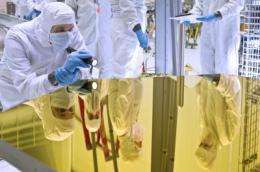
An engineer examines the Webb telescope primary mirror Engineering Design Unit segment in the clean room at NASA's Goddard Space Flight Center, Greenbelt, Md. Credit: NASA/Chris Gunn
It takes two unique types of mirrors working together to see farther back in time and space than ever before, and engineers at NASA's Goddard Space Flight Center have just received one of each type. Primary and Secondary Mirror Engineering Design Units (EDUs) have recently arrived at NASA's Goddard Space Flight Center in Greenbelt, Md. from Northrop Grumman Aerospace Systems in Redondo Beach, Calif. and are undergoing examination and testing. When used on the James Webb Space Telescope those two types of mirrors will allow scientists to make those observations.
"The Primary mirror EDU will be used next year to check out optical test equipment developed by Goddard and slated to be used to test the full Flight Primary mirror," said Lee Feinberg, the Optical Telescope Element Manager for the Webb telescope at NASA Goddard. "Following that, the primary and secondary EDU's will actually be assembled onto the Pathfinder telescope. The Pathfinder telescope includes two primary mirror segments (one being the Primary EDU) and the Secondary EDU and allows us to check out all of the assembly and test procedures (that occur both at Goddard and testing at Johnson Space Center, Houston, Texas) well in advance of the flight telescope assembly and test."
The primary mirror is actually composed of 18 smaller hexagonal mirrors that are assembled together into what appears to be a giant hexagon that sits atop the Webb telescope's sunshield. Webb Telescope's scientists and engineers determined that a primary mirror measuring 6.5 meters (21 feet 4 inches) across is what was needed to measure the light from these distant galaxies. Each of these mirrors is constructed from beryllium, a light and strong metal. Each of the 18 mirror segments weighs approximately 20 kilograms (46 pounds).
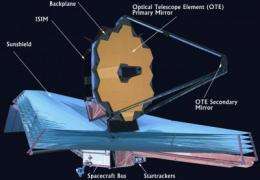
This artist's rendition of the James Webb Space Telescope shows where the primary and secondary mirrors are located. Credit: NASA
Why are the mirrors hexagonal shaped? Because a hexagon allows a segmented mirror to fit together without gaps. When Webb's primary mirror is focused on a distant star for example, that image will appear in all 18 mirror segments. To focus on the star and get one image, the mirror segments can then be tilted to align the 18 separate images into a single image.Although there are 18 segments, there are three different optical prescriptions for the 18 segments: six segments of each prescription. The segment received is the first of the "A" prescription segments for which a total of 7 will be made - 6 flight and 1 spare. A prescription is similar to an eyeglass prescription and specifies a unique mirror curvature. Like eyeglasses, mirrors with the same prescription are interchangeable.
The primary mirror EDU that arrived at Goddard is also a flight spare. That means it can be used on the actual telescope. In fact, it could even be put on the telescope now if needed.
The primary mirror segment has already been cleaned and coated. Ball Aerospace & Technologies cleaned the mirror segment and Quantum Coating, Inc., in Moorestown, N.J., coated it. Ball Aerospace then took the mirror segment back, reassembled it with mounts and actuators and conducted final vibration testing.
Afterward, the mirror segment went back to the X-ray and Cryogenic Facility (XRCF) in Huntsville, Ala., where Ball performed final cryogenic acceptance testing on the segment before it came to NASA Goddard.
The secondary mirror on the Webb telescope will direct the light from the primary mirror to where it can be collected by the Webb's instruments. The secondary mirror is connected to "arms" that position it in front of the 18 primary mirror segments. It will focus all of the light from the 18 primary mirrors.
The secondary EDU at Goddard is not coated but can be, so it can be a flight spare once coated.
Eventually, the final flight mirrors will all come to NASA Goddard and be assembled on the telescope and the instrument module. Then, as a complete unit it will undergo acoustic and vibration testing at Goddard.
Provided by
NASA's Goddard Space Flight Center
-
From lemons to lemonade: Reaction uses carbon dioxide to make carbon-based semiconductor,
32 comments
-
Thioridazine kills cancer stem cells in human while avoiding toxic side-effects of conventional cancer treatments,
3 comments
-
SpaceX private rocket blasts off for space station (Update),
42 comments
-
Climate scientists say they have solved riddle of rising sea,
30 comments
-
Research team claims to have found evidence Lake Cheko is impact crater for Tunguska Event,
18 comments
-
revamping general concept and cosmological principle
May 25, 2012
-
Transiting Exoplanet Light Curve
May 25, 2012
-
Math behind Theoretical Physics
May 24, 2012
-
Do we know whats at the center of galaxies yet?
May 23, 2012
-
Structure of the Milky Way?
May 20, 2012
-
What would it take to terraform Pluto and Charon?
May 19, 2012
- More from Physics Forums - General Astronomy
More news stories
SpaceX capsule has 'new car' smell, astronauts say (Update)
SpaceX's Dragon cargo vessel smells like a new car, said astronauts at the International Space Station after opening the hatches Saturday following the spacecraft's landmark mission to the orbiting lab.
Space & Earth / Space Exploration
18 hours ago |
4.5 / 5 (20) |
0
Astronomers seize last chance in lifetime for Venus Transit
Astronomers are gearing for one the rarest events in the Solar System: an alignment of Earth, Venus and the Sun that will not be seen for another 105 years.
18 hours ago |
5 / 5 (3) |
2
Australia hails surprise super-telescope decision
Australia has hailed a surprise decision giving it a role in a radio telescope project aimed at revolutionising astronomy, vowing to draw on its decades of experience in space science.
18 hours ago |
5 / 5 (4) |
1
Astronauts enter world's 1st private supply ship
(AP) -- Space station astronauts floated into the Dragon on Saturday, a day after its heralded arrival as the world's first commercial supply ship.
Space & Earth / Space Exploration
18 hours ago |
5 / 5 (5) |
0
Sophisticated simulations predict future warming
The chances of our planet being hit by a global warming of 3 degrees Celsius by 2050 is as likely as it being hit by an increase of 1.4 degrees, new research shows. Presented in the journal Nature Geoscience, the British study ...
Space & Earth / Earth Sciences
May 22, 2012 |
4.4 / 5 (9) |
51
Scientist: Evolution debate will soon be history
(AP) -- Richard Leakey predicts skepticism over evolution will soon be history. Not that the avowed atheist has any doubts himself.
Dell tablet leak: 10.1-inch display, two-battery choice
(Phys.org) -- Headline after headline talks about vendors tablets in the wings as likely number-one contenders for the iPad. Such claims have justifiably been taken with a grain of salt, considering ...
SpotterRF debuts Radar Backpack Kit (w/ Video)
(Phys.org) -- SpotterRF has announced a special radar backpack kit designed to enhance situational awareness for soldiers on the ground. The company says its special radar is designed for warfighters as part ...
Thousands of shellfish found dead in Peru
Thousands of crustaceans were found dead off the coast of Lima following the mystery mass death of dolphins and pelicans, the Peruvian Navy said Friday.
Keep food safety in mind this memorial day weekend
(HealthDay) -- Picnics, parades and cookouts are as much a part of Memorial Day weekend as tributes to the United States' war veterans.
Family history of Alzheimer's affects functional connectivity
(HealthDay) -- Cognitively normal individuals with a family history of late-onset Alzheimer's disease (AD) may display lower resting state functional connectivity in the default mode network (DMN) of the brain, ...

Apr 13, 2011
Rank: not rated yet
They're going to launch this in one piece? Amazing.