Eyes of rock let chitons see predators
April 14, 2011

Eyes of rock let chitons see predators

Enlarge

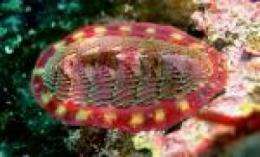
This lined chiton, whose anterior end is to the right, lives about 50 feet below the water's surface near Whidbey Island, Washington. Credit: Kirt L. Onthank

Using eyes made of a calcium carbonate crystal, a simple mollusk may have evolved enough vision to spot potential predators, scientists say.

Daniel Speiser, a postdoctoral fellow in the Department of Ecology Evolution and Marine Biology at UC Santa Barbara, studied mollusks that he collected in the Florida Keys. His research of their vision, performed during his graduate studies at Duke University, resulted in a study published today by .

The three-inch-long mollusks, called chitons, have hundreds of eye-like structures with lenses made of aragonite, a type of . It's the first time scientists have found an animal that makes lenses from aragonite and not the rock's close cousin, calcite.

Scientists discovered the chiton's unique eyes decades ago. But it wasn't clear whether chitons used these eyes to see objects overhead, or simply to sense changes in light. "Turns out they can see objects, though probably not well," said Speiser.

"It's surprising how these make their eyes from rocks," said Sönke Johnsen, associate professor of biology at Duke. Most animals make their eyes from cells with proteins and chitin. "But it seems like an easy way to evolve eyes, by using what you've already got," he said. Chitons also make their shells from aragonite.
Eyes of rock let chitons see predators
Enlarge

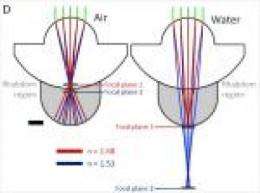
This drawing shows the way light would bend and focus in the chiton's eye depending on whether the animal was above or below water. Credit: Daniel Speiser and Current Biology

Johnsen and Speiser studied West Indian fuzzy chitons, or Acanthopleura granulata, which have flat shells made of eight separate plates. Hundreds of tiny lenses on the surface of the plates cover clusters of light-sensitive cells beneath.

To test the creature's vision, Speiser placed individual chitons on a slate slab. When left undisturbed, they lift part of their armored, oval-shaped body to breathe. At this point, Speiser showed them either a black disk ranging from .35 centimeters to 10 centimeters in diameter or a corresponding gray slide that blocked the same amount of light. The disk or slide appeared 20 centimeters above the chitons.

When shown the gray screens, the chitons did not respond. But they clamped down when shown a black disk three centimeters or larger in diameter. That would be the equivalent of humans looking in the sky and seeing a disk the diameter of 20 moons, making human vision about a thousand times sharper than chiton vision, Johnsen said.

Because the chitons responded to the larger disks and not the gray slides, they seem to be seeing the disk and not simply responding to a change in light, said University of Sussex biologist Michael Land, an expert on animal vision who was not involved in the research. It's not yet clear if they respond only to the removal of light by the disk as opposed to added light.

Land also said it's not likely that the chitons' eyes were part of the evolutionary route to human eyes.

Chitons are an ancient, primitive species that first appeared on Earth more than 500 million years ago. But the oldest chitons with eyes only began to appear in the fossil record in the last 25 million years, making their eyes among the most recent to evolve in animals. Speiser said chitons probably evolved to have eyes with lenses so they could see their and defend themselves against being eaten.

Speiser and his colleagues also tested whether the chitons' eyes work in both air and water, since some species spend time in both. The experiments made a strong case for the chiton lens being able to focus light differently, depending on whether the animal is above or below water, Land said.

He added that chiton eyes are still an anomaly in the of vision. The retinas are structurally similar to snail and slug retinas. But snail and slug retinas respond to the appearance of light, while chiton retinas may only respond to the removal of light, a difference that might be worth another look, Land said.

More information: http://www.cell.co … 11%2900305-8

Provided by University of California - Santa Barbara search and more info website

Filter


Move the slider to adjust rank threshold, so that you can hide some of the comments.


Display comments: newest first

Tachyon8491
Apr 14, 2011

Rank: 5 / 5 (3)
As traceable in the biostratigraphic record, eyes have been developed in dozens of different and specialised ways, from simple crystalline eyes to biconvex, from eye-spots in algae to raptor eyes with two foveas, giant squid's eyes capable of colour vision and the mantis shrimp eye which has ten different photoreceptors for fine colour differentiation in its own specialised environment. Eyes are an evolutionary solution to the same challenge - remote shape-and-movement detection that is an improvement on simpler senses such as the tactile, taste (suspended particulates) and acoustic/seismic based functions.
Rank 5 /5 (2 votes)
Relevant PhysicsForums posts

More news stories

Scientist: Evolution debate will soon be history

(AP) -- Richard Leakey predicts skepticism over evolution will soon be history. Not that the avowed atheist has any doubts himself.

Biology / Evolution

created 9 hours ago | popularity 3.4 / 5 (8) | comments 21

Thousands of shellfish found dead in Peru

Thousands of crustaceans were found dead off the coast of Lima following the mystery mass death of dolphins and pelicans, the Peruvian Navy said Friday.

Biology / Ecology

created 19 hours ago | popularity 4.8 / 5 (4) | comments 6

More plant species responding to global warming than previously thought

(Phys.org) -- Far more wild plant species may be responding to global warming than previous large-scale estimates have suggested.

Biology / Ecology

created May 22, 2012 | popularity 4.6 / 5 (14) | comments 18 | with audio podcast

Totally rad: Scientists create rewritable digital data storage in DNA

(Phys.org) -- Scientists from Stanford's Department of Bioengineering have devised a method for repeatedly encoding, storing and erasing digital data within the DNA of living cells.

Biology / Biotechnology

created May 21, 2012 | popularity 4.9 / 5 (17) | comments 11 | with audio podcast

For monogamous sparrows, it doesn't pay to stray (but they do it anyway)

It's quite common for a female song sparrow to stray from her breeding partner and mate with the male next door, but a new study shows that sleeping around can be costly.

Biology / Plants & Animals

created May 22, 2012 | popularity 5 / 5 (1) | comments 7 | with audio podcast


Dell tablet leak: 10.1-inch display, two-battery choice

(Phys.org) -- Headline after headline talks about vendors’ tablets in the wings as likely number-one contenders for the iPad. Such claims have justifiably been taken with a grain of salt, considering ...

SpotterRF debuts Radar Backpack Kit (w/ Video)

(Phys.org) -- SpotterRF has announced a special radar backpack kit designed to enhance situational awareness for soldiers on the ground. The company says its special radar is designed for warfighters as part ...

SpaceX capsule has 'new car' smell, astronauts say (Update)

SpaceX's Dragon cargo vessel smells like a new car, said astronauts at the International Space Station after opening the hatches Saturday following the spacecraft's landmark mission to the orbiting lab.

Astronomers seize last chance in lifetime for Venus Transit

Astronomers are gearing for one the rarest events in the Solar System: an alignment of Earth, Venus and the Sun that will not be seen for another 105 years.

Keep food safety in mind this memorial day weekend

(HealthDay) -- Picnics, parades and cookouts are as much a part of Memorial Day weekend as tributes to the United States' war veterans.

Australia hails surprise super-telescope decision

Australia has hailed a surprise decision giving it a role in a radio telescope project aimed at revolutionising astronomy, vowing to draw on its decades of experience in space science.