Era of canopy crane ending; certain research and education activities remain
April 28, 2011

Era of canopy crane ending; certain research and education activities remain

Enlarge

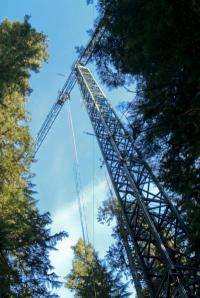
The Liebherr 550 HC crane was purchased used and erected in 1995. It had previously been used at construction sites. Credit: University of Washington

The 25-story construction crane used since 1995 to investigate such things as how Pacific Northwest forests absorb carbon dioxide, obtain sufficient water and resist attacks by pests and diseases is being pruned back to just the tower.

The Wind River Canopy Crane, located in a 500-year-old near Stevenson in southwest Washington, has been operated cooperatively by the University of Washington, the Forest Service's Pacific Northwest Research Station and the Gifford Pinchot National Forest. The partners say the jib – the arm of the crane – is being removed because the faces budget shortfalls and replacement parts for the crane are becoming more difficult to obtain. Funding for the crane's operation has largely come from the station's budget. The jib will be removed when money is available, possibly this summer.

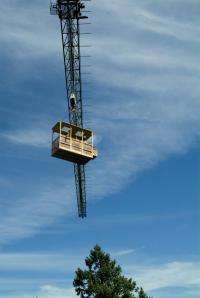
Gone will be the ability to carry a gondola with researchers and instruments from the bottom to the top of trees as tall as 220 feet in a 560-foot circle of old-growth forest. The Wind River crane has the farthest reach of any of the nine forest canopy research cranes operating in the world today.

Remaining will be the 230-foot tower with sensors that collect data about how the is absorbed and released by the forest, work under way since 1999. Because of the crane, the UW and the Forest Service have one of the world's longest, continuously collected data sets of carbon flux from a forest, according to Jerry Franklin, UW professor of forest resources, who was the prime mover in the 1990s for landing the $1 million project.
Era of canopy crane ending; certain research and education activities remain
Enlarge

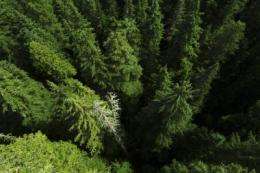
The crane lifts researchers above trees as tall as 220 feet. The old-growth Douglas fir and western hemlock forest is typical of those that once covered much of the Cascades in western Washington and Oregon. Credit: University of Washington

The carbon flux data are important as policymakers and citizens consider how to manage forests to maximize the amount of carbon they hold, he said.

Work at the crane site produced some of the first data to substantiate what Franklin and other scientists suspected in the 1980s: that old-growth Douglas fir forests weren't emitting more carbon than they were absorbing.

"Data collected at the crane site revealed that old growth forests are a sink for carbon," Franklin says.

A growing number of partners, ranging from the National Oceanic and Atmospheric Administration to the Smithsonian Institution Global Earth Observatories, count on carbon flux and isotope data being collected at the Wind River facility from the tower. Recently the site was chosen as the Pacific Northwest core site for the National Ecological Observatory Network, known as NEON, a major new initiative of the National Science Foundation.
Era of canopy crane ending; certain research and education activities remain
Enlarge

Scientists in the gondola were able to reach the canopy in a 560-foot circle of the forests. Credit: University of Washington

The crane has facilitated other significant scientific discoveries, Franklin says, including seminal research on the structure of forest canopies, physiology of northwestern tree species, carbon and water cycles in forests, forest productivity and health, and the contributions of forest canopies to biodiversity, including birds, bats and insects. Researchers and students using the crane have generated more than 250 scientific publications.

The crane has, for example, enabled Pacific Northwest Research Station ecologist Rick Meinzer to study how very tall trees get the water they need to survive centuries of environmental extremes. During annual cycles of summer drought, trees rely on internal water storage to stabilize the supply of water to foliage high in the canopy, and on their deep roots to bring water close to the surface to feed shallow roots that might otherwise die every summer.

"Research using the crane has provided important insights about the factors that limit maximum tree height and why height growth slows drastically as a tree becomes taller," Meinzer says. "The tower will continue to be part of the nationwide network for continuous camera observation of changes in the timing of events such as leaf emergence and senescence, which are being influenced by climate change. Camera images are updated continuously and are available to both scientists and the public through websites."

The tower site and experimental forest also will continue to provide educational opportunities for high-school and college students focused on forest ecology, population dynamics and functions such as the cycling of carbon, water and nutrients.

More information: http://depts.washi … f/crane.html

Provided by University of Washington search and more info website

Filter


Move the slider to adjust rank threshold, so that you can hide some of the comments.


Display comments: newest first

omatumr
May 01, 2011

Rank: 1 / 5 (1)
Thanks for the story.

This looks like boondoggle - a project funded from Washington, DC by a bureaucrat trying to spend an overabundance of research funds for "climate".

So long as our government ignored the influence of Earth's variable heat source - the Sun, all of those federal research funds were squandered.

See: "Earth's Heat Source - The Sun", Energy and Environment 20, 131-144 (2009);
http://arxiv.org/pdf/0905.0704

With kind regards,
Oliver K. Manuel
Rank not rated yet
Relevant PhysicsForums posts

More news stories

SpaceX capsule has 'new car' smell, astronauts say (Update)

SpaceX's Dragon cargo vessel smells like a new car, said astronauts at the International Space Station after opening the hatches Saturday following the spacecraft's landmark mission to the orbiting lab.

Space & Earth / Space Exploration

created 19 hours ago | popularity 4.5 / 5 (20) | comments 0

Astronomers seize last chance in lifetime for Venus Transit

Astronomers are gearing for one the rarest events in the Solar System: an alignment of Earth, Venus and the Sun that will not be seen for another 105 years.

Space & Earth / Astronomy

created 19 hours ago | popularity 5 / 5 (3) | comments 2

Australia hails surprise super-telescope decision

Australia has hailed a surprise decision giving it a role in a radio telescope project aimed at revolutionising astronomy, vowing to draw on its decades of experience in space science.

Space & Earth / Astronomy

created 19 hours ago | popularity 5 / 5 (4) | comments 1

Astronauts enter world's 1st private supply ship

(AP) -- Space station astronauts floated into the Dragon on Saturday, a day after its heralded arrival as the world's first commercial supply ship.

Space & Earth / Space Exploration

created 19 hours ago | popularity 5 / 5 (5) | comments 0

Sophisticated simulations predict future warming

The chances of our planet being hit by a global warming of 3 degrees Celsius by 2050 is as likely as it being hit by an increase of 1.4 degrees, new research shows. Presented in the journal Nature Geoscience, the British study ...

Space & Earth / Earth Sciences

created May 22, 2012 | popularity 4.4 / 5 (9) | comments 51


Scientist: Evolution debate will soon be history

(AP) -- Richard Leakey predicts skepticism over evolution will soon be history. Not that the avowed atheist has any doubts himself.

Dell tablet leak: 10.1-inch display, two-battery choice

(Phys.org) -- Headline after headline talks about vendors’ tablets in the wings as likely number-one contenders for the iPad. Such claims have justifiably been taken with a grain of salt, considering ...

SpotterRF debuts Radar Backpack Kit (w/ Video)

(Phys.org) -- SpotterRF has announced a special radar backpack kit designed to enhance situational awareness for soldiers on the ground. The company says its special radar is designed for warfighters as part ...

Thousands of shellfish found dead in Peru

Thousands of crustaceans were found dead off the coast of Lima following the mystery mass death of dolphins and pelicans, the Peruvian Navy said Friday.

Keep food safety in mind this memorial day weekend

(HealthDay) -- Picnics, parades and cookouts are as much a part of Memorial Day weekend as tributes to the United States' war veterans.

Family history of Alzheimer's affects functional connectivity

(HealthDay) -- Cognitively normal individuals with a family history of late-onset Alzheimer's disease (AD) may display lower resting state functional connectivity in the default mode network (DMN) of the brain, ...