Einstein@Home detects unusual stellar pair
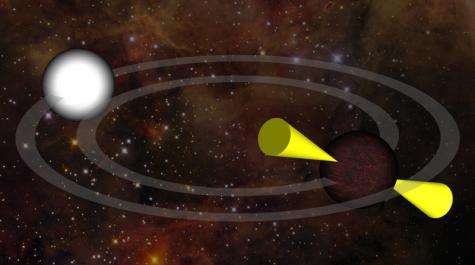
Orbiting around a common centre of gravity: This simulation shows the orbits of pulsar J1952+2630 and its companion, presumably a white dwarf. The orbits are virtually circular, they only appear to be elliptical due to the viewing angle. The mass of the white dwarf, at 95 per cent of that of our Sun, is unusually high for such a binary system. Credit: AEI
(PhysOrg.com) -- Neutron stars are quite unique: the material they are made of is packed much more densely than conventional matter. They rotate extremely fast about their own axis, emitting radiation in the process, so they are often visible as pulsars in the radio spectrum. Researchers at the Max Planck Institute for Gravitational Physics in Hanover, working as part of the international PALFA Collaboration, and with the help of participants in the Einstein@Home project, have now discovered a pulsar accompanied by a white dwarf a burnt-out star. The researchers want to weigh the pair, using what is known as the Shapiro effect.
When faced with tricky questions relating to the general theory of relativity, scientists usually look in the universe for answers. Even then, it is often very difficult to filter out the right astrophysical objects from the plethora of data. That is why scientists call on volunteers to help them in the time-consuming process of analysing data, making unused computing power on their home or office computers available for projects like Einstein@Home.
Armed with this support, the research group headed by Bruce Allen, Director at the Max Planck Institute for Gravitational Physics (Albert Einstein Institute/AEI), Hanover, along with colleagues from the PALFA Collaboration, discovered radio pulsar J1952+2630. The researchers found it in data from the Arecibo telescope. "I'm very excited that the Einstein@Home team has discovered another exotic radio pulsar. These amazing objects are so extreme that if they were crushed to one-third of their size, they would collapse to form black holes. And a big ,thank you` to our thousands of volunteers: we'd be nowhere without their contributions," says Allen.
J1952+2630 flashes every 20.7 milliseconds, and is around 31,000 light-years from Earth. From the radio pulse modulation, the astronomers concluded that the pulsar has a partner star with at least 95 per cent of the Suns mass. These two celestial bodies revolve around their common centre of gravity, orbiting once every 9.4 hours in what are virtually perfect circles.
From the shape of their orbits, the astrophysicists can draw important conclusions as to what the companion is like and how it came to exist, even though they cant see it directly. It is probably a (relatively heavy) white dwarf an expired star that was once quite ordinary, like our Sun. At the end of its life, it blew up into a red giant and cast off its outer layer of matter, some of which the neutron star then absorbed.
The two stars also exchanged (orbital) angular momentum, which is how they came to have perfectly circular orbits. Had this star formerly had a much greater mass than the Sun, then it, too, would have exploded into a supernova at the end of its life, and become a neutron star. The momentum generated in this process would have kicked it into an asymmetric elliptical orbit.
Astronomers currently know of 1,900 pulsars, single stars included.
The combination of a neutron star and a rather massive white dwarf orbiting one another in a perfect circle is rare. White dwarfs orbiting like this usually have a mass of just 10 to 30 percent of the mass of the Sun. And just half a dozen of the hundred or so known binary star systems with pulsars are like this.
Thanks to the relatively high mass of the companion, this binary star system will presumably be suited to testing a phenomenon of general relativity, namely the gravitational time delay of light, says Allens Ph.D. student Benjamin Knispel. Which means we could also determine the precise mass of each component.
This effect, also known as the Shapiro delay, occurs when visible light or radio waves pass through a gravitational field, for instance that of a star, on their way through the universe. The gravitational field diverts these beams from their straight path. But this means the light takes longer to make the detour. When the white dwarf moves into the line of sight between the pulsar and the Earth, the radio pulses which are emitted by the neutron star in regular intervals must travel further and further.
The pulses thus reach the observer at ever-increasing time intervals. To measure this, we need to look at the system from the side, if possible that is, at the edge of the plane of orbit so that, in certain configurations, the radio pulses from the neutron star pass through the white dwarfs gravitational field on their way to us, says Knispel. This method can be used to weigh the two stars. Knispel and his colleagues are already planning the next observations to do just that.
The pulsar ALFA (PALFA) Consortium was founded in 2003 with the aim of conducting a large-scale pulsar survey with the Arecibo telescope. It includes astronomers from 20 universities, institutes and observatories worldwide.
Einstein@Home, with more than 290,000 participants, is one of the largest distributed computing projects in the world. It was set up in 2005 and has been searching for gravitational waves amongst the data from the detectors of the international LIGO/Virgo/GEO collaboration. Since 2009, it has been using 35 per cent of its available computing power to support the work of the PALFA Collaboration.
The two amateur scientists whose computers found the strongest signal in the data analysis are Vitaly V. Shiryaev (Moscow, Russia) and Stacey Eastham (Darwen, Great Britain), who are credited by name and thanked in the publication.
More information: B. Knispel, et al. Arecibo PALFA Survey and Einstein@Home: Binary Pulsar Discovery by Volunteer Computing. Astrophysical Journal Letters 732/1 L1 http://iopscience. … 205/732/1/L1
Provided by
Max-Planck-Gesellschaft
-
From lemons to lemonade: Reaction uses carbon dioxide to make carbon-based semiconductor,
32 comments
-
Thioridazine kills cancer stem cells in human while avoiding toxic side-effects of conventional cancer treatments,
3 comments
-
SpaceX private rocket blasts off for space station (Update),
42 comments
-
Climate scientists say they have solved riddle of rising sea,
30 comments
-
Research team claims to have found evidence Lake Cheko is impact crater for Tunguska Event,
18 comments
-
revamping general concept and cosmological principle
May 25, 2012
-
Transiting Exoplanet Light Curve
May 25, 2012
-
Math behind Theoretical Physics
May 24, 2012
-
Do we know whats at the center of galaxies yet?
May 23, 2012
-
Structure of the Milky Way?
May 20, 2012
-
What would it take to terraform Pluto and Charon?
May 19, 2012
- More from Physics Forums - General Astronomy
More news stories
SpaceX capsule has 'new car' smell, astronauts say (Update)
SpaceX's Dragon cargo vessel smells like a new car, said astronauts at the International Space Station after opening the hatches Saturday following the spacecraft's landmark mission to the orbiting lab.
Space & Earth / Space Exploration
19 hours ago |
4.5 / 5 (20) |
0
Astronomers seize last chance in lifetime for Venus Transit
Astronomers are gearing for one the rarest events in the Solar System: an alignment of Earth, Venus and the Sun that will not be seen for another 105 years.
19 hours ago |
5 / 5 (3) |
2
Australia hails surprise super-telescope decision
Australia has hailed a surprise decision giving it a role in a radio telescope project aimed at revolutionising astronomy, vowing to draw on its decades of experience in space science.
19 hours ago |
5 / 5 (4) |
1
Astronauts enter world's 1st private supply ship
(AP) -- Space station astronauts floated into the Dragon on Saturday, a day after its heralded arrival as the world's first commercial supply ship.
Space & Earth / Space Exploration
19 hours ago |
5 / 5 (5) |
0
Sophisticated simulations predict future warming
The chances of our planet being hit by a global warming of 3 degrees Celsius by 2050 is as likely as it being hit by an increase of 1.4 degrees, new research shows. Presented in the journal Nature Geoscience, the British study ...
Space & Earth / Earth Sciences
May 22, 2012 |
4.4 / 5 (9) |
51
Scientist: Evolution debate will soon be history
(AP) -- Richard Leakey predicts skepticism over evolution will soon be history. Not that the avowed atheist has any doubts himself.
Dell tablet leak: 10.1-inch display, two-battery choice
(Phys.org) -- Headline after headline talks about vendors tablets in the wings as likely number-one contenders for the iPad. Such claims have justifiably been taken with a grain of salt, considering ...
SpotterRF debuts Radar Backpack Kit (w/ Video)
(Phys.org) -- SpotterRF has announced a special radar backpack kit designed to enhance situational awareness for soldiers on the ground. The company says its special radar is designed for warfighters as part ...
Thousands of shellfish found dead in Peru
Thousands of crustaceans were found dead off the coast of Lima following the mystery mass death of dolphins and pelicans, the Peruvian Navy said Friday.
Keep food safety in mind this memorial day weekend
(HealthDay) -- Picnics, parades and cookouts are as much a part of Memorial Day weekend as tributes to the United States' war veterans.
Family history of Alzheimer's affects functional connectivity
(HealthDay) -- Cognitively normal individuals with a family history of late-onset Alzheimer's disease (AD) may display lower resting state functional connectivity in the default mode network (DMN) of the brain, ...
Apr 07, 2011
Rank: 1.3 / 5 (18)
We now have reason to believe that
a.) The Sun and other ordinary stars reformed on the pulsar remains of a previous star, and
b.) Neutron repulsion is the energy source that powers the Sun and other ordinary stars, sustains our lives, and also causes massive explosions of stars and galactic centers.
Neutron Repulsion, The APEIRON Journal, in press, 19 pages,
http://arxiv.org/...2.1499v1
Apr 07, 2011
Rank: 1 / 5 (13)
Oliver K. Manuel
Former NASA Principal
Investigator for Apollo
Apr 07, 2011
Rank: 5 / 5 (10)
'We do???
What about the Chandrasekhar limit?
Apr 07, 2011
Rank: 5 / 5 (15)
Please. One person does not constitute a 'we'.
Apr 07, 2011
Rank: 5 / 5 (14)
I am sure that there is at least one other person somewhere that agrees. You can get a number of people to agree that the earth is obviously flat.
My main disagreement is the forth word, 'reason'.
Reason lives in a different universe than these theories.
Apr 07, 2011
Rank: 4.3 / 5 (6)
Apr 07, 2011
Rank: 4.5 / 5 (8)
Apr 07, 2011
Rank: 1 / 5 (6)
Um...previously un-described force?
Apr 07, 2011
Rank: 3.5 / 5 (8)
ju-ju?
Apr 07, 2011
Rank: 4.3 / 5 (6)
Still not tired of posting crap?
Apr 07, 2011
Rank: 4.3 / 5 (12)
What is so bloody hard about that question that you had to lie and call me a Communist instead of answering?
Ethelred
Apr 07, 2011
Rank: 2 / 5 (1)
The atomic force does repel neutrons from another in the nucleus of an atom and will emit energy when disrupted, (He4), but is not a significant part of the fusion process of the Sun.
Apr 07, 2011
Rank: 4 / 5 (4)
He really called you a communist behind that s***?
That's funny...not ha ha funny, but...
Apr 07, 2011
Rank: 3 / 5 (2)
Indeed? Interesting, do you have a source for that?
I know that electrons are "repulsive" (degeneracy pressure) in white dwarfs via the Pauli exclusion principle (actually as I understand it all fermions are), but I've never heard of anything similar for neutrons.
on edit: ahhh I see that indeed neutrons are composite fermions. My assumption was incorrect.
Apr 07, 2011
Rank: 3.7 / 5 (3)
Apr 07, 2011
Rank: 3.7 / 5 (3)
Apr 07, 2011
Rank: 1.6 / 5 (14)
It is called neutron repulsion, NR.
NR powered the first atomic bomb, the one over Hiroshima that brought WWII to an end, but NR was only recognized in 2000:
www.omatumr.com/D...Data.htm
NR was first reported as the source of stellar energy in 2001:
"Attraction and repulsion of nucleons: Sources of stellar energy" [J. Fusion Energy 19, 93-98 (2001)]
www.omatumr.com/a...tnuc.pdf
"The sun's origin, composition and source of energy" [Lunar and Planetary Science XXIX, 1041 (2001)]
www.omatumr.com/lpsc.prn.pdf
Apr 07, 2011
Rank: 1.6 / 5 (14)
www.youtube.com/w...yLYSiPO0
Nuclear rest mass data reveals evidence of neutron repulsion in every nucleus with two or more neutrons.
Why do we care? We care because the erratic behavior of Earth's heat source is probably controlled by events in the solar pulsar or in the iron-rich mantle that surrounds it.
"Super-fluidity in the solar interior: Implications for solar eruptions and climate" [Journal of Fusion Energy 21, 193-198 (2002)].
http://arxiv.org/.../0501441
Apr 07, 2011
Rank: 3.7 / 5 (3)
Apr 07, 2011
Rank: 3.9 / 5 (11)
What make it YOUR neutron repulsion instead of the Pauli Exclusion Principle?
You have no evidence to support that.
Is Neuron repulsion a long range force or not Oliver?
There are only two REASONS for you to not answer that Oliver.
You don't know and thus the rest of your idea is based on ingnorance.
You know its short range and thus exactly the same as the PEP.
Its in your best interest to answer. You can support yourself or you can give up Cranking.
Ethelred
Apr 07, 2011
Rank: 5 / 5 (2)
My guess is that it will take work with the VLBA or the like to get the uncertainty down to under a second, before someone with a visual telescope can find the visual blinking. (And that will probably take work with a photometer.)
Apr 07, 2011
Rank: 2.1 / 5 (14)
"Is Neuron repulsion a long range force or not?"
Lol, in your head that's a certainty!
On a serious note electromagnetically neutral particles radiate so repulsion is present as long as electromagnetism is. When energy is not present there is no repulsion (like in a BEC), true BEC'a cannot exist, but if Energy disappeared the whole universe would fall into one singular point.
Omatumr is correct, neutron repulsion is very much real, ridicule all you like but the only way for neutron repulsion to cease is to remove energy from the neutron ( don't forget that a neutron in vacuum quickly becomes a proton and electron ).
Apr 07, 2011
Rank: 3 / 5 (6)
Apr 07, 2011
Rank: 3.4 / 5 (5)
Apr 08, 2011
Rank: not rated yet
Apr 08, 2011
Rank: 4 / 5 (8)
Oliver won't answer the question. Yet he clearly has an opinion on it and HE is the expert since he is nearly the only person that believes in HIS neutron repulsion. I seriously doubt the students that did the work have ever said anything to support him. He sure hasn't used any paper of theirs written after that one for support.
Radiate what? They are electromagnetically neutral overall and the variation of charge within a neutron is minimal since the positions of the quarks overlap due to Uncertainty. There is supposed to be a tiny bit of charge separation.
There would nothing to fall and no gravity. Mass and energy are equivalent.
More
Apr 08, 2011
Rank: 4.2 / 5 (10)
And he refuses to say what differentiates his force from the Pauli Exclusion Principle. All indications are the he never heard of it till it was brought up on one forum or another. He still hasn't acknowledged the question. On many forums he would be banned for that.
Half life is about 11 minutes. Now where is some evidence to support the idea and what separates it from the PEP.
Ethelred
Apr 08, 2011
Rank: 5 / 5 (10)
-How do you know that neutron repulsion caused the [nuclear] bomb to explode?
-Well Andrew, adding a single neutron to the uranium nucleus is what triggered the explosion that produced the fission event.
Did you just say that the first neutron did not itself split an atom? Or did you mean to say that the first neutron triggered the fission event which caused the chain reaction? If the latter you're just full of nonsense. The fact that one triggers uranium fission with a neutron has nothing to do with "neutron repulsion." That's just a bullshit correlation argument aimed at the same people who will swallow the other pseudoscience crap such as "The Secret" and you know it.
Apr 08, 2011
Rank: 5 / 5 (6)
If was matter of the gravity of the galaxies then M31 in Andromeda would also be red shifted, however it is blue shifted.
Ethelred
Apr 08, 2011
Rank: 1 / 5 (7)
Thanks for your comment. As pointed our earlier in other PhysOrg.com sites,
1. Weak long-range forces become strong at short distances, and strong short-range forces become weak at long distances. Either/or views of nature are not insight, but a handicap.
2. Personal attacks from those who hide their own identity are like actions of the Communist Youth League in the old USSR who supported Lysenkoism:
A self-sustainable cult-like system of distortions, omissions, and lies designed to support faulty or fraudulent research of "politically correct" pseudo-scientists.
www.softpanorama....sm.shtml
Apr 08, 2011
Rank: 4.5 / 5 (8)
The Pauli Exclusion Principle isn't a "force". You've got four choices, I assume you know them. Which force is responsible for neutron repulsion either at short or long ranges?
Apr 08, 2011
Rank: 1 / 5 (6)
"Which force is responsible for neutron repulsion either at short or long ranges?"
We've found neutron stars through radio, visible light, X-ray, and gamma ray detectors.
So, what force is responsible for neutron repulsion? Electromagnetism.
Apr 08, 2011
Rank: 4.4 / 5 (7)
Try again. According to electromagnetism neutrons would have to have a charge to attract or repel each other. Since they have no charge this force by DEFINITION can't be responsible.
Apr 08, 2011
Rank: 1 / 5 (6)
You know which and how many choices?
Did you ever consider that experimental observations are at the foundation of all models?
Neutron repulsion is an empirical fact, stored as rest mass in every nucleus with two or more neutrons.
http://www.online...ll/1984/
Apr 08, 2011
Rank: 4.2 / 5 (10)
I'm sorry, was there an answer in there? If there was I missed it...
Yes I do know how many choices you have and which. Do you want a lesson in elementary physics?
BTW stamping your feet and saying something is an empirical fact doesn't actually make it a fact. You're entitled to your own OPINIONS, but not your own FACTS. The FACT is that neutrons are not repulsive at all, but exert degeneracy pressure against one another via the PEP.
Try again.
Apr 08, 2011
Rank: 1.6 / 5 (7)
Neutron neutron repulsion is real, and it is electromagnetism that is causing it.
Apr 08, 2011
Rank: 1 / 5 (8)
If already you know everything,
You will learn nothing.
Others learn from observations like these:
www.omatumr.com/D...Data.htm
Summarized here:
http://arxiv.org/...410717v1
http://arxiv.org/...410168v1
www.omatumr.com/a...2002.pdf
http://arxiv.org/...609509v3
www.omatumr.com/a...2002.pdf
http://arxiv.org/...2.1499v1
www.omatumr.com/D...Data.htm
www.omatumr.com/D...ata1.htm
Apr 09, 2011
Rank: 1 / 5 (7)
1. Astronomers use the Sun as a model for distant stars.
2. Astronomers view hundreds of distant stars through telescopes,
3. We used this instrument to obtain detailed information on the Sun:
www.omatumr.com/D...Spec.htm
The data (above) do not fit major parts of the Standard Solar Model:
a.) The Sun's origin
b.) The Sun's composition
c.) The Sun's source of energy
d.) The Sun's influence on Earth's climate
That is the observational basis for the disagreement.
With kind regards,
Oliver K. Manuel
Former NASA Principal
Investigator for Apollo
Apr 10, 2011
Rank: 1 / 5 (6)
Yes, neutron repulsion is explained in this video:
http://www.youtub...yLYSiPO0
Apr 10, 2011
Rank: 2.3 / 5 (6)
Apr 10, 2011
Rank: 1 / 5 (1)
Apr 16, 2011
Rank: 5 / 5 (3)
It is demonstrably not subject to either being one of the most stable and unreactive elements known.