Earth's gravity revealed in unprecedented detail (w/ video)
April 1, 2011

Earth's gravity revealed in unprecedented detail (w/ video)

Enlarge

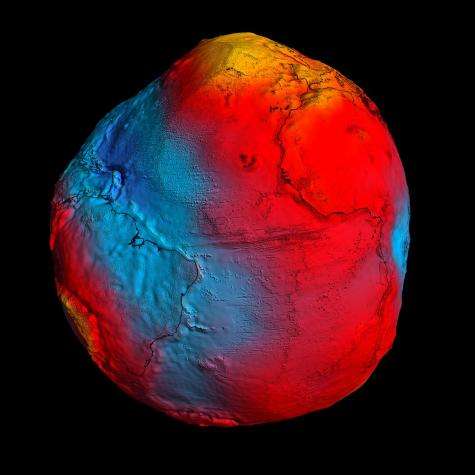
ESA's GOCE mission has delivered the most accurate model of the 'geoid' ever produced, which will be used to further our understanding of how Earth works. A precise model of Earth's geoid is crucial for deriving accurate measurements of ocean circulation, sea-level change and terrestrial ice dynamics. The geoid is also used as a reference surface from which to map the topographical features on the planet. In addition, a better understanding of variations in the gravity field will lead to a deeper understanding of Earth's interior, such as the physics and dynamics associated with volcanic activity and earthquakes. Credits: ESA/HPF/DLR

(PhysOrg.com) -- After just two years in orbit, ESA's GOCE satellite has gathered enough data to map Earth's gravity with unrivalled precision. Scientists now have access to the most accurate model of the 'geoid' ever produced to further our understanding of how Earth works.

The new geoid was unveiled today at the Fourth International GOCE User Workshop hosted at the Technische Universität München in Munich, Germany. Media representatives and scientists from around the world have been treated to the best view yet of global gravity.

The geoid is the surface of an ideal global ocean in the absence of tides and currents, shaped only by gravity. It is a crucial reference for measuring ocean circulation, sea-level change and ice dynamics – all affected by climate change.

Prof. Reiner Rummel, former Head of the Institute for Astronomical and Physical Geodesy at the Technische Universität München, said, "We see a continuous stream of excellent GOCE gradiometry data coming in. With each new two-month cycle, our GOCE gravity field model is getting better and better.

This video is not supported by your browser at this time.

ESA's GOCE mission has delivered the most accurate model of the 'geoid' ever produced, which will be used to further our understanding of how Earth works. The geoid is the surface of an ideal global ocean in the absence of tides and currents, shaped only by gravity. It is a crucial reference for measuring ocean circulation, sea-level change and ice dynamics - all affected by climate change. Credits: ESA/HPF/DLR

"Now the time has come to use GOCE data for science and applications. I am particularly excited about the first oceanographic results.

"They show that GOCE will give us dynamic topography and circulation patterns of the oceans with unprecedented quality and resolution. I am confident that these results will help improve our understanding of the dynamics of world oceans."

The two-day workshop provides the science community with the latest information on the performance of the satellite and details about data products and user services.

Participants are also discussing how the GOCE geoid will make advances in ocean and climate studies, and improve our understanding of Earth’s internal structure.

For example, the gravity data from GOCE are helping to develop a deeper knowledge of the processes that cause earthquakes, such as the event that recently devastated Japan.

Since this earthquake was caused by tectonic plate movement under the ocean, the motion cannot be observed directly from space. However, earthquakes create signatures in gravity data, which could be used to understand the processes leading to these natural disasters and ultimately help to predict them.

The was launched in March 2009 and has now collected more than 12-months of gravity data.

This video is not supported by your browser at this time.

The need for GOCE to fly in a low orbit means it has to compensate for the atmospheric drag it experiences at this exceptionally low altitude. The animation shows a close-up of the ion-propulsion assembly, which keeps the satellite in a smooth trajectory - free from all effects except those of gravity itself. Two winglets provide additional aerodynamic stability. Credits: ESA /AOES Medialab

Volker Liebig, Director of ESA's Earth Observation Programmes said, "Benefiting from a period of exceptional low solar activity, GOCE has been able to stay in low orbit and achieve coverage six weeks ahead of schedule.

"This also means that we still have fuel to continue measuring gravity until the end of 2012, thereby doubling the life of the mission and adding even more precision to the GOCE geoid."

GOCE has achieved many firsts in observation. Its gradiometer – six highly sensitive accelerometers measuring gravity in 3D – is the first in space.

It orbits at the lowest altitude of any observation satellite to gather the best data on Earth's . The design of this sleek one-tonne satellite is unique.

In addition, GOCE uses an innovative ion engine that generates tiny forces to compensate for any drag the experiences as it orbits through the remnants of Earth's atmosphere.

Prof. Liebig added, "You could say that, at its early conception, GOCE was more like science fiction. GOCE has now clearly demonstrated that it is a state-of-the-art mission."

Rune Floberghagen, ESA's GOCE Mission Manager, noted "This is a highly significant step for the mission. We now look forward to the coming months, when additional data will add to the accuracy of the GOCE , further benefiting our data users."

Provided by European Space Agency search and more info website

4.5 /5 (14 votes)  

Filter


Move the slider to adjust rank threshold, so that you can hide some of the comments.


Display comments: newest first

Yellowdart
Apr 01, 2011

Rank: 4.8 / 5 (4)
How about a legend for what the colors mean on the pretty video there physorg...
wakawaka
Apr 01, 2011

Rank: not rated yet
Right on. You'd think the yellow colors and bulges have the biggest gravitational field. If that's the case, I guess the Andes show up pretty well as they ought to, but what about the himalyas?
Mayday
Apr 01, 2011

Rank: 1 / 5 (1)
Wouldn't the lowest areas have the highest gravity? I thought that one of the factors in mountain ranges' rising up was due to being lighter than the surrounding crust. Maybe that was an urban myth. And if the bulging exagerates the shape water would take under these gravitational forces, is it piling up higher where gravity is higher or is it sinking deep there and piling up where gravity is lowest? This article needs a little help, IMO.
Donutz
Apr 01, 2011

Rank: 2.6 / 5 (5)
kevinrts and his fellow creotards are going to have to deny the validity of this report, since it disproves the existance of the "waters from the deep" that are supposed to have supplied the missing water for the biblical flood. It's trivially easy to calculate the size of the cavern that would be required to hold that much water, and it/they would stick out on this mapping like a gaggle of sore thumbs. So, as usual, when observations disagree with superstition, observations have to change.
Bog_Mire
Apr 01, 2011

Rank: 1 / 5 (1)
blues are higher gravity, reds lighter
Jotaf
Apr 01, 2011

Rank: not rated yet
Yes, they say the surface represents what a hypothetical sea would look like if affected only by gravity (the height is probably scaled way up so these differences are visible of course).
Shootist
Apr 01, 2011

Rank: 5 / 5 (1)
blues are higher gravity, reds lighter


Reverse that.

The lowest gravity is shown in blue. The highest in red. Iceland has the highest gravity.

http://www.icelan...ews.aspx
REP01
Apr 02, 2011

Rank: not rated yet
I knew I didn't gain a pound when my plane stopped in Iceland last summer. Airline food isn't good enough for that.
FGLWRK
Apr 02, 2011

Rank: not rated yet
So if Earth's gravity field was under time elapsed photography it would look like "Sphere Eversion" I presume.; with regions near the equator exhibiting more plasmic variation - as predicted by Smale's Paradox? (ref. Google video "Outside In")

So my questions are:
1. Can all the associated equations known thus far (including the recently solved Millenia Question) be used to predict where the flow of the earth plasma, or tectonic plates are going next?
2. Is the Earth a living organism in the grand scale of things? (I believe it's a fractal replication.)
3. So then, are we, so to speak, the equivalent of parasites, on board?
Quantum_Conundrum
Apr 02, 2011

Rank: 1 / 5 (2)
Donutz:

You are once again quite clearly wrong.

There are tremendous amounts of "extra" water stored in the trenches and more importantly "underground" locations, such as the wet rocks in subduction zones and so forth.

Several of the trenches are deeper than Everest is tall, and far, far longer than Everest.

Tectonic forces represented by this, "fountains of the deep" could have expunged this water onto the surface of the planet.

Recall also the rain, and the fact that as you put large amounts of water in a container, such as a basin, you weight down that continent and therefore actually lower it's elevation some as well. See China's three Gorges dam, which has actually caused many small earthquakes as the entire region settles under the mass of the water trapped behind it.

You can say, "Well, where is the water now?" It is included in the chemistry of wet rocks and other places. It's everywhere really.
Bog_Mire
Apr 02, 2011

Rank: 5 / 5 (2)
Sorry, my bad - the higher gravity is shaded yellow while the lower gravity is blues. (darkest blue the lowest) Red must be mediums? Rather an ugly shape.
Yellowdart
Apr 04, 2011

Rank: not rated yet
Wouldn't the lowest areas have the highest gravity? I thought that one of the factors in mountain ranges' rising up was due to being lighter than the surrounding crust.


Areas with greater mass should have higher gravity. Note that this is an exaggeration with the colors. The values differ little really.

Some of the greatest gravitational differences have been recorded in the ocean trenches. As in they are lower and suggest a mass deficiency.
Yellowdart
Apr 04, 2011

Rank: not rated yet
Ugh tried to edit my last comment. Here is what it should say.

Wouldn't the lowest areas have the highest gravity? I thought that one of the factors in mountain ranges' rising up was due to being lighter than the surrounding crust.


Areas with greater mass should have higher gravity. Note that this is an exaggeration with the colors for what the elevation would look like based on gravity alone. In other words, it normalizes gravity.

In other words (again), the higher the isoconcentration, the greater the anomoly, not necessarily an indication of gravitational strength. Although, if my understanding is correct, positive on the scale should mean lower gravity and negative on the scale should mean higher gravity.
Yellowdart
Apr 04, 2011

Rank: not rated yet
kevinrts and his fellow creotards are going to have to deny the validity of this report, since it disproves the existance of the "waters from the deep" that are supposed to have supplied the missing water for the biblical flood.


Under conditions of water, bursting forth from the crust, you would expect to find a potato like shape as well. It would vastly offset the earth's homogeneity.
Further, you would not expect to find a layer of water now, as it would have been expelled.

It's trivially easy to calculate the size of the cavern that would be required to hold that much water, and it/they would stick out on this mapping like a gaggle of sore thumbs.


Let me make this easy for you. Say you squeeze your toothpaste out, what happens to the tube? You force the tube to collapse creating pressure to expel the paste. Likewise, the moment you remove water from the subsurface deep in the crust, the overlying rock would collapse by gravitational forces alone.
Rank 4.5 /5 (14 votes)
Relevant PhysicsForums posts

More news stories

SpaceX capsule has 'new car' smell, astronauts say (Update)

SpaceX's Dragon cargo vessel smells like a new car, said astronauts at the International Space Station after opening the hatches Saturday following the spacecraft's landmark mission to the orbiting lab.

Space & Earth / Space Exploration

created 19 hours ago | popularity 4.5 / 5 (20) | comments 0

Astronomers seize last chance in lifetime for Venus Transit

Astronomers are gearing for one the rarest events in the Solar System: an alignment of Earth, Venus and the Sun that will not be seen for another 105 years.

Space & Earth / Astronomy

created 19 hours ago | popularity 5 / 5 (3) | comments 2

Australia hails surprise super-telescope decision

Australia has hailed a surprise decision giving it a role in a radio telescope project aimed at revolutionising astronomy, vowing to draw on its decades of experience in space science.

Space & Earth / Astronomy

created 19 hours ago | popularity 5 / 5 (4) | comments 1

Astronauts enter world's 1st private supply ship

(AP) -- Space station astronauts floated into the Dragon on Saturday, a day after its heralded arrival as the world's first commercial supply ship.

Space & Earth / Space Exploration

created 19 hours ago | popularity 5 / 5 (5) | comments 0

Sophisticated simulations predict future warming

The chances of our planet being hit by a global warming of 3 degrees Celsius by 2050 is as likely as it being hit by an increase of 1.4 degrees, new research shows. Presented in the journal Nature Geoscience, the British study ...

Space & Earth / Earth Sciences

created May 22, 2012 | popularity 4.4 / 5 (9) | comments 51


Scientist: Evolution debate will soon be history

(AP) -- Richard Leakey predicts skepticism over evolution will soon be history. Not that the avowed atheist has any doubts himself.

Dell tablet leak: 10.1-inch display, two-battery choice

(Phys.org) -- Headline after headline talks about vendors’ tablets in the wings as likely number-one contenders for the iPad. Such claims have justifiably been taken with a grain of salt, considering ...

SpotterRF debuts Radar Backpack Kit (w/ Video)

(Phys.org) -- SpotterRF has announced a special radar backpack kit designed to enhance situational awareness for soldiers on the ground. The company says its special radar is designed for warfighters as part ...

Thousands of shellfish found dead in Peru

Thousands of crustaceans were found dead off the coast of Lima following the mystery mass death of dolphins and pelicans, the Peruvian Navy said Friday.

Keep food safety in mind this memorial day weekend

(HealthDay) -- Picnics, parades and cookouts are as much a part of Memorial Day weekend as tributes to the United States' war veterans.

Family history of Alzheimer's affects functional connectivity

(HealthDay) -- Cognitively normal individuals with a family history of late-onset Alzheimer's disease (AD) may display lower resting state functional connectivity in the default mode network (DMN) of the brain, ...