Concrete recycling may cut highway construction cost, landfill use
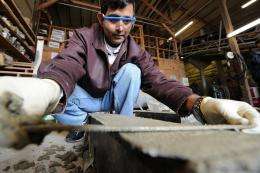
(PhysOrg.com) -- Purdue University civil engineers are working with the Indiana Department of Transportation (INDOT) to perfect the use of recycled concrete for highway construction, a strategy that could reduce material costs by as much as 20 percent.
Concrete pavements are made by mixing cement with water, sand, and "virgin aggregates" obtained from rock quarries located in the proximity of the construction site. In Indiana most of these aggregates are quarried limestone.
"Some parts of Indiana have plenty of quarries near highway construction sites," said Nancy Whiting, a scientist with the Applied Concrete Research Initiative at Purdue's School of Civil Engineering. "In other places, it's more difficult to find quality aggregate. If you have to drive 50 or 100 miles to get a good quality aggregate, it's going to be much more cost effective to use recycled materials by crushing the concrete you have in place."
Whiting is leading the concrete recycling project funded by INDOT through the Joint Transportation Research Program with Jan Olek, a Purdue professor of civil engineering, postdoctoral research associate Jitendra Jain and graduate research assistant Kho Pin Verian.
"If you are going to pave, you may have to remove the old concrete and break it into pieces anyway, so recycling makes sense," Olek said. "And you avoid putting it in landfills."
Jain gave a research presentation about the work earlier this month during a meeting of the American Concrete Institute in Tampa, Fla.
The researchers are testing concrete mixtures that contain varying percentages of recycled concrete. They also are developing cost-analysis software that will enable the state and construction contractors to estimate how much they could save by using recycled concrete. Crushing old concrete pavements into aggregate that can be recycled in new concrete can potentially reduce materials costs by 10 percent to 20 percent, depending on whether any quarries are located near construction sites.
"Whether that would mean a comparable reduction in overall construction costs is part of what our research will determine," Whiting said.
Also involved in the work are Mark Snyder, an engineering consultant based in Pittsburgh, and Tommy Nantung, a project administrator at INDOT. Indiana currently allows the use of "recycled concrete as aggregate," or RCA, as a base layer to support new pavements. However, no existing specifications allow for use of this material in new concrete mixtures. The goal of the research project is to extend the use of the crushed concrete for manufacturing of mixtures that can be used to construct the pavement itself.
The team will finalize a report early next year, providing guidelines and recommendations to help create design and material standards. Standards are needed to control the quality of RCA and its proper use in creating the new concrete.
"Various other states have used crushed concrete as aggregate, but there has been no standardization, so the end result hasn't always been good," Whiting said. "We are trying to show INDOT that it can work and how to be consistent about getting a good product."
One aim is to ensure resistance of the RCA to cracking due to freezing and thawing cycles the pavements are exposed to during winter. Some aggregates are more susceptible to cracking than others. The focus of the standards will be on test methods for freeze-thaw durability and absorption of water and deicing chemicals.
The researchers are working with industry to produce nearly 400 test specimens of varying sizes and shapes containing different percentages of recycled aggregate. Concrete taken from State Route 26 when it was recently repaved in Lafayette has been crushed for use as RCA for the project.
"Slabs of concrete have been crushed into aggregate by Milestone Contractors LP under the direction of J. Beland," said Whiting.
A commercial concrete plant in Lafayette operated by Irving Materials Inc. is mixing the material. In addition, Jay Snider and Calvin Kingery of Irving Materials as well as Dick Newell of Milestone Contractors are working alongside the researchers, helping with issues ranging from adjusting mixture proportions to placement of trial slabs in the field.
Industry partners helped found the Applied Concrete Research Initiative in 2008 along with INDOT and academia, and are providing their services free of charge.
"They are doing this as a courtesy to us," Olek said. "This type of collaboration with practitioners is critical with respect to implementation of laboratory derived materials and technologies in the field."
More information: Predicting Long Term Durability of Concretes with Recycled Concrete as Coarse Aggregates
ABSTRACT
The use of recycled concrete (RCA) as coarse aggregates in concrete is a sustainable, cost-effective alternative to disposing the old concrete pavements. Previous studies indicated that replacing up to 30% of the original (virgin) coarse aggregate in the mixture with RCA will have no negative effects on the freeze-thaw (F/T) resistance and mechanical properties of hardened concretes. In the present study, RCA was used in both plain and fly ash (20% of Class C fly ash) concretes to substitute for crushed limestone coarse virgin aggregates at four different replacement levels (0%, 30%, 50%, and 100%). The long-term durability of all concrete mixtures was evaluated by determining the F/T resistance (ASTM C666 procedure A), scaling resistance (ASTM C672), and rapid chloride penetration (RCP) resistance (ASTM C1202). In addition, the electrical impedance spectroscopy (EIS) measurements were performed on the same concrete specimens that were used for RCP test. EIS spectra were obtained using a Solartron™ 1260 gain-phase analyzer. A frequency range of 1 Hz–10 MHz using a 250 mV AC signal was employed, with 10 measurements per decade. The relationship between the values of final charge passed and bulk resistance obtained from EIS will be used to evaluate the effects of increase in temperature on charge passed during RCP for concretes with RCA. The different test results from this study would be useful to optimize the replacement levels as well as preferred tests to predict long-term durability of concretes with RCA.
Provided by Purdue University


.jpg)


