New carbon allotrope could have a variety of applications
April 22, 2011 by Lisa Zyga feature

New carbon allotrope could have a variety of applications

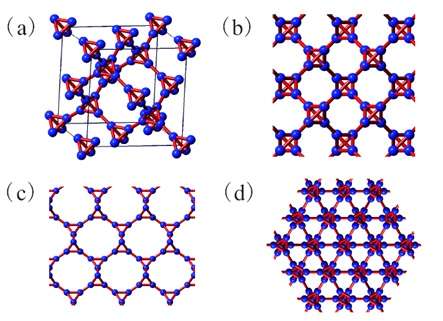
The structure of the new carbon allotrope, T-carbon, is shown from different directions. T-carbon is obtained by replacing each carbon atom in diamond with a carbon tetrahedron. Image credit: Sheng, et al. ©2011 American Physical Society.

(PhysOrg.com) -- Carbon comes in many different forms, and now scientists have predicted another new form, or allotrope, of carbon. The new form of carbon, which they call T-carbon, has very intriguing physical properties that suggest that it could have a wide variety of applications.

The scientists, Xian-Lei Sheng, Qing-Bo Yan, Fei Ye, Qing-Rong Zheng, and Gang Su, from the Graduate University of Chinese Academy of Sciences in Beijing, China, have published their study on the first-principles calculations of T-carbon in a recent issue of .

Allotropes are formed when the atoms in a substance that contains only one type of atom are arranged differently. Although many substances have multiple allotropes, carbon has the greatest number of known allotropes. The three best-known carbon allotropes are amorphous carbon (such as coal and ), graphite, and diamond. Since the 1980s, scientists have been synthesizing newer allotropes, including carbon nanotubes, graphene, and fullerenes, all of which have had a significant scientific and technological impact.

With more recent advances in synthetic tools, scientists have been investigating a wide variety of new – and sometimes elusive – carbon allotropes. In light of these investigations, Sheng, et al., write in their study that it appears that we might be entering the era of carbon allotropes.

Here, the scientists explained how to obtain a new carbon allotrope by substituting each carbon atom in diamond with a carbon tetrahedron (hence the name “T-carbon”). They were inspired by the substitution of each carbon atom in methane with a carbon tetrahedron, which forms tetrahedrane.

“[Our study] adds a possible new allotrope of carbon with amazing properties,” Su told PhysOrg.com. “T-carbon has bond angles different from graphite and diamond, but the interesting structure is still quite stable and has the same group symmetry as diamond, thereby widening people’s vision and knowledge on carbon bonding.”

Each unit cell of the T-carbon structure contains two tetrahedrons with eight carbon atoms. As the scientists’ calculations showed, T-carbon is thermodynamically stable at ambient pressure and is a semiconductor. T-carbon is one-third softer than diamond, which is the hardest known natural material. The new carbon allotrope also has a much lower density than diamond, making it “fluffy.”

The scientists also calculated that T-carbon has large interspaces between compared to other forms of carbon, which could make it potentially useful for hydrogen storage. In addition, the unique physical properties of this new carbon allotrope make it a promising material for photocatalysis, adsorption, and aerospace applications.

“We believe that, if obtained, T-carbon is so fluffy that it can be used to store hydrogen, lithium, and other small molecules for energy purposes,” Su said. “It can be used as photocatalysis for water-splitting to generate hydrogen, or as an adsorption material for environmental protection. As it has very low density but a high modulus and hardness, it is quite suitable for aerospace materials, sports materials like a tennis racket, golf club, etc., and cruiser skin, and so forth.”

The scientists also noted that T-carbon could have astronomical implications as a potential component of interstellar dust and carbon exoplanets.

“There is a long-standing puzzle in astronomy known as the ‘carbon crisis’ in interstellar dust,” Su said. “Observations by the Hubble telescope revealed that the carbon budget in dust is deep in the red, and there is not sufficient carbon in dust to account for the light distortions.”

In addition, the exoplanet WASP-12b has recently been found to have a large amount of carbon, making it the first carbon-rich exoplanet ever discovered. Since the structure of the carbon in WASP-12b is still unclear, T-carbon might also be one of possible candidates for this carbon planet.

To investigate T-carbon further, the researchers would like to synthesize the new allotrope in the lab, although they say that this would likely be very difficult.

“A synthesis of T-carbon in the lab poses a great challenge for materials scientists and chemists,” Su said. “We suggest the following ways: using the CVD technique under a negative pressure environment; detonation on diamond or graphite; crystallization of amorphous tetragonal ; or stretching cubic diamond under extremely large strength.”

More information: Xian-Lei Sheng, et al. “T-Carbon: A Novel Carbon Allotrope.” Physical Review Letters 106, 155703 (2011). DOI: 10.1103/PhysRevLett.106.155703

Copyright 2010 PhysOrg.com.
All rights reserved. This material may not be published, broadcast, rewritten or redistributed in whole or part without the express written permission of PhysOrg.com.

4.4 /5 (19 votes)  

Filter


Move the slider to adjust rank threshold, so that you can hide some of the comments.


Display comments: newest first

fmfbrestel
Apr 22, 2011

Rank: 2 / 5 (4)
OK, materials science guys, once you get large sheets of graphene figured out and meter length nanotubes, here is your next project. Nice to have the job security if you're a materials science researcher, but it would be nice to get one of these tackled before racing to the next big thing.
Eikka
Apr 22, 2011

Rank: 4.3 / 5 (6)
Advances in science often occur laterally, and trying to solve the harder problem sometimes gives you the answer to the easier one that you couldn't solve.

What you're suggesting is like saying that Jules Verne shouldn't hypothesize about going to the moon before the Wright brothers have made an airplane first.
quasi44
Apr 22, 2011

Rank: 5 / 5 (1)
I think a highly significant, and lucrative use for this configuration would be helium storage, considering the high rate of loss in nature and the predictions that it will become quite scarce in a decade or so.
lib
Apr 22, 2011

Rank: 3 / 5 (2)
Well, there is nothing wrong with predictions to be bold but it is embarrassing when results published in a PRL-level journal show the lack of basic understanding of the subject.

For a person working in the field the claim that a new form of carbon was found to be "thermodynamically stable at ambient pressure" may sound like "we just found a few unaccounted trillion dollars to balance the budget". Sure enough, their calculations show that T-carbon is actually unfavored by 1.2-1.3 eV/atom (!) compared to diamond/graphite. The athours' comment that this only "suggests" "that this structure might be less thermodynamical stable against those allotropes at zero pressure" is, mildly put, an understatement. The proposed structure is not only ridiculously high in energy but it is also not dense meaning that application of pressure will further destabilize it. Temperature effects typically change the relative stability by much less than 0.1 eV/atom.
lib
Apr 22, 2011

Rank: 1 / 5 (1)
(cont) How exactly do the authors think their bulk structure could be synthesized, let alone used for applications? This makes you wonder whether the referees read the paper at all.
eachus
Apr 22, 2011

Rank: 5 / 5 (2)
I quote from the article: "They were inspired by the substitution of each carbon atom in methane with a carbon tetrahedron, which forms tetrahedrane."

No, it doesn't. It doesn't even come close. Tetra-tert-butyltetrahedrane was synthesized in 1978 with a tetrahedral carbon atom arrangement at its core, but the four butyl groups completely surround it and stabilize it. Interestingly, two other "platonic solids" have been created: Dodecahedrane (C20H20) and cubane (C8H8). You can only make these compounds where each carbon atom has bonds to three other carbon atoms. Five is right out, and with four, octahedrane? there are no bonds left for the hydrogen.

Are the referees Loony Toons? Not really, this is the way science works. The authors, computational chemists, designed and named the compound. Now "real" chemists can try and make it, or more likely make some related compound that they think is easier, like the tetra-tert-butyltetrahedrane mentioned above.
neiorah
Apr 25, 2011

Rank: 4 / 5 (1)
Come on guys you can do something about inappropriate content however I continually see these stupid advertisements in a place where thoughtful discussions should be.

DO SOMETHING TO GET THIS POLLUTION OUT OF THIS PLACE
PPihkala
Apr 30, 2011

Rank: 4 / 5 (1)
DO SOMETHING TO GET THIS POLLUTION OUT OF THIS PLACE

Every time I see pollution that has nothing to do with commenting, I report it as abuse. What might be more effective in the long run would be harder, slower process of getting the writing rights to physorg.com. Or maybe system where abuse votes from sufficient individuals would 'ban' writers and/or their comments without needing physorg staff intervention.
Rank 4.4 /5 (19 votes)
Relevant PhysicsForums posts
  • Writing a book so im learning about things, i have some general questions please read
    created2 hours ago
  • Question about induced E field.
    created3 hours ago
  • Charging a capacitor in a tesla coil
    created3 hours ago
  • Water Rocket
    created7 hours ago
  • why do trucks have bigger brakes?
    created12 hours ago
  • Solar Sail Physics - Do they work on a large scale?
    created12 hours ago
  • More from Physics Forums - General Physics

More news stories

Dopant gives graphene solar cells highest efficiency yet

(Phys.org) -- By taking advantage of graphene’s favorable electrical and optical properties, and then adding an organic dopant, researchers have achieved the highest power conversion efficiency yet for ...

Nanotechnology / Nanophysics

created May 21, 2012 | popularity 5 / 5 (10) | comments 14 | with audio podcast feature

Nanomedicine: Quantum dots appear safe in pioneering study on primates

A pioneering study to gauge the toxicity of quantum dots in primates has found the tiny crystals to be safe over a one-year period, a hopeful outcome for doctors and scientists seeking new ways to battle diseases ...

Nanotechnology / Bio & Medicine

created May 20, 2012 | popularity 4.3 / 5 (3) | comments 8 | with audio podcast

In nanorod crystal growth, nanoparticles seen as artificial atoms

In the growth of crystals, do nanoparticles act as "artificial atoms" forming molecular-type building blocks that can assemble into complex structures? This is the contention of a major but controversial theory ...

Nanotechnology / Nanophysics

created May 24, 2012 | popularity 4.8 / 5 (6) | comments 0 | with audio podcast

First direct observation of oriented attachment in nanocrystal growth

Berkeley Lab researchers have reported the first direct observation of nanoparticles undergoing oriented attachment, the critical step in biomineralization and the growth of nanocrystals. A better understanding ...

Nanotechnology / Nanophysics

created May 24, 2012 | popularity 4.7 / 5 (3) | comments 0 | with audio podcast

Synthetic nano-waste does not disappear

(Phys.org) -- Tiny particles of cerium oxide do not burn or change in the heat of a waste incineration plant. They remain intact on combustion residues or in the incineration system, as a new study by Swiss ...

Nanotechnology / Bio & Medicine

created May 25, 2012 | popularity 5 / 5 (2) | comments 1 | with audio podcast


Scientist: Evolution debate will soon be history

(AP) -- Richard Leakey predicts skepticism over evolution will soon be history. Not that the avowed atheist has any doubts himself.

Dell tablet leak: 10.1-inch display, two-battery choice

(Phys.org) -- Headline after headline talks about vendors’ tablets in the wings as likely number-one contenders for the iPad. Such claims have justifiably been taken with a grain of salt, considering ...

SpotterRF debuts Radar Backpack Kit (w/ Video)

(Phys.org) -- SpotterRF has announced a special radar backpack kit designed to enhance situational awareness for soldiers on the ground. The company says its special radar is designed for warfighters as part ...

SpaceX capsule has 'new car' smell, astronauts say (Update)

SpaceX's Dragon cargo vessel smells like a new car, said astronauts at the International Space Station after opening the hatches Saturday following the spacecraft's landmark mission to the orbiting lab.

Thousands of shellfish found dead in Peru

Thousands of crustaceans were found dead off the coast of Lima following the mystery mass death of dolphins and pelicans, the Peruvian Navy said Friday.

Astronomers seize last chance in lifetime for Venus Transit

Astronomers are gearing for one the rarest events in the Solar System: an alignment of Earth, Venus and the Sun that will not be seen for another 105 years.