Replacing batteries may become a thing of the past, thanks to 'soft generators'
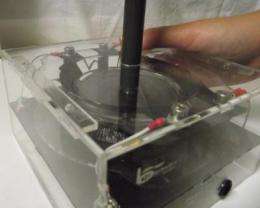
This image shows a hand-pumped soft generator the researchers are using to demonstrate it. Credit: N/A
Battery technology hasn't kept pace with advancements in portable electronics, but the race is on to fix this. One revolutionary concept being pursued by a team of researchers in New Zealand involves creating "wearable energy harvesters" capable of converting movement from humans or found in nature into battery power.
A class of variable capacitor generators known as "dielectric elastomer generators" (DEGs) shows great potential for wearable energy harvesting. In fact, researchers at the Auckland Bioengineering Institute's Biomimetics Lab believe DEGs may enable light, soft, form-fitting, silent energy harvesters with excellent mechanical properties that match human muscle. They describe their findings in the American Institute of Physics' journal Applied Physics Letters.
"Imagine soft generators that produce energy by flexing and stretching as they ride ocean waves or sway in the breeze like a tree," says Thomas McKay, a Ph.D. candidate working on soft generator research at the Biomimetics Lab. "We've developed a low-cost power generator with an unprecedented combination of softness, flexibility, and low mass. These characteristics provide an opportunity to harvest energy from environmental sources with much greater simplicity than previously possible."
Dielectric elastomers, often referred to as artificial muscles, are stretchy materials that are capable of producing energy when deformed. In the past, artificial muscle generators required bulky, rigid, and expensive external electronics.
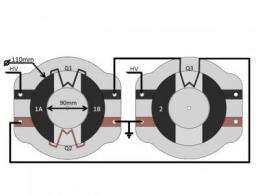
This is a schematic of the physical layout of the soft generator. Credit: N/A
"Our team eliminated the need for this external circuitry by integrating flexible electronicsdielectric elastomer switchesdirectly onto the artificial muscles themselves. One of the most exciting features of the generator is that it's so simple; it simply consists of rubber membranes and carbon grease mounted in a frame," McKay explains.McKay and his colleagues at the Biomimetics Lab are working to create soft dexterous machines that comfortably interface with living creatures and nature in general. The soft generator is another step toward fully soft devices; it could potentially be unnoticeably incorporated into clothing and harvest electricity from human movement. When this happens, worrying about the battery powering your cell phone or other portable electronics dying on you will become a thing of the past. And as an added bonus, this should help keep batteries out of landfills.
Provided by American Institute of Physics
-
From lemons to lemonade: Reaction uses carbon dioxide to make carbon-based semiconductor,
32 comments
-
Thioridazine kills cancer stem cells in human while avoiding toxic side-effects of conventional cancer treatments,
3 comments
-
SpaceX private rocket blasts off for space station (Update),
42 comments
-
Climate scientists say they have solved riddle of rising sea,
30 comments
-
Research team claims to have found evidence Lake Cheko is impact crater for Tunguska Event,
18 comments
-
Writing a book so im learning about things, i have some general questions please read
2 hours ago
-
Question about induced E field.
3 hours ago
-
Charging a capacitor in a tesla coil
3 hours ago
-
Water Rocket
7 hours ago
-
why do trucks have bigger brakes?
11 hours ago
-
Solar Sail Physics - Do they work on a large scale?
12 hours ago
- More from Physics Forums - General Physics
More news stories
Is a classical electrodynamics law incompatible with special relativity?
(Phys.org) -- The laws of classical electromagnetism that were developed in the 19th century are the same laws that scientists use today. They include Maxwell’s four equations along with the Lorentz la ...
Landmark calculation clears the way to answering how matter is formed
(Phys.org) -- An international collaboration of scientists, including Thomas Blum, associate professor of physics, is reporting in landmark detail the decay process of a subatomic particle called a kaon ...
May 25, 2012 |
4.2 / 5 (21) |
47
|
Lying in wait for WIMPs: Researchers seek to dramatically increase sensitivity of Large Underground Xenon detector
Although it's invisible, dark matter accounts for at least 80 percent of the matter in the universe. No one knows what it is, but most scientists would bet on weakly interacting massive particles, or WIMPs.
May 23, 2012 |
4 / 5 (7) |
15
|
Hall effect at the speed of light: How can you demonstrate relativistic effects with your mobile phone?
The relativistic Hall effect describing objects rotating at speeds comparable with the speed of light has been reported.
May 21, 2012 |
4.3 / 5 (3) |
8
Cloak of invisibility: Engineers use plasmonics to create an invisible photodetector
A team of engineers at Stanford and the University of Pennsylvania has for the first time used "plasmonic cloaking" to create a device that can see without being seen - an invisible machine that detects light. It is the first ...
May 21, 2012 |
4.8 / 5 (16) |
7
|
Scientist: Evolution debate will soon be history
(AP) -- Richard Leakey predicts skepticism over evolution will soon be history. Not that the avowed atheist has any doubts himself.
Dell tablet leak: 10.1-inch display, two-battery choice
(Phys.org) -- Headline after headline talks about vendors tablets in the wings as likely number-one contenders for the iPad. Such claims have justifiably been taken with a grain of salt, considering ...
SpotterRF debuts Radar Backpack Kit (w/ Video)
(Phys.org) -- SpotterRF has announced a special radar backpack kit designed to enhance situational awareness for soldiers on the ground. The company says its special radar is designed for warfighters as part ...
SpaceX capsule has 'new car' smell, astronauts say (Update)
SpaceX's Dragon cargo vessel smells like a new car, said astronauts at the International Space Station after opening the hatches Saturday following the spacecraft's landmark mission to the orbiting lab.
Thousands of shellfish found dead in Peru
Thousands of crustaceans were found dead off the coast of Lima following the mystery mass death of dolphins and pelicans, the Peruvian Navy said Friday.
Astronomers seize last chance in lifetime for Venus Transit
Astronomers are gearing for one the rarest events in the Solar System: an alignment of Earth, Venus and the Sun that will not be seen for another 105 years.

Apr 06, 2011
Rank: 1.6 / 5 (19)
I'd file this under "interesting but impractical". After all, every TV comes with a remote now days for a reason. One more thing for the landfill.
Apr 06, 2011
Rank: 4.2 / 5 (6)
I really don't think you understand...
Sure, you can't put a shirt with this incorporated into it on a comma patient and expect to get much energy out, but for any reasonably alive and alert human you can expect a certain degree of movement, even when "idle". The low conversion efficiency isn't all that important when it is currently zero. If I could pay an extra $30-50 per article of clothing in order to extend the battery life of my phone by as little as 10% per charge I would do so happily.
Apr 06, 2011
Rank: 1.2 / 5 (6)
Apr 06, 2011
Rank: 1.7 / 5 (12)
Its kind of like that light I had on my bicycle as a kid that had a generator powered off the read wheel. It slowed the bike down so much and made it so much harder to pedal that I took it off. Wasn't worth the effort. I suspect the same will be true here as well.
Apr 06, 2011
Rank: 4.3 / 5 (8)
As for the landfill comment: I don't know for sure what they mean, but I'd imagine they're referring to the slower charge rate making the battery last longer as we commonly see in batteries now.
Apr 06, 2011
Rank: 3.5 / 5 (16)
Apr 06, 2011
Rank: 4.7 / 5 (11)
No...
You use energy to move your clothing around already... sure this may add a TINY degree of extra resistance but so what? You won't even notice it if it is implemented correctly. You ALREADY use energy to "push" your clothing around when you move, and some of this energy is lost to the environment (frictional heating at least).
Apr 06, 2011
Rank: 1.9 / 5 (14)
Its extra resistance. Unless you are on that development team or have access to their calculations, you (like I) have no idea how efficient or inefficient this technology is.
I suspect you are idealizing the potential. That's a fun thing to do, but I was speculating about its likely real world development possibilities in the near term. Which is, as I suggested before, a novelty - much like those friction generator bicycle lights.
Apr 06, 2011
Rank: 4.4 / 5 (8)
I hope it does add a bit of resistance... I'll extend the life of my phone while staying in shape a little easier. Perhaps there could be multiple versions that allow you trade off resistance of the material with energy generation capacity. Either way it may be in it's infancy but it will be much more than a novelty if it ever becomes fully realized.
Apr 06, 2011
Rank: 3.7 / 5 (3)
Now that's a comment I can respect. I don't share your interest in having such a product if it involves extra resistance but I get that you do. Thanks for the level response.
Apr 06, 2011
Rank: 4.3 / 5 (6)
I see this invention to have enormous potential for good.
The authors mention not having to worry all the time about recharging the batteries of gadgets we carry around. That is a genuine issue. The fact that it might take a little extra energy walking around is no big deal; most US Americans eat too much already, same for most Aussies and Brits also I think. Only good can come from over-fed people having to expend more muscular effort.
Batteries in land fill are a major threat for pollution of ground water; and that is a BIG issue. In addition, if less recharging devices are needed then less energy will be taken from fossil fuels; that is another significant benefit.
Apr 06, 2011
Rank: 5 / 5 (2)
In the late '80s I bought a dynamo that pressed onto the tread of the tyre and it had good grip and the resistance I felt was much less than for the old side-presser type. It was really effective at night riding home from work and utterly dependable in the wet when it was particularly needed. I was really pissed off to find that they were no longer being manufactured so I couldn't replace it with the same. I was hoping to get a hub dynamo for my front wheel when ordering my most recent bike, but none could be found.
Apr 06, 2011
Rank: 3.9 / 5 (7)
This might be useful some sort of medical sensor that requires a ridiculously low amount of power, but it is NOT going to power your Cell Phone.
For goodness sakes...
1 Day:
2000 food calories = 8400000Joules
8400000Joules / 86400Seconds = 97.22Watts
This is how much power your body uses, most of it is brain, heart, and lungs.
I showed on another thread that even if you moved CONSTANTLY, there is no way you'd ever be able to charge a modern cell phone with this, because the charger couldn't possibly be efficient enough, and there isn't enough available energy in your body movements to charge it as fast as you'd need, and that was assuming 24 hours of continuous motion. You aren't moving around nearly as much as you think.
sleep
eating (little movement)
sitting in front of a computer
driving (little movement)
Apr 06, 2011
Rank: 3.3 / 5 (6)
Apr 06, 2011
Rank: 2.2 / 5 (5)
Fortunately facts don't really care about opinions.
If indeed they are talking about eliminating the battery in personal electronics then you will have to continuiously and without hesitation provide the needed power. Hence, my comment about the Walkman. When you stop activity, you stop generation of power and your device quits. The vast majority of our population would not be interested in this as the trend is towards making things easier (less work).
Apr 06, 2011
Rank: 3.7 / 5 (3)
No one is talking about this... Do you really think this is intended to be used absent of a battery?
Apr 06, 2011
Rank: 5 / 5 (4)
Personally i think it would be a great thing to have (even if only generating a small ammt of power) it would be nice to get something from my nervous habbit of shaking my leg.
Apr 06, 2011
Rank: 2 / 5 (4)
I don't think so:
Total: approx. 100 watts
Brain: approx. 20 watts
Heart: approx. 1-5W watts
Lungs: (haven't found a reference - I'd guess about 5 watts)
So these a only slightly more than 25% of power consumption.
On the other hand, my 4 watt charger charges my phone in about an hour, and I only need to do this once every few days. Continuous charging during waking hours (16 hours per day) would require perhaps as little as 0.05 watts = 50 milliwatts.
Apr 06, 2011
Rank: 2 / 5 (4)
Excellent post QC! This is the kind of stuff I've noticed you're particularly good at: Look at the big picture and run the numbers... not so much on other things (no offense).
I fived you! I don't usually do that on your posts, but every now and then, you've got some really good posts. Keep'em coming and I'll five you more and it may cancel out the 1's I've been giving you. ;)
Apr 06, 2011
Rank: 3 / 5 (2)
Probably the most efficient would be in a shoe using our weight to push something like a plunger. On a level surface this would still have the effect of essentially going uphill on a slight grade. Each step would be like going up a staircase with very low steps. A lot of energy could be generated by doing work like this. Didn't you see Conan the Barbarian? Before he was freed he was turning the mill wheels by himself. Probably generating hundreds of thousands of Hollywood psuedokilojoules.
Apr 06, 2011
Rank: not rated yet
Quote from the article:
Batteries don't really care what charges them provided enough of the right type of power is available, so the only way to keep batteries out of the landfills is to not have them in the devices in the first place. If this is just a potential technique to charge batteries, it would have no or possibly even an adverse effect on the number going to landfills. Some batteries are limited on their number of charge/discharge cycles. In such cases even a partial charge and discharge limits the battery life. Unless you are willing to expend energy until the battery is fully charged you will lessen its life expectancy.
Apr 06, 2011
Rank: not rated yet
Apr 06, 2011
Rank: 2.5 / 5 (2)
"The mechanical power of the human heart is ~1.3 watts. It takes a much higher rate of energy turnover (~13 watts) to provide this mechanical power, since the mechanical efficiency of the heart is very low (less than 10%)"
So your heart has an OUTPUT of 1.3 watts, but has an input of 13watts, since it is about 10% efficient.
hypertextbook.com/facts/2003/IradaMuslumova.shtml
The energy used to digest food is about 10% of that taken in...
greenanswers.com/q/89548/health/general/does-our-digestive-system-use-more-energy-respiratory
Respiration is a bit complicated. In cellular respiration, apparantly 38 ATP is produced in one cycle, but 8 ATP is consumed during the cycle for respiration itself, therefore cellular respiration consumes 21.05% of the energy it produces...
However, cellular respiration doesn't translate well to the idea of "breathing" and how much it takes for you diaphragm to work the lungs, which I too have not been able to find.
Apr 06, 2011
Rank: 2.8 / 5 (4)
Brain: 20%
Heart: 13Watts
Digestion: 10%
Respiration*: More than 6.5 watts (Possibly 13 watts or more)
Total: significantly more than 49.5 watts
Don't forget the other major organs such as the lymph/spleen, kidneys, liver, pancrease, bladder, etc...
*Using the amount of air we actually breathe, and assuming a half meter of displacement from the bottom of the lungs to the nostrils we find the minium work required to move air up and out of the lungs. We breathe in/out 11.1456kg of air per day. Using pressure, I was able to calculate that the diaphragm has an output of at least 6.51 watts just to move air ONE way. Thus if it were an ideal machine it would use only 6.5 watts, but it is less than ideal...
Apr 06, 2011
Rank: 2.8 / 5 (4)
97 watts - 6.5watts to 13 watts = 91.5watts to 85watts
21% of 91.5watts = 19.215 watts
21% of 85watts = 17.85 watts
So now when you add the energy consumed by cellular respiration in the process of cellular respiration BACK TO the energy used by the lungs in bring the air into the body in the first place, we have:
from: 6.5 + 19.215 = 25.715 watts
To: 13 + 17.85 = 30.85 watts
So all together, with round numbers, "Respiration" actually uses 26 to 31 Watts out of the 97 watts food and respiration combined actually produce.
Apr 06, 2011
Rank: 2.8 / 5 (4)
brain: 20
Heart: 13
Lungs: 6.5 to 13
Cellular respiration: 19 to 18
Digestion: 10
Total: 68.5watts to 74watts
Apr 06, 2011
Rank: 5 / 5 (3)
Apr 07, 2011
Rank: 1 / 5 (1)
Apr 07, 2011
Rank: 3 / 5 (4)
Ever use a rowing machine at the gym? You pull the cable and push with your feet while seated to spin a resisting flywheel.
You're saying that all of that energy isn't even enough to power a phone? Seems kind of bizarre.
Apr 07, 2011
Rank: 4.2 / 5 (5)
No. It will just mean that what is now radiated away as heat (through friction/movement of the fabric) is then captured (partially) as a usable form of energy. No additional food intake required.
Apr 07, 2011
Rank: not rated yet
They do talk of other ways of using it that are not clothing based and perhaps more practical.
Apr 07, 2011
Rank: 4.5 / 5 (4)
I'm fairly sure that the lungs would do less work than the heart does pumping all of that liquid blood around the body. I'm inclined to believe this figure: (output) power of ~ 1 watt:
http://www.ncvs.o...dex.html
Apr 07, 2011
Rank: 4 / 5 (1)
You think the only way to HELP keep batteries out of landfills is to stop using them entirely? How about using them LESS?
Apr 07, 2011
Rank: 3.7 / 5 (3)
Milliwatts don't mean JACK compared to a WATT-HOUR.
4 watt-hours means that you have a power supply of 4 watts for one hour, OR a power supply of 1 watt for 4 hours, or any multiplicative combination totalling 4.
Either way, 4 watt-hours equals 14,400Joules.
To get that much energy from a 1 milliwatt generator in your clothing would take 167 days.
Beard:
Exercising uses more energy because it burns more calories. People who work out regularly eat a LOT more food and breathe a lot more all together compared to people who do not work out as often.
You even help prove the point that in order to charge something like this requires constant work/motion, and the larger and more rapid the motions the better.
Your clothes hardly move at all while you are just sitting or standing or typing and similar things.
Apr 07, 2011
Rank: 3.7 / 5 (3)
A "Watt" is not a unit of energy, it is a unit of POWER.
The number of Watts tells you how many JOULES(energy) your device consumes or produces PER SECOND.
"Watt-hours" is the multiple of POWER and TIME to get ENERGY.
So 4 watt-hours is 14,400 Joules.
A kilowatt-hour is 3,600,000 Joules.
A milliwatt class generator is insignificant compared to your cell phone's energy needs.
Apr 07, 2011
Rank: not rated yet
That is an option, but history has shown that the demand has been rising sharply for personal electronics and the batteries that power them. Another option (my preference) is to continue to make electronics more effecient - and preferrably more environmentally friendly and recyclable.
Apr 07, 2011
Rank: 5 / 5 (1)
Shouting doesn't improve your argument one bit.
QC: "So anyway, to educate certain people on this thread..."
Having been availed of a PhD in particle physics since the early nineties, I have a reasonable idea of such things.
"To get that much energy from a 1 milliwatt generator in your clothing would take 167 days."
Now you are just picking silly numbers. See above where I said: "Continuous charging during waking hours (16 hours per day) would require perhaps as little as 0.05 watts = 50 milliwatts."
You don't seen to be aware that phone battery capacities are commonly quoted in watt-hours. I'm not sure why you take exception to the term.
"Your clothes hardly move at all while you are just sitting or standing or typing and similar things."
No everyone is a pimply couch potato that wears diapers so they don't have to get up though.
Apr 07, 2011
Rank: not rated yet
Apr 07, 2011
Rank: not rated yet
...
Puts down Big Mac.
Darn.
Interesting discussions here on all sides, but all speculation - how it feels, how it works wouldn't be known until there is a working model that we can try out.
Heck if it turns out to be stiffer fabric, well then that might just do away with the need for starch in shirts, no?
Apr 07, 2011
Rank: not rated yet
Apr 07, 2011
Rank: 4 / 5 (1)
Apr 08, 2011
Rank: 1 / 5 (1)
Apr 08, 2011
Rank: 1 / 5 (1)
Apr 08, 2011
Rank: 2 / 5 (2)
I ran 3 miles and walked another mile yesterday after work. Not exactly a couch potato as a 50+ yr old. I find the concept interesting, but just don't think it's practical or that the public will go for it en-masse.
Apr 08, 2011
Rank: 5 / 5 (1)
I think that 'smart' clothing incorporating dielectric elastomer generators (DEGs) and shoes with same or with piezoelectric generators in the heels could very well generate the 4 or 5 watts needed to keep lithium batteries charged. It may be that charge is first supplied incrementally to capacitors before being released into the batteries. Soon all these different devices will be endowed with sophisticated 'homeostatic' computing power which will be able to regulate the energy throughput and adjust usage to fit in with [local - on the body] supply and demand.
Apr 09, 2011
Rank: not rated yet
Which brings me to my other idea, does anyone remember that they developed fuel cells that run on glucose, and can be implanted in arteries? I'm waiting for that technology to mature, so I can just plug my TV into my gut, down some potato chips and sugary beverages and get thin! What American wouldn't want that? The more TV you watch, and the bigger your TV, the more you can eat without gaining a pound.
Apr 09, 2011
Rank: not rated yet
Apr 09, 2011
Rank: not rated yet
Apr 10, 2011
Rank: 1 / 5 (3)
Apr 10, 2011
Rank: 3.7 / 5 (3)
Apr 12, 2011
Rank: 2.5 / 5 (2)
It would be like trying to pull a semi truck trailer with your car. Who in thier right mind would want to wear stiff heavy generator clothes on a nice hot 100 degree summer day anyway?