Bacteria can grow under extreme gravity: study
April 26, 2011 by Deborah Braconnier
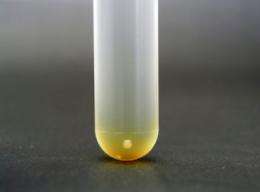
Photograph of pellet of E. coli cells formed after incubation at 403,367 × g and 37 °C for 60 h. The outer diameter of the tube is 18 mm. Image (c) PNAS, doi: 10.1073/pnas.1018027108
(PhysOrg.com) -- A new study in the Proceedings of the National Academy of Sciences shows that bacteria is capable of growing under gravity more than 400,000 times that of Earth and gives evidence that the theory of panspermia could be possible.
Biologist Shigeru Deguchi of the Japan Agency for Marine-Earth Science and Technology led the research. With his team, he set out to test the growth capability of bacteria under intense gravity conditions. With the use of a machine called an ultracentrifuge, they spun four different species of bacteria in a way to replicate hyper-gravity.
While the bacteria clumped together in pellet form when the gravity increased, their growth rate was not affected. Two of the species, Paracoccus dentrificans (soil bacteria) and Escherichia coli were able to continue growth within a gravity rate of 403,627 g.
Researchers believe that the reason the microbes are not affected is due to their size and structure. The smaller an organism is the less sensitive it is to gravitational forces. Bacteria, a prokaryotic cell, do not have organelles. Organelles, such as cell nuclei, tend to compact and are subject to sedimentation effect and shutting down. Bacteria, by contrast, do not suffer with this problem. Researchers are still unclear as to why some bacteria are more resistant than others and say further study is needed.
The theory of panspermia believes that life on Earth could have begun when comets or asteroids carrying microbes collided with Earth. While there is no proof that microbes here are descendants from alien life, it is now a possible theory. This research however does allow for expansion into areas where we previously thought life would not be possible. For example, the gravity on a brown dwarf has been estimated at around 10 to 100 g. While it wasnt believed that life could grow under those conditions, this study shows that is not the case.
More information: Microbial growth at hyperaccelerations up to 403,627 × g, PNAS, Published online before print April 25, 2011, doi:10.1073/pnas.1018027108
Abstract
It is well known that prokaryotic life can withstand extremes of temperature, pH, pressure, and radiation. Little is known about the proliferation of prokaryotic life under conditions of hyperacceleration attributable to extreme gravity, however. We found that living organisms can be surprisingly proliferative during hyperacceleration. In tests reported here, a variety of microorganisms, including Gram-negative Escherichia coli, Paracoccus denitrificans, and Shewanella amazonensis; Gram-positive Lactobacillus delbrueckii; and eukaryotic Saccharomyces cerevisiae, were cultured while being subjected to hyperaccelerative conditions. We observed and quantified robust cellular growth in these cultures across a wide range of hyperacceleration values. Most notably, the organisms P. denitrificans and E. coli were able to proliferate even at 403,627 × g. Analysis shows that the small size of prokaryotic cells is essential for their proliferation under conditions of hyperacceleration. Our results indicate that microorganisms cannot only survive during hyperacceleration but can display such robust proliferative behavior that the habitability of extraterrestrial environments must not be limited by gravity.
© 2010 PhysOrg.com
-
From lemons to lemonade: Reaction uses carbon dioxide to make carbon-based semiconductor,
32 comments
-
Thioridazine kills cancer stem cells in human while avoiding toxic side-effects of conventional cancer treatments,
3 comments
-
SpaceX private rocket blasts off for space station (Update),
42 comments
-
Climate scientists say they have solved riddle of rising sea,
30 comments
-
Research team claims to have found evidence Lake Cheko is impact crater for Tunguska Event,
18 comments
-
What would stain as translucent on light-coloured fabric?
10 hours ago
-
How do I identify different bacteria on culture plates?
20 hours ago
-
Why Do Dogs do Strange things...
May 25, 2012
-
What does exophillic and endophillic mean in terms of mosquito and their control?
May 24, 2012
-
Semen stains glows under black lights (uv light)?
May 23, 2012
-
Question on Human Chromosome 2
May 23, 2012
- More from Physics Forums - Biology
More news stories
Scientist: Evolution debate will soon be history
(AP) -- Richard Leakey predicts skepticism over evolution will soon be history. Not that the avowed atheist has any doubts himself.
9 hours ago |
3.4 / 5 (8) |
21
Thousands of shellfish found dead in Peru
Thousands of crustaceans were found dead off the coast of Lima following the mystery mass death of dolphins and pelicans, the Peruvian Navy said Friday.
19 hours ago |
4.8 / 5 (4) |
6
More plant species responding to global warming than previously thought
(Phys.org) -- Far more wild plant species may be responding to global warming than previous large-scale estimates have suggested.
May 22, 2012 |
4.6 / 5 (14) |
18
|
Totally rad: Scientists create rewritable digital data storage in DNA
(Phys.org) -- Scientists from Stanford's Department of Bioengineering have devised a method for repeatedly encoding, storing and erasing digital data within the DNA of living cells.
May 21, 2012 |
4.9 / 5 (17) |
11
|
For monogamous sparrows, it doesn't pay to stray (but they do it anyway)
It's quite common for a female song sparrow to stray from her breeding partner and mate with the male next door, but a new study shows that sleeping around can be costly.
May 22, 2012 |
5 / 5 (1) |
7
|
Dell tablet leak: 10.1-inch display, two-battery choice
(Phys.org) -- Headline after headline talks about vendors tablets in the wings as likely number-one contenders for the iPad. Such claims have justifiably been taken with a grain of salt, considering ...
SpotterRF debuts Radar Backpack Kit (w/ Video)
(Phys.org) -- SpotterRF has announced a special radar backpack kit designed to enhance situational awareness for soldiers on the ground. The company says its special radar is designed for warfighters as part ...
SpaceX capsule has 'new car' smell, astronauts say (Update)
SpaceX's Dragon cargo vessel smells like a new car, said astronauts at the International Space Station after opening the hatches Saturday following the spacecraft's landmark mission to the orbiting lab.
Astronomers seize last chance in lifetime for Venus Transit
Astronomers are gearing for one the rarest events in the Solar System: an alignment of Earth, Venus and the Sun that will not be seen for another 105 years.
Keep food safety in mind this memorial day weekend
(HealthDay) -- Picnics, parades and cookouts are as much a part of Memorial Day weekend as tributes to the United States' war veterans.
Australia hails surprise super-telescope decision
Australia has hailed a surprise decision giving it a role in a radio telescope project aimed at revolutionising astronomy, vowing to draw on its decades of experience in space science.
Apr 26, 2011
Rank: 4.3 / 5 (7)
This goes to show that life should be relatively unnaffected by 2-3 g's on these planets...meaning that 'super-earths' are now a very attractive place to look for life.
Apr 26, 2011
Rank: 4 / 5 (4)
I assure you, a theory of panspermia is quite possible. In fact, entire books have been written about the theory. Let us know when there's some evidence that the theory is true.
Apr 26, 2011
Rank: 5 / 5 (5)
Apr 26, 2011
Rank: 5 / 5 (9)
Flat.
Apr 26, 2011
Rank: not rated yet
I doubt you would see land based creatures much larger than a small mouse. In all likelyhood most of the creatures would be aquatic, using equilibrium to abate the effects of gravity. But that's just a guess.
Apr 26, 2011
Rank: 5 / 5 (1)
Apr 26, 2011
Rank: not rated yet
On a side track What is the highest pressure that bacteria can grow in? I believe it is over 1000 atmospheres but is there a known limit?
Apr 27, 2011
Rank: 1 / 5 (4)
ANDROMEDA- no amino acids, no DNA, crystalline life that uses compartments rather than organs for biochemical synthesis. Ooops, Andromeda "...used everything and wasted nothing.." no evident mechanism for adaptive evolution, since instead of mutating it would eat the adaptive trigger, heat, cosmic rays, stray x-rays, etc, and grow forever. Shucks, back to the lab Pinky!
-word-to-ya-muthas-
Apr 27, 2011
Rank: not rated yet
Apr 27, 2011
Rank: 5 / 5 (2)
Apr 27, 2011
Rank: not rated yet
Google doesn't seem to know the answer to this one..
Apr 27, 2011
Rank: 4 / 5 (2)
Apr 27, 2011
Rank: 5 / 5 (2)
I don't have figures for that, but a harddrive falling on a stone floor experiences up to 30000g at the moment of impact. Given that a meteorite might be a bit faster than a falling harrdrive I could well believe that the impact accelerations might be an order of magnitude greater.
Apr 27, 2011
Rank: 5 / 5 (5)
Apr 27, 2011
Rank: not rated yet
Apr 27, 2011
Rank: 1 / 5 (5)
Apr 27, 2011
Rank: 4.5 / 5 (2)
Imagine the structures these bacteria would evolve over time under such high gravity. Very well could discover some novel processes by which one could create biological supermaterials.
Apr 27, 2011
Rank: 5 / 5 (1)
Apr 27, 2011
Rank: 5 / 5 (1)
Yes, heat is now the biggest hazard to panspermia, especially based on the high g's that we now know that bacteria can handle. However, that question has been worked on too, and if the bacteria have a spot deep enough in the rock, they are protected to the point where it is very viable. In small asteroids (say, less than 10 feet across), they don't need to be very deep at all.
That said, I'm not a proponent of panspermia. I think it's certainly possible in small scale scenerios, but becomes very unlikely outside of a single star system - It is only slightly better than a pure acedemic question - at least it does give us something to look for on asteroids and such.
Apr 27, 2011
Rank: 5 / 5 (4)
Apr 27, 2011
Rank: not rated yet
Apr 27, 2011
Rank: 5 / 5 (4)
There very well could have been hundreds of starts to life that transferred genetic material to each other resulting in a single ancestor for all of life, without that ancestor being the original life form. Right, right, because originating elsewhere averts all the challenges of creating life here and introduces no new challenges.../sarcasm
Apr 27, 2011
Rank: not rated yet
Im picturing something like a groundhog, but with legs proportioned more like a rhinoceros. I picked up a prairie dog once, and was surprised at how stalwart and muscular it was. It tried to burrow under me as I sat on the floor, and was able to wedge itself right under 80% of my mass! Its not a huge stretch for me to imagine a 10 pound rodent like that being redesigned to carry 10 times the weight. It's bones would have to be pretty thick, and it might even have some kind of exoskeleton as well that would support it's organs. Just using my imagination, Id bet that under 10g, dog- sized creatures might be the maximum size reached. Thick, anklyosaur- like dogs.
Apr 28, 2011
Rank: not rated yet
If the organisms on the 10g world are selected for size and use exotic biology, it might be beyond our imagination.
Apr 28, 2011
Rank: 5 / 5 (1)
The question is: Did that forst life form originate here? That is as of yet unanswerable. We'll know when we detect life elsewhere.
No. Evolution would take care of that pretty quickly if one type is better at gathering resources than any other. Once one type gains enough of a head start in the evolutionary game then it's increasingly unlikely that a 'new start' would provide an alternative that doesn't die out immediately thereafter.
since we haven't looked at too man of these (and the vast majority of them would be of non-planetary origin or have undergone conditions that would preclude life) that conclusion is a BIT premature.
Apr 28, 2011
Rank: not rated yet
He's got a good point there. I'm sure there is a point where gravity becomes an overriding factor, but based on our own biosphere and history, it seems to indicate that bouancy or thickness of the medium(IE - look at the oceans, and the blue whale) and the oxygen content or analogue (IE look at the dinosaurs sizes) will probably have more effect on animal size than a few G's.
Apr 28, 2011
Rank: 5 / 5 (1)
Apr 28, 2011
Rank: 5 / 5 (1)
You've just made me realize that I want to see one before I die.
Apr 29, 2011
Rank: 1 / 5 (5)
I conclude that because we cannot find any different kind of life it implies that it is very difficult to create and that it is more likely to have been created elsewhere and gotten here that to have been created here.
Apr 29, 2011
Rank: 5 / 5 (1)
Apr 29, 2011
Rank: 5 / 5 (1)
Apr 29, 2011
Rank: 5 / 5 (1)
In theory :-)
Apr 30, 2011
Rank: not rated yet
Applying this knowledge, and assuming our redwoods are at or very near their upper height and mass limits, then the maximum height of an Earth biology tree on a planet with 10g gravity should be roughly 12 to 13ft before it breaks under it's own weight, assuming otherwise Earth-like conditions and Earth-like winds.
On the other hand, under 0.1g, a tree the size of the Avatar tree should theoretically be possible with earth-like biology and no pruning.
Apr 30, 2011
Rank: not rated yet
Additionally, for heavy gravity, this does not consider the possibility of "trees" which become much wider than they are tall, and therefore may exceed this maximum height just by becoming some sort of "mound" of tree or tree-like material, although the lower portions of the organism may still become crushed under it's own weight, destroying the cellular life there, so it might not be possible anyway. The tree may become some sort of coral-like structure building mounds on it's own dead cells.
Apr 30, 2011
Rank: not rated yet
Assuming Sauropods are at or very near the maximum size for an animal on Earth. Then the maximum height of an earth-like animal on a 10g planet would be much less than the linear figure of a factor of 10 might suggest. It is again smaller by a factor of around 31, or 10^1.5. Probably around a foot in height, and maybe 1.5 to 3 feet in length head to tail.
Basicly the size of a small cat or dog would be the upper limit, and these would be the "giants" of the planet.
Apr 30, 2011
Rank: not rated yet
Why wouldn't a sauropod like creature on an 8g world with 1/2 the area and 1/8 the volume be equivalent to the ones we had on earth in terms of structural stability?
Apr 30, 2011
Rank: 1 / 5 (5)
May 01, 2011
Rank: 1 / 5 (1)
May 01, 2011
Rank: not rated yet
May 01, 2011
Rank: not rated yet
The strength of a material does not "scale". At a certain point, adding more bone increases the weight more than it increases the strength.
Wood and bone grow more in total strength as cross sectional area increases, yes, but their strength per unit area remains the same.
So mass (and consequently weight) increases by a cubic function with volume, but the strength of wood or bones increases by a square function with the cross sectional area.
May 01, 2011
Rank: not rated yet
As long as the breaking weight is greater than the current weight, then there is still theoretical room for growth. As the structure grows, the breaking weight increases because the cross section increases. A tree can only grow taller if it continues to grow thicker.
It's easier to see going from Earth gravity to weaker gravity. If you take a tree that is at it's breaking weight when it's mass equals M, and magically transport it to a moon with 0.1g gravity, then initially, it has room to grow to a mass of 10M. However, by the time it reaches mass 10M, the trunk and primary branches are, on average, 4.64 times as large in cross-section, so therefore they can now support a mass of 46.4M...but by the time the tree gets to mass 46.4M, the trunk and primary branches reach a cross-section even bigger...
May 01, 2011
Rank: not rated yet
h*(1/(Xg))^1.5 = H
The reason for this is life doesn't grow magically. You need time for the cross-section to grow so strength exceeds what the breaking weight will be when the structure is completely grown.
May 02, 2011
Rank: 5 / 5 (1)