Atomic-level crystal gazing: Revelation of crystallization mechanism enables fast writing of data to DVDs
April 8, 2011

Atomic-level crystal gazing

Enlarge

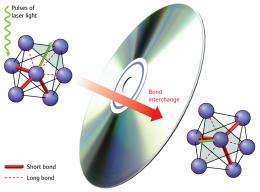
Figure 1: Pulses of light alter the atomic bonds (red) in the material AIST, enabling quick storage and deletion of data. Credit: 2011 Masaki Takata

Some 300 exabytes (3 × 1020 bytes) of information were stored in electronic media -- magnetic disks and tapes or optical disks -- throughout the world by 2007. Yet, the demand for electronic storage grows daily, driving an ever-increasing need to pack data into smaller volumes in quicker time. By studying how laser pulses alter the atomic structure of data-storage materials, a research team in Japan has uncovered a fundamental mechanism that could aid in the design of even faster information storage in the future1. The finding was published by Masaki Takata from the RIKEN SPring-8 Center, Harima, Shinji Kohara from the Japan Synchrotron Radiation Research Institute/SPring-8, Noboru Yamada from Panasonic Corporation and a team of scientists from Japan, Germany and Finland.

Rewritable memory, such as the random-access memory found in computers or on DVDs, is based on a phase change in specific types of materials in which the atoms change from one stable arrangement to another. Pulses of laser light can induce a phase change, a process known as ‘writing,’ and the material’s phase can be identified by ‘reading’ its signature optical properties.

To provide the first full understanding of the atomic structure of one such phase-change material, AgInSbTe (AIST)—often used in rewritable DVDs—Takata and his colleagues combined state-of-the-art materials-analysis techniques and theoretical modeling. A pulse of light can change AIST from an amorphous state, in which the atoms are disordered, into a crystalline phase in which the atoms are form an ordered-lattice structure. This process of crystallization happens in just a few tens of nanoseconds: the faster the crystallization, the faster data can be written and erased. No-one understood, however, why phase changes in AIST were so fast.

The teams’ analyses and modeling showed that AIST crystallizes in a different way to other commercially available phase-change materials. They found that crystallization of AIST is a simple process: the laser light excites the bonding electrons and causes them to move. A central atom of antimony (Sb) switches between one long (amorphous) and one short (crystalline) bond without any bond breaking (Fig. 1). “We hope to verify this bond-interchange model in the near future,” says Takata. “Crystallization is the storage-rate-limiting process in all phase-change materials, and an atomistic understanding of it is essential.”

The researchers also discovered that the absence of cavities within the crystal structure contributes to the faster writing speeds on AIST. This contrasts starkly with the alternative material germanium antimony telluride in which 10% of lattice sites in are empty.

More information: Matsunaga, T., et al. From local structure to nanosecond recrystallization dynamics in AgInSbTe phase-change materials. Nature Materials 10, 129–134 (2011). http://www.nature. … mat2931.html

Provided by RIKEN search and more info website

4.3 /5 (3 votes)  

Filter


Move the slider to adjust rank threshold, so that you can hide some of the comments.


Display comments: newest first

Eikka
Apr 08, 2011

Rank: 5 / 5 (3)
Rewritable memory, such as the random-access memory found in computers


No it isn't. DRAM is based on storing electric charge in a capacitor.
holoman
Apr 10, 2011

Rank: not rated yet
3D holographic molecular storage using ferroelectrics
published many years ago on the web using same technology.
Rank 4.3 /5 (3 votes)
Relevant PhysicsForums posts
  • Transparency of molten substances?
    createdMay 25, 2012
  • saturated paramagnetic and ferromagnetic
    createdMay 24, 2012
  • How to calculate the bandstructure of Twisted Bilayer Graphene
    createdMay 23, 2012
  • vast computational richness from swapping one proton
    createdMay 22, 2012
  • Oscillator strength of mixed LH- and HH-excitons
    createdMay 22, 2012
  • 2D Quantum Well and k-values
    createdMay 21, 2012
  • More from Physics Forums - Atomic, Solid State, Comp. Physics

More news stories

Is a classical electrodynamics law incompatible with special relativity?

(Phys.org) -- The laws of classical electromagnetism that were developed in the 19th century are the same laws that scientists use today. They include Maxwell’s four equations along with the Lorentz la ...

Physics / General Physics

created May 24, 2012 | popularity 4.7 / 5 (15) | comments 38 | with audio podcast feature

Landmark calculation clears the way to answering how matter is formed

(Phys.org) -- An international collaboration of scientists, including Thomas Blum, associate professor of physics, is reporting in landmark detail the decay process of a subatomic particle called a kaon – ...

Physics / General Physics

created May 25, 2012 | popularity 4.2 / 5 (21) | comments 47 | with audio podcast

Lying in wait for WIMPs: Researchers seek to dramatically increase sensitivity of Large Underground Xenon detector

Although it's invisible, dark matter accounts for at least 80 percent of the matter in the universe. No one knows what it is, but most scientists would bet on weakly interacting massive particles, or WIMPs.

Physics / General Physics

created May 23, 2012 | popularity 4 / 5 (7) | comments 15 | with audio podcast

Hall effect at the speed of light: How can you demonstrate relativistic effects with your mobile phone?

The relativistic Hall effect describing objects rotating at speeds comparable with the speed of light has been reported.

Physics / General Physics

created May 21, 2012 | popularity 4.3 / 5 (3) | comments 8

Cloak of invisibility: Engineers use plasmonics to create an invisible photodetector

A team of engineers at Stanford and the University of Pennsylvania has for the first time used "plasmonic cloaking" to create a device that can see without being seen - an invisible machine that detects light. It is the first ...

Physics / General Physics

created May 21, 2012 | popularity 4.8 / 5 (16) | comments 7 | with audio podcast


Scientist: Evolution debate will soon be history

(AP) -- Richard Leakey predicts skepticism over evolution will soon be history. Not that the avowed atheist has any doubts himself.

Dell tablet leak: 10.1-inch display, two-battery choice

(Phys.org) -- Headline after headline talks about vendors’ tablets in the wings as likely number-one contenders for the iPad. Such claims have justifiably been taken with a grain of salt, considering ...

SpotterRF debuts Radar Backpack Kit (w/ Video)

(Phys.org) -- SpotterRF has announced a special radar backpack kit designed to enhance situational awareness for soldiers on the ground. The company says its special radar is designed for warfighters as part ...

SpaceX capsule has 'new car' smell, astronauts say (Update)

SpaceX's Dragon cargo vessel smells like a new car, said astronauts at the International Space Station after opening the hatches Saturday following the spacecraft's landmark mission to the orbiting lab.

Thousands of shellfish found dead in Peru

Thousands of crustaceans were found dead off the coast of Lima following the mystery mass death of dolphins and pelicans, the Peruvian Navy said Friday.

Astronomers seize last chance in lifetime for Venus Transit

Astronomers are gearing for one the rarest events in the Solar System: an alignment of Earth, Venus and the Sun that will not be seen for another 105 years.